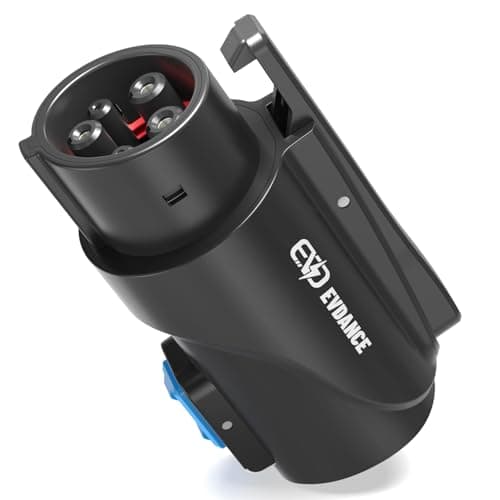
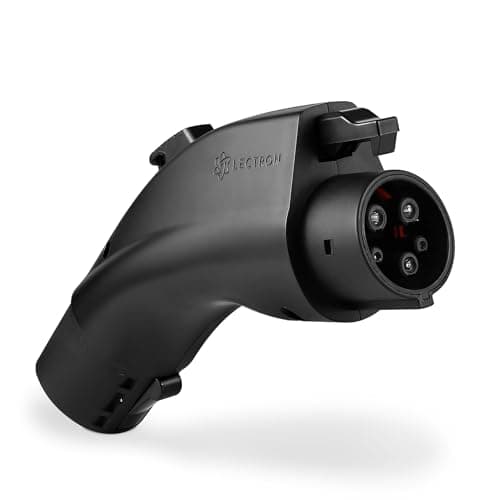
If you drive a J1772 car and want to charge from a Tesla-style (NACS) home or destination charger, the Lectron NACS-to-J1772 adapter is the safe default - rated for the full 48 amps and widely used for AC home charging. The EVDANCE is the value pick that does the same job, usually for less, at an even higher 80-amp rating.
First, make sure this is the direction you need. A NACS-to-J1772 adapter goes on the end of a NACS (Tesla) connector so it can plug into a J1772 car. If you have the opposite problem - a Tesla or a NACS-port car that wants to use J1772 chargers - you need the other adapter, covered in our J1772-to-NACS roundup. New to the connector alphabet soup? Start with the connector types explainer. And because an adapter adds a second latching joint between the charger and the car, it is worth knowing the release order before you need it - a plug or adapter stuck in the car covers that, including why pulling hard is the one thing never to do.
The one spec that matters: the safety listing
An adapter sits in the path of the full charging current, so the safety listing is the spec we weigh above all others. Look for an explicit rating and, ideally, a UL listing. Current headroom is easy here - most home circuits never exceed 48 amps, so any adapter rated for 48 or 80 amps has plenty of margin. What you are really buying is a snug, well-built connection that will not overheat or work loose over hundreds of plug cycles.
AC only. A passive adapter like these enables AC charging from Tesla Wall Connectors, Destination Chargers and Mobile Connectors. It does not unlock Tesla Supercharger (DC) use - that is handled by the car and the network, not a plug adapter.
The picks
The Lectron is the conservative choice: a widely used, well-reviewed 48-amp adapter with a long track record for AC home charging. The EVDANCE matches the function at a higher 80-amp / 250-volt rating and usually a lower price - the value pick if you are comfortable with a shorter brand history. Both let a non-Tesla EV draw from the growing base of NACS home and destination chargers, which is increasingly useful as the standard shifts.
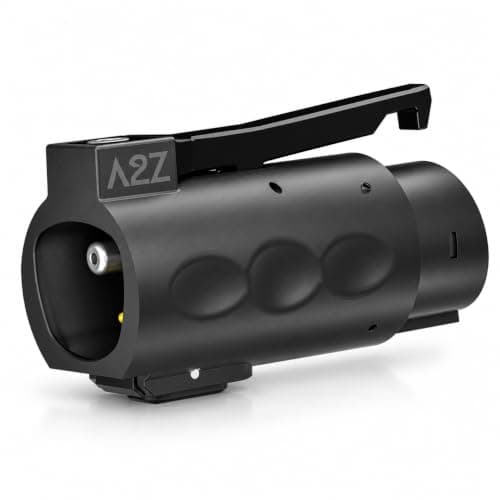
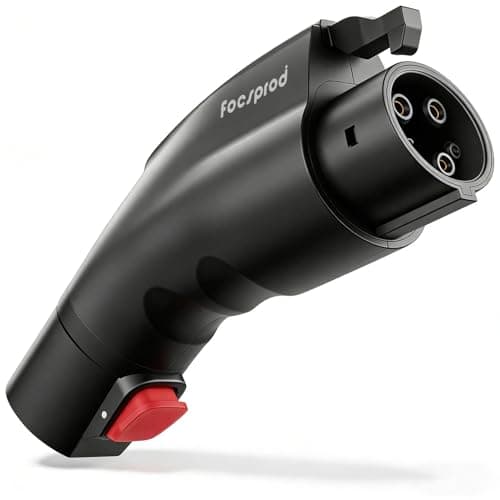
Two more are worth knowing about. The A2Z EV Stellar Plug is the most heavily certified adapter in the category - UL2252 and CSA-C22.2 certified with a published certification number, dual over-temperature sensor switches, an IP67 enclosure (IP54 at the mating surface) and a locking pin that keeps it in the port while charging. It is rated to 80 amps and 19.2 kW. It is also several times the price of a commodity adapter, and on the 40- or 48-amp circuit almost every reader is actually using, the Lectron carries that load with margin to spare - which is why the Lectron, not the A2Z, is the pick. Buy the A2Z if you want the belt-and-braces option, if the adapter will live outdoors, or if you use 80-amp commercial AC stations. The FOCSPROD 60A lands between the two: UL 2252 named on the listing, 60 amps of headroom, mid-market money.
The four compared
| Adapter | Amps / kW | Direction | Safety listing | Weather | Locks in | Price tier |
|---|
| Lectron | 48A / 11.5 kW | NACS charger to J1772 car | Widely used, long track record | Not stated | No | Premium |
| EVDANCE | 80A / 250V | NACS charger to J1772 car | Not named | Not stated | No | Budget |
| A2Z EV Stellar Plug | 80A / 19.2 kW | NACS charger to J1772 car | UL2252 + CSA-C22.2 | IP67 body, IP54 mating, Type 3R | Yes | Premium |
| FOCSPROD | 60A / 250V | NACS charger to J1772 car | UL 2252 | Not stated | No | Mid |
All four are AC-only adapters for Level 1 and Level 2 charging. Ratings are as published by each manufacturer; we compare documented specifications and listings rather than bench-testing, as our methodology sets out.
How to choose a NACS-to-J1772 adapter
1. Confirm the direction, then stop worrying about amps
This adapter goes on the end of a NACS (Tesla-style) connector so it can plug into a J1772 car. Get that backwards and nothing fits. Once the direction is right, amperage is almost a non-issue: a home NACS charger delivers 40 or 48 amps, and every adapter here is rated at or above 48. An 80-amp rating is headroom, not speed - it will not charge your car any faster.
2. Buy on the safety listing, because that is the real variable
An adapter sits directly in the path of the full charging current, in a joint you make and break every day. UL 2251 and UL 2252 are the standards written for EV charging couplers and adapters; a product that names one has been tested to a real bar. UL 2252 in particular covers adapters across AC and DC use cases. Where two adapters cost the same, take the listed one. Where the listed one costs more, decide how much a certified joint carrying 40 amps for six hours a night is worth to you.
3. Level 1 vs Level 2 changes nothing here, but load management might
A passive adapter is indifferent to whether the station is a 120-volt Level 1 outlet or a 240-volt Level 2 wall unit - it passes through whatever the charger and car agree on. What it cannot do is change that negotiation. If your charger is dialled down for load management or shared with a second car, the adapter will faithfully pass the reduced current and no more.
4. Understand what it does not unlock
No passive adapter enables Tesla Supercharging. Superchargers are DC, and DC sessions are negotiated between the car and the network. These adapters open the AC side: Tesla Wall Connectors, Destination Chargers and Mobile Connectors. The full explanation is in do NACS adapters work at Superchargers.
5. Consider whether you need an adapter at all
An adapter is the right tool when you are visiting NACS equipment you do not own. If the problem is your own garage, buying the right charger is tidier than adapting the wrong one - see best Level 2 chargers and hardwired vs plug-in. And if the problem is reach rather than connector shape, you want an extension cable, not an adapter.
So, which one?
Buy the Lectron for a normal home or destination-charger setup. Take the EVDANCE if you want the same function for less and are comfortable with a shorter brand history. Buy the A2Z Stellar Plug if you want the most certified adapter available, the adapter lives outdoors, or theft is a concern - it locks into the port. Take the FOCSPROD if you want a named UL 2252 listing without the premium.
Two follow-on pages if you are down to a decision. The top two picks here go head to head on Lectron vs A2Z- current rating, the locking pin, and why an adapter's IP number is measured unmated. And if what you actually have is a Tesla charger on a garage wall and a J1772 car in the driveway, the whole situation start to finish is can a Tesla Wall Connector charge a non-Tesla EV.