"What amp charger should I buy?" is the most common home charging question, and it has a satisfying answer once you see what is really going on. The amperage printed on a charger is a ceiling, not a guarantee. Three things decide the number you can actually use: a code rule about continuous loads, how much your electrical panel can spare, and how fast your specific car is willing to accept AC power. Get those three straight and the decision makes itself.
The rule that sizes everything: continuous load
EV charging pulls near-maximum current for hours at a stretch, so the National Electrical Code classifies it as a continuous load. The practical consequence is a single multiplier: the circuit and breaker must be rated to 125% of the charger's current draw. That one rule is why the breaker is always a size up from the charger.
- A 40-amp charger needs a 50-amp breaker (40 x 1.25 = 50) and typically 6 AWG copper wire.
- A 48-amp charger needs a 60-amp breaker (48 x 1.25 = 60) and typically 6 AWG copper, often stepped up to heavier 4 AWG on long runs.
This is also why a plug-in charger on a 50-amp NEMA 14-50 outlet is capped at 40 amps - the outlet's circuit rating and the 125% rule leave no room for more. We dig into that specific case in the NEMA 14-50 outlet guide.
The reason behind the rule is heat. A breaker and wire sized exactly to the running current would sit at their absolute limit for hours every night, and components held continuously at their limit run hot and age fast. The 25 percent cushion keeps everything working comfortably below its ceiling, which is why the code treats a load lasting three hours or more differently from a quick, intermittent one like a power tool.
| Charger draw | Breaker required | Typical copper wire |
|---|
| 32A | 40A | 8 AWG |
| 40A | 50A | 6 AWG |
| 48A | 60A | 6 AWG (4 AWG on long runs) |
These figures are a planning reference, not an installation spec. Wire gauge depends on run length, conduit, temperature, and local code, and a licensed electrician must size the actual conductors and breaker for your job. Do not pull wire off a table.
Ceiling one: what your panel can spare
A charger cannot use amperage your panel does not have. Before the charger's rating matters at all, your electrical service has to have room for a new 50- or 60-amp circuit on top of everything else the house runs. Older or heavily loaded panels often cannot, and forcing a 48-amp charger onto a panel that can only spare a 50-amp circuit does nothing but waste money - the charger simply runs at the lower rate, or does not get installed at all.
This is why we keep saying to assess the panel first. If capacity is tight, the honest options are a lower-amperage charger, a load-management setup, or a service upgrade - and that upgrade is a real cost, as the installation guide lays out.
Ceiling two: what your car will accept
The second ceiling lives in the car. Every EV has an onboard charger - a converter with a fixed acceptance rate for AC power - and it will not draw more than that no matter how big your wall unit is. Many EVs accept 32 amps (about 7.7 kW); many others accept 48 amps (about 11.5 kW).
The implication is blunt: if your car only accepts 32 amps, a 48-amp charger charges it at exactly the same speed a 40-amp charger would - you paid for headroom the car cannot use. Buying amperage is only worth it if the car can actually take it. Check your vehicle's onboard AC charging rate before you shop, not after.
Finding your car's acceptance rate
Since the onboard charger is one of the two hard ceilings, it is worth knowing where to find the number. Look in the vehicle specifications for the AC or "onboard charger" rating, usually given in kilowatts and sometimes in amps. A car listed at 7.7 kW accepts roughly 32 amps; one listed at 11.5 kW accepts roughly 48 amps. That figure is fixed hardware - no wall charger, cable, or setting raises it.
Be careful not to confuse this AC acceptance rate with a car's DC fast-charging peak, which is a much larger number quoted for public charging. The AC rate is the one that governs your home charger. If the two numbers look wildly different, that is expected - they describe two different charging paths through the car.
A worked example, start to finish
Say you drive a mainstream EV whose onboard charger accepts 48 amps, and a 48-amp wall unit is tempting to match it. Before you buy, walk the three ceilings. The charger can do 48 amps - ceiling one is fine. Your car accepts 48 amps - ceiling two is fine. Then the electrician opens your panel and finds it can spare a 50-amp circuit but not a 60. Ceiling three is the binding one, so your real maximum is 40 amps, and the honest move is a 40-amp charger on a 50-amp circuit - the 48-amp unit would just run at 40 anyway.
Now change one fact: the panel has plenty of room for a 60-amp circuit. Now all three ceilings clear 48 amps, and the faster charger genuinely delivers, adding meaningfully more range per hour. Same car, same charger on the shelf, opposite right answer - decided entirely by the panel. That is why we keep insisting you assess the panel before falling for a spec.
Two ceilings, one rule. Your usable amperage is the lowest of: what the charger is rated for, what your panel can supply, and what your car will accept. Whichever is smallest wins - the other two are just headroom.
So what should most people buy?
For the majority of homes, a 40-amp charger on a 50-amp circuit is the sweet spot. It adds roughly 30-plus miles of range per hour, it fits the common NEMA 14-50 plug-in path, and it stays within reach of most panels without a service upgrade. It is fast enough that the car is full every morning, and it does not ask your electrical service for more than it can comfortably give.
There is also a diminishing-returns angle worth naming. Going from Level 1 to a 40-amp Level 2 charger is a transformation - a car that could never keep up suddenly refills overnight. Going from 40 amps to 48 is a nice bump, not a transformation, and only when everything lines up to allow it. Spend your effort and budget clearing the first, much bigger gap; treat the second as a bonus you take only when the panel and car hand it to you for free.
Stepping up to 48 amps only pays off when two things are both true: your panel can support a 60-amp circuit, and your car actually accepts 48 amps. When both line up, it is a genuine speed gain worth having. When either is missing, it is money spent on a number you will never reach. If you want smart load management to squeeze a charger onto a busier panel, some of the units in our best smart chargers roundup can help; if you just want a solid capable unit, start with the best Level 2 chargers.
One thing amperage does not change: your electricity bill per mile is set by your utility rate, not by how fast you charge, so a bigger charger does not cost more to run - it just finishes sooner. We show that math in the cost to charge at home. And as always, confirm the panel capacity, breaker, and wire with a licensed electrician - the reasoning here is ours, compiled the way we describe on our methodology page, but the install is theirs.
Future-proofing without overspending
There is a sensible version of buying ahead and a wasteful one. The sensible version is on the circuit side: because running wire is most of the install cost, having your electrician size the conduit and circuit for more amps than you need today - if your panel supports it - can be cheaper than tearing it out later for your next car. The wire in the wall is the expensive thing to change.
The wasteful version is buying a charger rated far above what your car and panel can use, on the theory that bigger is safer. It is not - a 48-amp box on a 32-amp car adds zero speed and costs more. Buy the charger for the car and panel you have; consider sizing the circuit for the car you might get. Those are two different decisions, and mixing them up is how people overspend.
How the six compare
| Charger | Adjustable range and top amps / kW | Plug type | Cable | Smart / Wi-Fi | Safety listing | Price tier |
|---|
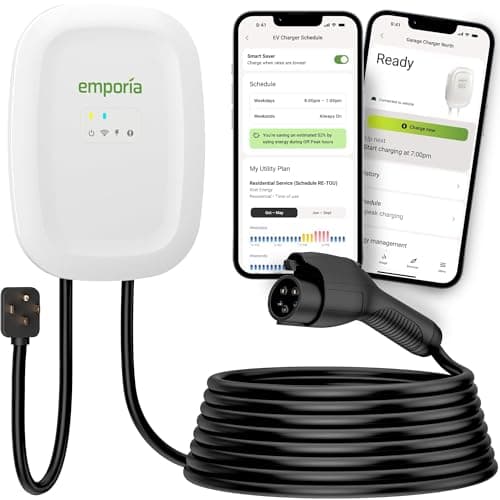
| Emporia Level 2 | 6-48A hardwired, 6-40A plug-in in single-amp steps - tops out at 48A / 11.5 kW | NEMA 14-50 plug or hardwired | 25 ft | Wi-Fi, Emporia app | UL listed, Energy Star | Mid |
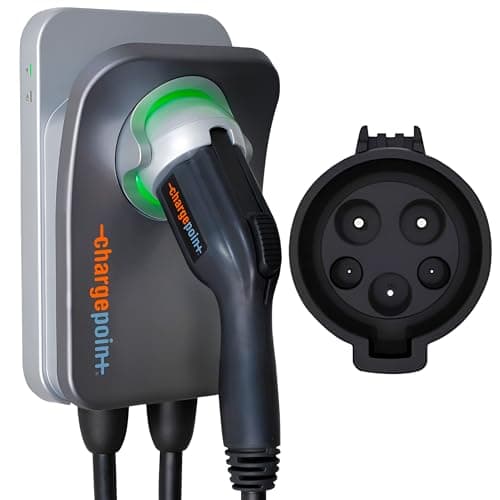
| ChargePoint Home Flex | 16 / 24 / 32 / 40 / 48 / 50A selectable - tops out at 50A / 12.0 kW | NEMA 14-50 plug (to 40A) or hardwired (to 50A) | 23 ft | Wi-Fi, ChargePoint app | UL / cUL (UL 2594, UL 2231), Energy Star | Premium |
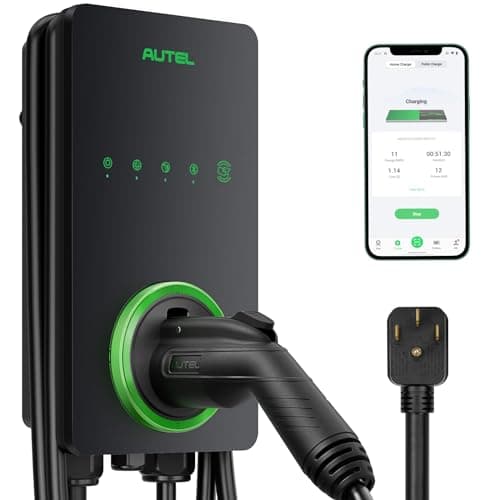
| Autel MaxiCharger | App-adjustable output current - tops out at 40A / 9.6 kW | NEMA 14-50 plug | 25 ft + holster | Wi-Fi + Bluetooth, Autel Charge | NEMA 4X weather-rated shell; no UL mark named in our spec set | Mid |
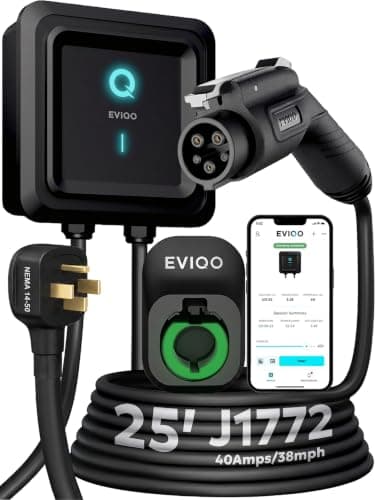
| EVIQO Level 2 | Fixed at its rating - 40A / 9.6 kW | NEMA 14-50 plug | 25 ft | Wi-Fi, EVIQO app | UL and ETL, IP66 / NEMA 4 | Mid |
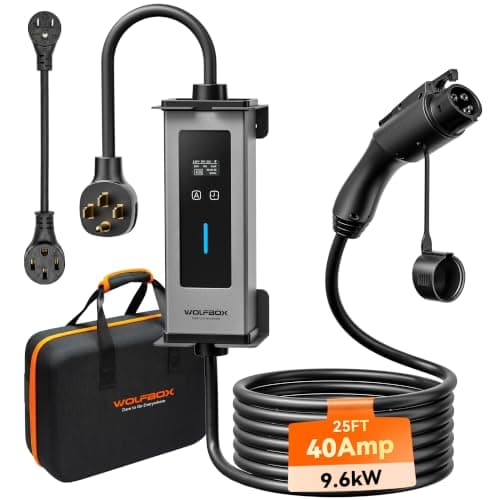
| WOLFBOX 40A Portable | 6-40A on the box, no app needed - tops out at 40A / 9.6 kW | NEMA 14-50, plus 5-15 and 6-20 adapters | 25 ft | No app - on-box amp dial and 1-12h delay timer | ETL listed, IP66 / NEMA 4 | Value |
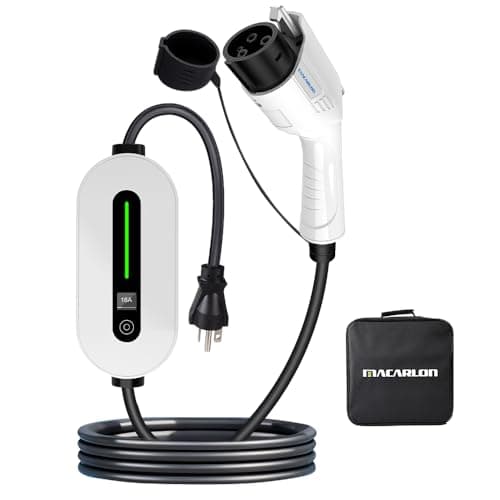
| MACARLON 16A Level 1/2 | 8 / 10 / 13 / 16A selectable - tops out at 16A / 3.8 kW at 240V | NEMA 6-20, plus 5-15 adapter | 25 ft | No app - on-box current select and schedule | IP66 rated body | Budget |
Every figure above is the manufacturer's published claim from its live listing, datasheet or install guide. We compile and compare documented specifications, safety listings and code requirements; we do not bench-measure charging rates, and our methodology page says so in those words.
The buyer's guide: sizing in four numbers
Number one - amps to kilowatts
Amps times 240 volts, divided by 1,000. That is the whole ladder: 16A is 3.8 kW, 24A is 5.8 kW, 32A is 7.7 kW, 40A is 9.6 kW, 48A is 11.5 kW and 50A is 12.0 kW. To turn kilowatts into miles per hour, divide by the car's consumption - roughly 0.3 kWh per mile for a typical EV, more for a truck. So 9.6 kW is around 32 miles per hour and 11.5 kW around 38. The DOE's own rule of thumb for Level 2 is about 25 miles of range per hour, which is the conservative end of that range.
Number two - the breaker, from the 125 percent rule
EV charging is a continuous load under the National Electrical Code, so the branch circuit is sized to 125 percent of the charger's draw - or, read backwards, the charger may only draw 80 percent of its breaker. 32A needs a 40-amp breaker, 40A needs 50, 48A needs 60, and ChargePoint's own installation guidance puts the 50-amp setting on a 70- or 80-amp breaker. Wire gauge follows from the breaker and the run length, and it is an electrician's call, not a table's - wire and breaker sizing has the reference figures.
Number three - what the car will accept
This is the ceiling people forget, and it is the one that wastes the most money. The onboard AC charger inside the car sets a hard limit no wall unit can exceed. Most current EVs sit at 11 to 11.5 kW - Tesla Model 3 and Model Y, Hyundai Ioniq 5, Kia EV6, VW ID.4 and Mustang Mach-E are all published at around 11 kW, and the Chevrolet Bolt, Equinox EV and Rivian R1T at 11.5 kW. A 40 kWh Nissan Leaf accepts 3.6 kW and will not go faster on any charger ever made. At the other end, the Lucid Air and the 2022-2023 F-150 Lightning on Ford's Charge Station Pro accept 19.2 kW, which is an 80-amp charger on a 100-amp circuit and a different class of install. Look up your own car before you buy amps for it: how fast will my EV charge.
Number four - what the panel can spare
A load calculation decides whether a new 50- or 60-amp circuit fits on your service at all. If it does not, you have three honest options and only one of them is expensive: dial the charger down to a circuit the panel can carry, add dynamic load management so the charger throttles when the rest of the house draws, or upgrade the service. The code explicitly allows an automatic load management system to define the maximum load a service must be sized for, which is what makes option two legitimate rather than a workaround. Start with the load calculation, then do I need a panel upgrade.
Level 1 vs Level 2, and where 16 amps fits
If all four numbers come back small, the answer may not be a wall box at all. Level 1 on a 120-volt outlet is 12 to 15 amps and about 5 miles of range per hour; a 16-amp Level 2 unit on a NEMA 6-20 is 3.8 kW and roughly double to triple that, for the price of a small 240-volt outlet rather than a 50-amp circuit. That is the rung of the ladder the MACARLON occupies, and for a plug-in hybrid or a short commute it is often the correct purchase. Level 1 vs Level 2 runs the daily-miles test.
Plug or hardwire caps the answer at 40 or 48
There is no 48-amp plug. A NEMA 14-50 receptacle lives on a 50-amp circuit, so any cord-and-plug charger is capped at 40 amps and 9.6 kW; 48 amps means hardwiring onto a 60-amp circuit. If your sizing points above 40 amps, budget for an electrician to wire the unit in permanently. If it does not, plug-in keeps the charger portable at no speed cost - the trade is laid out in hardwired vs plug-in.
NACS vs J1772 does not change the amperage
Whichever connector your car uses, the amp math above is identical - a 40-amp NACS unit and a 40-amp J1772 unit both deliver 9.6 kW. The plug only decides whether you buy a native-NACS charger, a J1772 charger plus an adapter, or a J1772 charger for a J1772 car. See how to tell which port you have.