HUB 03
EV Charging Guides & Buying Advice
The pre-purchase questions answered with math and citations — charger types, amperage sizing, installation, and the wiring a Level 2 charger actually needs.
We earn a commission when you buy through our Amazon links, at no extra cost to you. It never affects our rankings, and we say so when the cheaper product is the better buy. How this works.
Before you buy a charger you have questions the product pages do not answer: what type you actually need, what breaker and wire a 40-amp charger draws, whether Level 2 is worth it over the cord that came with the car, and what a home install really costs. These guides answer those with arithmetic you can reproduce and sources you can check - including figures the product listings never mention.
Start with the fundamentals
If you are new to charging, read types of EV chargers first - it lays out Level 1 versus 2 versus 3, AC versus DC, and which actually matters at home (Level 2). Then Level 1 vs Level 2 settles whether the wall outlet you already have is enough or whether a 240-volt install is worth it for how you drive.
Then the practical ones
- What amp charger do I need- the NEC continuous-load math and your car's onboard-charger limit, which together decide the amperage you can actually use.
- Level 2 charger installation - the two install paths, permits, and real dollar ranges including a possible panel upgrade.
- NEMA 14-50 outlet - the receptacle a plug-in charger needs, why industrial-grade matters, and why the cheap ones fail.
The newer guides go deeper on the questions buyers keep asking: whether a home charger is worth it at all, 40 amps vs 48 amps, whether your setup needs its own dedicated circuit or fits on a 100-amp panel, what a surge protector adds, and where to mount the unit. If a smart charger will not link up, see Wi-Fi not connecting; for odd noises, humming or buzzing; and for the connector transition, how to future-proof for NACS or whether you can plug into a regular outlet.
On the wiring side, the newest guides answer whether the job needs a subpanel, whether to run copper or aluminum wire, whether the circuit needs a neutral wire or a disconnect switch, and what it takes to move a charger to a new house. For living with the unit, see whether it is safe to charge overnight, how often you should charge, and the troubleshooting set - fault codes and warning lights, a plug getting hot, and how to reset the charger.
How the guides connect to the picks
Each guide bridges back to the product pages it supports, so you can go from "what breaker do I need" straight to the chargers that fit it. Cost questions live in the charging costs hub, and if you are curious how fast an EV really charges away from home, the charge curve hub compiles the DC data.
A standing rule on anything electrical
We are enthusiasts, not licensed electricians, so anything touching your panel or wiring is framed as standard NEC practice to confirm with a professional and your local code - never as instructions to do it yourself. A home charger pulls 40 amps or more continuously for hours, often unattended overnight, and that is exactly the load you want sized and signed off correctly. Our full method - how we compile specs, verify listings, and do the math - is on the how we compare page.
Recently added
Three questions this library now answers. Off the grid or mid-outage, can I charge my EV with a generator gives the continuous-watts arithmetic and the ground check that stops most attempts before they start. On a ten-year purchase, how long do EV chargers last names the four parts that actually fail and why, on a plug-in install, it is usually the outlet rather than the charger. And on the road, charging an EV at a hotel covers the three tiers of hotel charging, what to ask when you book, and the etiquette that keeps the next EV guest welcome.
The amperage question in the middle
We had the 32-versus-48 and 40-versus-48 comparisons but not the pair most buyers actually face. 32 amps vs 40 amps fills that in, and the answer is less about the charger than people expect: almost every 40-amp unit includes 32 amps as a setting, so you are really choosing between a 40-amp circuit with 8-gauge wire and a 50-amp circuit with 6-gauge - and on a new install the faster one usually costs very little more.
The questions people ask before they buy anything
Three of the most common arrive before the charger decision does. Do all EVs use the same charger sorts out the connector question in plain terms, can you overcharge an EV answers the worry about leaving it plugged in overnight, and how long does it take to install an EV charger sets expectations for the day itself. If the walls are open, rough-in for new construction and conduit size and type are the two to read first, and does home insurance cover an EV charger covers the paperwork side nobody mentions until a claim.
Everything in this hub
All of Charging Guides
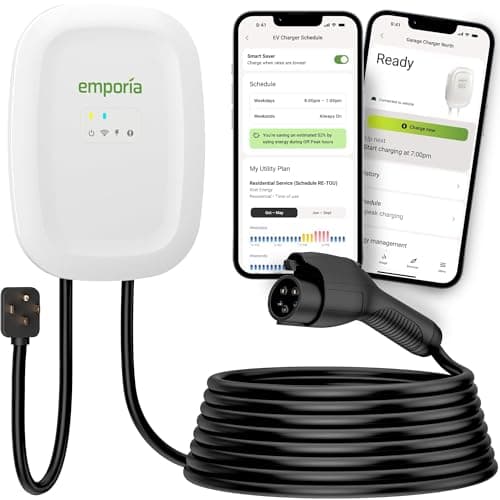
Buyer's guide
Level 1 vs Level 2 EV Charging at Home
A daily-miles decision framework for choosing between free 120V charging and a 240V Level 2 circuit - with the hardware for each answer, ranked and priced.
Top pick: Emporia Level 2 (48A) · 6 ranked, 5 with live prices
Check price on Amazon →Buyer's guide
What Amp EV Charger Do I Need? Breaker and Wire Sizing
How the NEC continuous-load rule, your panel, and your car's acceptance rate set the charger amperage that makes sense - with adjustable chargers for every answer, ranked and priced.
Top pick: Emporia Level 2 (48A) · 6 ranked, 5 with live prices
Check price on Amazon →Buyer's guide
Hardwired vs Plug-In EV Charger
The real trade-offs between hardwiring a charger and plugging it into a NEMA 14-50 - speed cap, portability, cost, and which to pick - with both kinds of unit ranked and priced.
Top pick: Emporia Level 2 (48A) · 6 ranked, 5 with live prices
Check price on Amazon →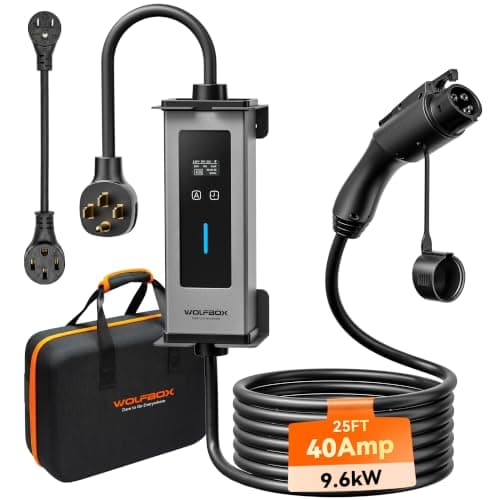
Buyer's guide
NEMA 14-50 vs 6-50: Which Outlet for EV Charging?
The practical difference between a NEMA 14-50, a 6-50 and a 30-amp 14-30 outlet for EV charging - the neutral wire, the amperage each allows, cost, and which chargers plug into which.
Top pick: WOLFBOX 40A Portable (Level 1/2) · 6 ranked, 5 with live prices
$299.99AmazonBuyer's guide
What Does EV Charger Installation Actually Cost?
What a Level 2 install actually costs, the five factors that set the price, and the chargers that keep the electrical bill at the cheap end - ranked and priced.
Top pick: Emporia Level 2 (48A) · 6 ranked, 5 with live prices
Check price on Amazon →