This is the first real charging decision most new EV owners face, and it is genuinely a decision, not a foregone conclusion. Level 1 costs nothing beyond the cordset in the trunk. Level 2 is faster but requires a 240-volt circuit, which is a real install cost. Whether that cost is worth it comes down to two things: how many miles you drive in a normal day, and what kind of car has to absorb them overnight.
What each one delivers overnight
Level 1 plugs into an ordinary 120-volt outlet and adds roughly 3 to 5 miles of range per hour. Left plugged in through a long night - say ten to twelve hours - that is somewhere around 40 to 50 miles recovered. For a short commute or a plug-in hybrid with a modest battery, that can quietly cover your driving without you ever thinking about it. For a long-range battery EV with a real daily commute, it is too slow: you wake up having replaced less than you drove, and the deficit compounds across the week.
Level 2 runs on 240 volts and adds roughly 20 to 40 miles of range per hour. That changes the shape of ownership. A typical day's driving refills in a couple of hours, and a nearly empty battery tops off comfortably overnight. You stop planning around the charger; the car is simply full each morning. For most drivers, that reliability is the entire value proposition of Level 2.
The two side by side
| Level 1 (120V) | Level 2 (240V) |
|---|
| Range added per hour | ~3-5 miles | ~20-40 miles |
| Typical overnight recovery | ~40-50 miles | A full daily commute, and then some |
| Hardware needed | None if you have an outlet | A 240V circuit (install cost) |
| Best fit | PHEVs, low-mileage drivers | Daily-driven battery EVs |
A decision framework by daily miles and car type
Instead of guessing, put a number on your driving. Look at what you actually cover on a typical day - not your worst road-trip day, the ordinary Tuesday - and match it to the car.
Under about 30-40 miles a day
Level 1 can genuinely keep up, especially for a plug-in hybrid whose battery is small to begin with. If your outlet is close to where you park and you rarely run the battery low, you may never need anything more. Keep the option open, but do not spend money to solve a problem you do not have.
Roughly 40-60 miles a day
This is the gray zone. Level 1 might cover it on a good night and fall behind on a bad one. If your car is a battery EV and you value never thinking about it, Level 2 is the safer call. If it is a plug-in hybrid, Level 1 is often still fine because the gas engine covers any shortfall.
More than about 60 miles a day, or a long-range BEV
Level 2 is the practical answer. A trickle charge simply cannot replace that much range in the hours a car sits at home, and you will spend your week chasing the battery. This is exactly the case Level 2 was built for.
Two quick real-world pictures
Picture a driver with a plug-in hybrid and a fifteen-mile round-trip commute. The battery is small, the daily draw is tiny, and a 120-volt outlet in the garage refills it several times over each night. For that driver, paying for a Level 2 circuit would be spending real money to solve a problem that does not exist - Level 1 is not a compromise here, it is the correct tool.
Now picture a driver with a long-range battery EV and a fifty-mile daily round trip. Level 1 gives back roughly 40 to 50 miles overnight, so this driver wakes up a little short every single day, and the gap grows across the week until a quiet weekend lets the car catch up. That is tiring to manage. Level 2 erases it: the fifty miles come back in a couple of hours and the car is full by morning. Same two drivers, opposite right answers - which is the entire reason to run your numbers instead of guessing.
A useful middle path: a dual-level portable charger. Many plug into a 240V outlet at home for Level 2 speeds and still carry a 120V plug for the road. If you are curious whether one unit can do both jobs, see our best portable EV chargers.
Where you park changes the answer
The tidy framework above assumes you can plug in where you sleep, and not everyone can. If your car sits on a driveway far from any outlet, even Level 1 may mean a cord run across a walkway, and Level 2 means paying to run a circuit out to that spot. If you park on the street or in a shared lot with no assigned outlet, home charging of either kind may not be practical at all, and your real plan becomes workplace or public Level 2. Sort out the physical question - can a cable reach the car where it lives - before the speed question, because it can quietly override everything else.
Does charging speed affect battery health?
A common worry is that faster home charging is somehow harder on the battery. In the range we are talking about, it is not a meaningful concern. Both Level 1 and Level 2 are AC charging at modest power relative to what the pack can handle, and the battery's management system governs the flow either way. The charging usually discussed in the context of long-term battery wear is repeated high-power DC fast charging, which is a different level entirely.
If anything, Level 2 makes the healthier habits easier, because it charges quickly enough that you can top up to a daily limit and unplug rather than leaving the car trickling at full for hours. So battery health is not a reason to pick Level 1 over Level 2 - if the miles say you need Level 2, the pack is entirely fine with it.
The cost side of the decision
Level 1 wins on upfront cost by default - the equipment is free with the car and needs no electrician. Level 2 asks for a 240V circuit, which is where the money goes; we break the range of installed costs down in how to install a Level 2 charger. The running cost of the electricity itself is nearly the same either way - a kilowatt-hour costs what it costs regardless of how fast it flows - and you can push that bill lower on either level by charging on cheaper overnight rates. We do that math in the cost to charge at home.
It is worth being clear-eyed about payback, because Level 2 does not "save" you money the way a solar panel might - the electricity costs about the same on either level. What you buy with a Level 2 install is time and certainty: a car that is always ready, and hours you never spend babysitting a slow charge. For a daily driver, that convenience is the return, and most owners decide it is worth it. For a light user it is not, and that is a perfectly reasonable conclusion too.
A low-risk way to decide: try Level 1 first
If you are genuinely unsure which camp you fall into, there is a cheap experiment: drive on Level 1 for a couple of weeks and watch the battery. Since the cordset comes with the car and needs no install, you can learn your real daily deficit for free before committing to a circuit. If the battery holds steady or climbs overnight, Level 1 is covering you. If it drifts downward day after day, you have measured your need for Level 2 rather than guessed at it - and you will know roughly how much faster you need to charge.
When that experiment points to Level 2, the only questions left are which unit and how many amps, which is where our best Level 2 chargers and the installation guide pick up. Nobody has to get this right on the first day of ownership.
Our honest take
If you drive a battery EV daily, Level 2 pays for itself in convenience faster than most people expect, and it is the setup we point most owners toward - the best Level 2 home chargers roundup is the place to start. But we are not going to pretend Level 1 is useless: for the right driver and the right car, the free option is the correct option, and spending on Level 2 would be buying speed you never use. Which recommendation you get from us depends only on your numbers, and you can see how we reason about all of this on our methodology page.
How the six compare
| Charger | Level and amps / kW | Plug type | Cable | Smart / Wi-Fi | Safety listing | Price tier |
|---|
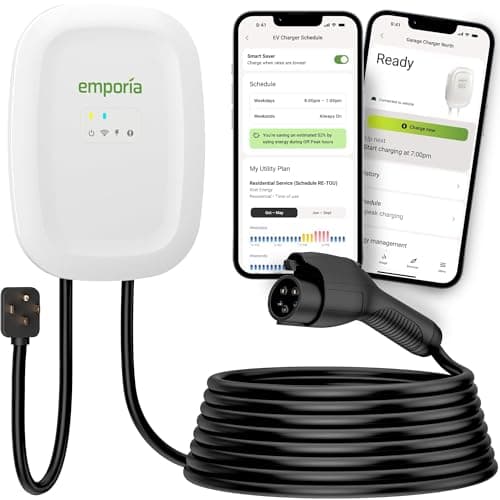
| Emporia Level 2 | Level 2 - 6-48A / up to 11.5 kW | NEMA 14-50 plug (40A) or hardwired (48A) | 25 ft | Wi-Fi, Emporia app | UL listed, Energy Star | Mid |
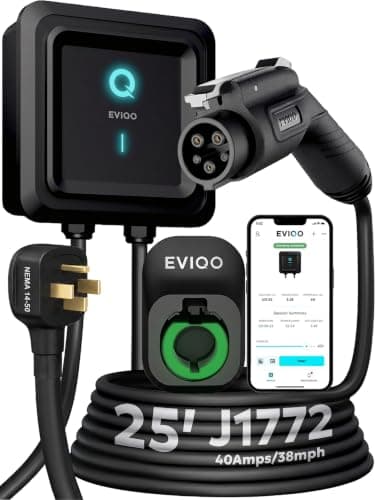
| EVIQO Level 2 | Level 2 - 40A / 9.6 kW | NEMA 14-50 plug | 25 ft | Wi-Fi, EVIQO app | UL and ETL, IP66 / NEMA 4 | Mid |
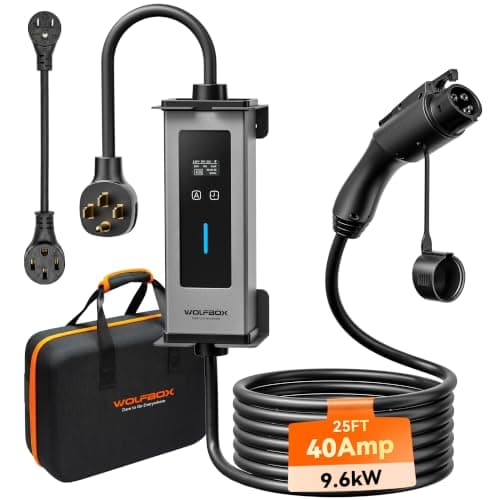
| WOLFBOX 40A Portable | Level 1 and 2 - 6-40A / up to 9.6 kW | NEMA 14-50, plus 5-15 and 6-20 adapters | 25 ft | No app - on-box amp dial and 1-12h delay timer | ETL listed, IP66 / NEMA 4 | Value |
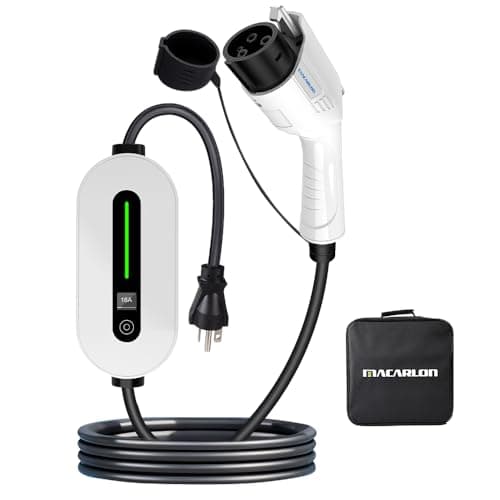
| MACARLON 16A Level 1/2 | Level 1 and 2 - 8-16A / 1.4-3.8 kW | NEMA 6-20, plus 5-15 adapter | 25 ft | No app - on-box current select and schedule | IP66 rated body | Budget |
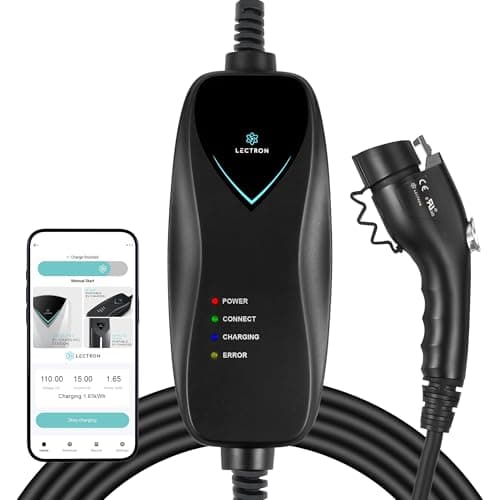
| Lectron Level 1 Wi-Fi | Level 1 - 15A / about 1.65 kW | NEMA 5-15 household plug | Wall-mountable cordset | Wi-Fi app, scheduling | ETL listed, IP65 | Budget |
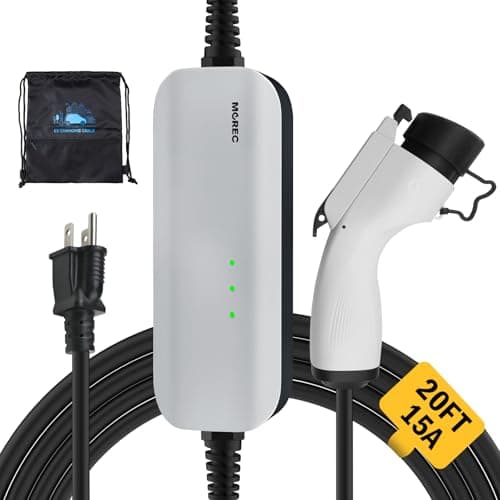
| Morec Level 1 | Level 1 - 15A / 1.8 kW | NEMA 5-15 household plug | 20 ft | None | IP65 rated body | Budget |
Every figure above is the manufacturer's published claim from its live listing or datasheet. We compile and compare documented specifications, safety listings and code requirements; we do not bench-measure charging rates, and our methodology page says so in those words.
The buyer's guide: turning the level into a purchase
Amps to kilowatts, and kilowatts to miles
One line of arithmetic settles most of this page. Multiply amps by volts and divide by 1,000. On a 120-volt household circuit, 12A is 1.4 kW and 15A is about 1.8 kW - that is Level 1, and the Department of Energy puts it at roughly 5 miles of range per hour. On a 240-volt circuit, 16A is 3.8 kW, 32A is 7.7 kW, 40A is 9.6 kW and 48A is 11.5 kW - that is Level 2, which the DOE puts at roughly 25 miles of range per hour and which reaches the high 30s on a car that accepts the full 11.5 kW. To convert kilowatts into miles yourself, divide by the car's consumption, roughly 0.3 kWh per mile for a typical EV. The full working is in what kW means in EV charging.
How many amps you actually need
The honest answer for most households is 40, not 48. A 40-amp charger on a NEMA 14-50 adds about 30 miles of range an hour, which refills a 40-mile commute before you have finished dinner. Going to 48 amps buys about six more miles per hour, costs a hardwired 60-amp circuit, and only pays off if the car's onboard AC charger accepts it - many cap at 7.7 or 9.6 kW and simply will not take more. Work out your own number in what amp charger do I need before you spend on speed the car cannot use.
NACS vs J1772: a plug shape, not a charging level
Every unit on this page is J1772, the connector almost every non-Tesla EV in the US has used for a decade. Teslas and a growing list of 2025-onward models use NACS (SAE J3400) instead. The connector changes nothing about Level 1 or Level 2 speed - a 40-amp NACS charger and a 40-amp J1772 charger both deliver 9.6 kW. What it decides is whether you need an adapter or a native-plug unit. Check the car, not the badge: how to tell which port you have takes thirty seconds, and the NACS charger roundup covers the native-plug options.
Hardwired vs plug-in, in one sentence
A plug-in charger tops out at 40 amps because a NEMA 14-50 receptacle sits on a 50-amp circuit and the National Electrical Code limits a continuous load to 80 percent of the circuit. Hardwiring onto a 60-amp circuit is the only way to 48 amps. Plug-in comes off the wall and moves house with you; hardwired removes the one connection most likely to loosen or overheat outdoors. Neither is a Level 1 vs Level 2 question - both are Level 2 - but it is the next decision you will make. It is settled in hardwired vs plug-in.
Load management: how to get Level 2 on a panel that says no
If an NEC load calculation says your service cannot spare a new 50- or 60-amp circuit, the answer is not automatically "stay on Level 1". Two cheaper routes exist. Dynamic load management watches the whole house and throttles the charger only when the dryer and the oven are running, which lets a full-speed unit live on a panel that could not otherwise carry it. Or simply dial the charger down - the Emporia adjusts in single-amp steps from 6 to 48, and a 24-amp setting on a 30-amp circuit is still Level 2 and still roughly three to four times a household outlet. Both beat a service upgrade on price; see the load calculation guide and the load-balancing chargers.
The safety listing is the spec to check last and trust first
A Level 1 cordset draws 12 to 15 amps for twelve hours at a stretch; a Level 2 unit draws 40 for four. Both are continuous loads on a residential circuit, which is why a third-party listing matters more here than the app does. Look for UL or ETL against UL 2594 (the EVSE standard) and UL 2231 (personnel protection). ETL is not a lesser mark - Intertek is an OSHA-recognized testing laboratory, and an ETL listing means the same standard was tested to by a different lab. Phrases like "UL-certified components" or "meets UL standards" on a listing mean nothing at all; the unit itself is either listed or it is not. More in UL-listed chargers and are cheap EV chargers safe.