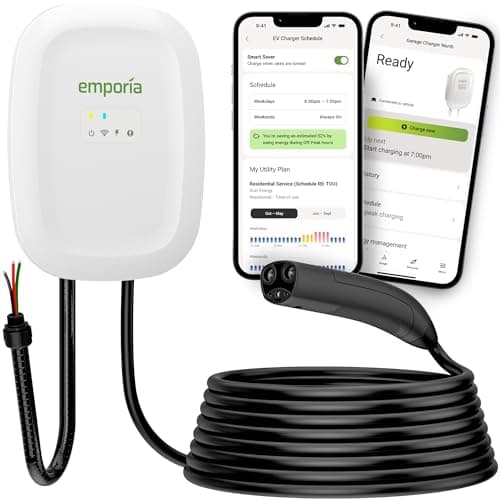
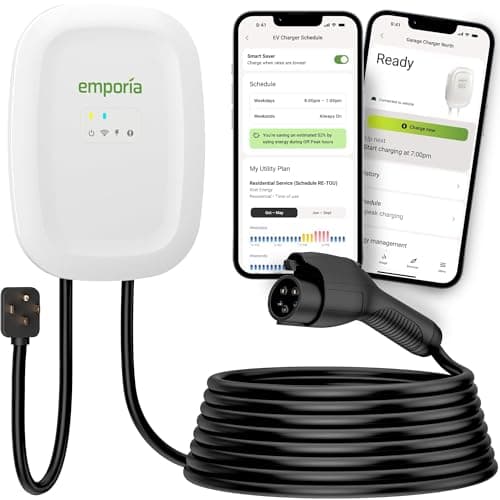
The Emporia Level 2 is the home charger we recommend to most people, because it does something rare: it delivers 48-amp speed and real smart features for roughly what a plain plug-in charger costs. You are not paying a premium for the software - you are getting it more or less for free.
In our best Level 2 chargers roundup the Emporia takes the top spot, and this is the longer look at why. As always, we compile the published specs and do the math rather than bench-testing hardware, so read this as documented research on a very well-regarded unit, not a lab teardown.
Who it is for
The Emporia fits the buyer who wants the fast option and the smart features but resents paying twice for both - a large share of EV owners. On a time-of-use electricity plan, the app scheduling alone can pay back the difference over a dumb charger by moving charging to cheaper overnight hours. It is the wrong charger for exactly one person: the buyer who never wants to open an app. For them, the Grizzl-E is the honest alternative.
The specs that matter
Emporia rates this unit at up to 48 amps / 11.5 kW when hardwired, with a J1772 connector, a 25-foot cable, and Wi-Fi app control. Two numbers do the real work:
- 48 amps, but only hardwired. The plug-in NEMA 14-50 version is capped at 40 amps, like every plug-in charger, because a 14-50 plug lives on a 50-amp circuit and the continuous-load rule limits draw to 40. To get the full 48 amps you hardwire it on a 60-amp circuit - and your car has to accept 48 amps too. Our amperage guide walks through which version to buy.
- 25-foot cable. Long enough to reach across a two-car garage and park either direction, which matters more day to day than most people expect.
What is good
The headline is value: 48-amp capability plus genuine energy monitoring and scheduling at a price that undercuts most smart rivals. The monitoring is not a gimmick - seeing what each charge costs, and scheduling it for off-peak hours automatically, is the feature set that actually saves money on a time-of-use plan. The 25-foot cable is generous, and the unit slots into Emporia's broader home-energy app if you use their monitoring products. For a single box that covers speed, smarts and reach without a premium, little else matches it.
Where it falls short
The weaknesses are the flip side of the strengths. The 48-amp figure requires hardwiring; go plug-in and you are living with 40 amps, same as the cheaper units. And the app and Wi-Fi are central to the experience, so setup is more involved than a plug-and-go charger, and the value proposition partly depends on you using the software. If your Wi-Fi is unreliable or you simply do not want an app, a sealed box is the better spend.
Installation notes
Decide hardwired versus plug-in before you order, because it changes which version you buy and what circuit you need. Plug-in wants a properly rated NEMA 14-50 outlet on a 50-amp circuit; hardwired at 48 amps wants a 60-amp circuit with appropriately sized wire. Either way, have a licensed electrician confirm your panel can support the load and handle the connection to code. If you go plug-in, do not skimp on the receptacle - an industrial-grade, listed 14-50 outlet is the part that survives a continuous 40-amp draw.
The Emporia lineup, model by model
Emporia sells one charger in several shapes rather than a ladder of different machines, which makes the buying decision unusually simple. Per Emporia's own product pages the range is:
- Classic (J1772) - the unit reviewed above. Up to 48 amps hardwired or 40 amps on a NEMA plug, a 25-foot cable, UL listed and Energy Star certified in a NEMA 4 indoor/outdoor enclosure, on a 3-year warranty. This is the one to buy if any car in the driveway has a J1772 port.
- Classic (NACS) - the same charger with a Tesla-style J3400 plug on the end, so a Tesla or a factory-NACS EV connects with nothing hanging off the handle. Same amperage, same listings, same app. Our catalogue entry for this one is the hardwired SKU, which ships preconfigured with the whip attached.
- Pro- the Classic plus PowerSmart load management and peak-demand management, which need Emporia's Vue energy monitor on the panel. This is the version to look at when the panel, not the car, is the constraint.
- V2X bidirectional - listed by Emporia as coming soon, with no published specification. We are not going to review a spec sheet that does not exist yet; when it ships, this page gets updated.
Note what is notin that list: there is no separate "faster" Emporia. The 48-amp ceiling is the top of the range, and you unlock it by hardwiring rather than by buying a different box. That is why the only two real decisions here are connector and install type.
Bottom line
The Emporia is the default recommendation because it removes the usual compromise: you do not have to choose between fast, smart and affordable. Hardwire it for the full 48 amps, use the scheduling if you are on a time-of-use rate, and it is hard to out-argue for most homes. The only buyers who should look elsewhere are the ones who never want an app - and for them the Grizzl-E lineup is the sealed-box alternative we would actually buy.
The Emporia lineup, side by side
Every figure below is Emporia's own published specification, compiled from the product pages and the amperage help article cited in Sources. We have not bench-tested these units and do not pretend to.
| Model | Amps / kW | Connector | Plug or hardwired | Cable | Smart features | Safety listing |
|---|
| Emporia Classic (J1772) | 6-48A / up to 11.5 kW | J1772 | NEMA 14-50 plug (40A) or hardwired (48A) | 25 ft | Wi-Fi app, scheduling, energy and cost tracking, solar | UL listed, Energy Star, NEMA 4 |
| Emporia Classic (NACS) | 6-48A / up to 11.5 kW | Native NACS (J3400) | Hardwired SKU in our catalogue | 24 ft | Same app, same monitoring, charge-port-door button | UL listed, Energy Star |
| Emporia Pro | Up to 48A / 11.5 kW | J1772 | Plug or hardwired | 25 ft | Adds PowerSmart load management and peak-demand management (needs a Vue monitor) | UL listed, Energy Star |
| Emporia V2X | Not published | Not published | Not published | Not published | Bidirectional - listed as coming soon | Not published |
How to pick the right Emporia
Level 1 versus Level 2, in one paragraph
Level 1 is the 120-volt cord that came with the car. It draws about 12 amps and returns roughly 5 miles of range per hour, which is fine for a plug-in hybrid and hopeless for a 300-mile battery. Level 2 is 240 volts, and the US Department of Energy puts the practical band at about 2.9 to 19.2 kW. Every Emporia here is Level 2. If you drive under about 40 miles a day and can leave the car plugged in for 12 hours, Level 1 genuinely works; above that, the reason to buy a charger at all is that Level 1 cannot refill what you used.
Amps to kW, and why 48 needs a hardwire
The arithmetic is amps x 240 volts / 1000 = kW. So 40 amps is 9.6 kW and 48 amps is 11.5 kW - about a 20 percent difference in charge rate, or roughly 6 miles per hour of charging on a typical EV. The catch is code, not the charger: EV charging is a continuous load, so the circuit must be sized to 125 percent of the draw. A 40-amp charger needs a 50-amp circuit; 48 amps needs 60. A NEMA 14-50 receptacle sits on a 50-amp circuit, which is exactly why every plug-in charger on the market - Emporia's included - is capped at 40 amps. Hardwiring is what removes the receptacle from the equation and lets the unit run at 48.
NACS or J1772
Buy the connector your car actually has. A Tesla and most 2025-and-later EVs from Ford, GM, Hyundai, Kia, Rivian and others use the NACS (SAE J3400) port; nearly everything older uses J1772. Either combination works with a small adapter, but an adapter is one more thing to hold, lose and weather-cycle, and it is worth avoiding on the charger you use every night. If the household mixes both, buy J1772 and adapt the NACS car - that direction is the cheaper, more widely supported adapter. Our J1772 vs NACS guide has the full decision tree.
Hardwired or plug-in
Plug-in wins on portability and on install cost when a properly rated NEMA 14-50 already exists; it loses 8 amps and puts a receptacle in the current path, which is the part that overheats when someone buys a bargain one. Hardwired wins on speed, on outdoor installs, and on having nothing to loosen over ten years of thermal cycling. If you rent or expect to move, plug-in. If this is your house, hardwire it.
Load management, if the panel is the problem
A 48-amp charger asks for a 60-amp circuit, and plenty of 100-amp and older 200-amp services cannot spare it. Emporia's answer is PowerSmart: the Vue meter watches the whole-home load and throttles the charger to keep the service under its rating, which the NEC recognizes as an alternative to a service upgrade. Emporia also publishes Intelligent Load Sharing for coordinating two of its chargers on one panel. Both are cheaper than a panel upgrade and worth pricing before you assume you need one - see our load-balancing picks.