HUB 03 · Charging Guides
NEMA 14-50 Outlet for EV Charging: What to Know
The 240-volt receptacle your plug-in charger relies on - and why the cheap version of it is the exact part that fails.
We earn a commission when you buy through our Amazon links, at no extra cost to you. It never affects our rankings, and we say so when the cheaper product is the better buy. How this works.
If you buy a plug-in Level 2 charger, there is a good chance it ends its cord in a NEMA 14-50 plug - and that plug has to go somewhere. That somewhere is a NEMA 14-50 outlet, and it is one of the few pieces of the charging puzzle where spending a little more genuinely matters. This guide explains what the outlet is, why your charger draws less than the number on the receptacle, and why the bargain-bin version is a false economy.
What a NEMA 14-50 outlet actually is
NEMA 14-50 is the standard name for a 240-volt, 50-amp receptacle with three poles and four wires - two hots, a neutral, and a ground. You have almost certainly seen one: it is the same outlet an electric range plugs into, and the same one RV parks use for shore power. In the EV world it is the default socket that a plug-in Level 2 charger or a portable EVSE connects to. Because it is a common, well-understood receptacle, it is the path of least resistance for a plug-in install.
That familiarity is the whole appeal. Your electrician has wired hundreds of them, the plug on your charger is built for it, and if you ever swap chargers, the new one almost certainly uses the same plug. It is the closest thing home charging has to a universal socket.
Physically, it is a chunky four-prong receptacle, usually mounted in a deep metal box because the wires feeding it are thick. You will most often see it installed near the garage door or wherever the electrician can reach the panel most directly, since every extra foot of that heavy cable adds to the bill.
The 14-50 versus the other outlets you might see
"NEMA" names describe a plug's shape and rating, and a few neighbors of the 14-50 turn up in garage conversations, so it helps to know why the 14-50 became the EV default. The number before the dash is the configuration and the number after it is the amperage - so a 14-50 is the 50-amp version of the 14 family, carrying two hots, a neutral, and a ground at 240 volts.
- NEMA 14-30 is the 30-amp dryer outlet. It is 240 volts but on a smaller circuit, so a charger on it is limited to roughly a 24-amp draw - slower, though still genuine Level 2.
- NEMA 6-50 is another 50-amp, 240-volt outlet, common on welders, but it is a three-wire pattern with no neutral. Some chargers ship with a 6-50 plug instead of a 14-50.
- NEMA 14-50 won the popularity contest because it was already everywhere - ranges and RV parks made it common - so chargers, plugs, and electricians all default to it.
The practical advice: match the outlet to the plug your charger actually ships with, and let your electrician confirm the circuit behind it. There is nothing wrong with a 6-50 if that is what your unit uses, but the 14-50 is the safe assumption when you have a choice.
Why a 50-amp outlet only gives you 40 amps
Here is the detail that confuses people. The receptacle is rated for 50 amps, but a charger plugged into it is limited to a 40-amp draw. That is not a defect - it is the National Electrical Code's continuous-load rule. EV charging runs at full current for hours, so the code treats it as a continuous load and requires the circuit to be rated at 125% of the actual draw. Run the math backward: on a 50-amp circuit, the continuous draw is capped at 40 amps, because 40 amps times 1.25 equals the 50-amp rating.
So a plug-in charger on a 14-50 outlet tops out at 40 amps, roughly 9.6 kilowatts, which is a healthy Level 2 speed for most cars. If you want the full 48 amps, you need a hardwired unit on a 60-amp circuit instead - a different install, covered in how to install a Level 2 charger. The reasoning behind all of this sizing lives in what amp EV charger do I need.
Buy the industrial-grade outlet, not the cheap one
This is the part that actually matters, and it is where we get a little insistent. NEMA 14-50 receptacles range from a few dollars for a builder-grade unit to considerably more for an industrial or commercial-grade one. For an electric range that draws hard for twenty minutes at dinnertime, the cheap one is fine. For an EV charger that pulls 40 amps continuously for hours, night after night, the cheap one is a documented failure point.
The failure mode is heat. A flimsy receptacle's contacts loosen and resist over time under sustained current, they warm up, and a warm connection gets worse in a self-reinforcing way. Melted and scorched builder-grade 14-50 outlets behind EV chargers are common enough to be a well-known caution in the community. An industrial-grade, properly listed receptacle uses better contact material and construction built for exactly this kind of continuous load.
This is not a place to save ten dollars. A listed, industrial-grade NEMA 14-50 is cheap insurance against the one component most likely to overheat under a continuous 40-amp EV load. Spend here.
What a quality receptacle looks like
If you are going to spend a little more on the outlet - and you should - it helps to know what the money buys. Industrial and commercial-grade 14-50 receptacles use more robust contact metal and a heavier internal build, so the spring tension that grips your charger's plug holds up under years of continuous heat cycles instead of relaxing into a loose, warm connection. A clear safety listing (UL or ETL) on the package is the baseline; the industrial-grade construction is the upgrade that matters for EV duty.
You do not need the single most expensive receptacle on the shelf. You need one that is listed and rated for continuous, heavy-duty use rather than the lightest builder-grade part that technically fits the hole. That is the whole distinction, and it is a small line item against the cost of the circuit and the charger.
Getting it installed right
The outlet is only as safe as the circuit behind it, and that circuit is a licensed-electrician job. A 50-amp EV circuit typically calls for 6 AWG copper conductors, sized and protected to code, on a breaker matched to the load. Distance from the panel, conduit, and local code all factor into the work - which is why the outlet-plus-circuit line item can range widely, as we cover in the installation cost breakdown.
Current electrical code has also tightened the rules around these receptacles - a 14-50 outlet on a new EV circuit typically needs GFCI protection, usually from a GFCI breaker at the panel. That is one more reason the job belongs with a licensed electrician who knows your local code: they will spec the protection correctly rather than leave you with an install that fails inspection.
One more decision point: if you are certain about a permanent charger and want maximum speed, hardwiring skips the outlet entirely. But if you value the flexibility to unplug, swap, or take the unit with you, the 14-50 outlet is the reason plug-in chargers are so popular. Either way, the chargers we cover in the best Level 2 roundup note which install each supports, and every recommendation is compiled from published specs and listings the way we describe on our methodology page.
When the outlet is not the right answer
The 14-50 outlet is the flexible, familiar choice, but it is not always the one to pick. If you want the fastest home charging - a full 48 amps - no 14-50 install gets you there, because the outlet lives on a 50-amp circuit and the continuous-load rule caps it at 40. That speed only comes from a hardwired unit on a 60-amp circuit, so a driver chasing maximum miles per hour should look past the outlet entirely.
Likewise, if the charger is going in a harsh or exposed location, or you simply never intend to move it, hardwiring removes the receptacle as a potential failure point and can be the cleaner install. The 14-50 earns its place when you value flexibility - the ability to unplug, swap, or take the charger along - which is exactly why it remains the most common home setup despite the 40-amp ceiling.
The gear
Recommended gear for this guide
The products this guide refers to, with prices pulled live from Amazon and dated on each card.
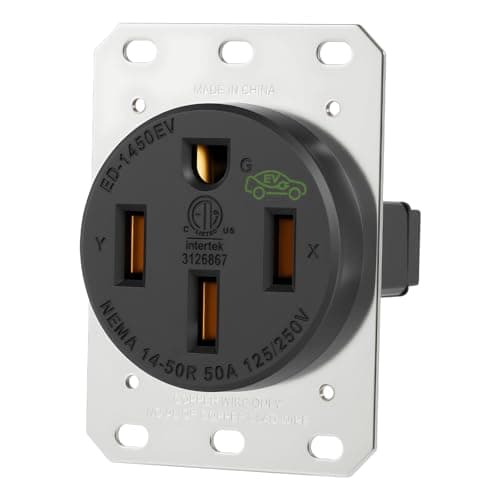
The outlet a plug-in charger needs
Industrial NEMA 14-50 Outlet
The receptacle a plug-in charger actually plugs into — buy the industrial-grade, listed version, because the cheap ones are the exact part that fails.
#ad · As an Amazon Associate we earn from qualifying purchases.
Questions
Frequently asked
What is a NEMA 14-50 outlet used for?
It is a 240V, 50-amp receptacle - three poles, four wires - used by electric ranges, RV shore power, and plug-in Level 2 EV chargers. For EVs it is the standard socket a plug-in charger or portable EVSE connects to.
Why is my EV charger limited to 40 amps on a 50-amp outlet?
Because EV charging is a continuous load. The NEC requires the circuit to be rated at 125% of the draw, so a 50-amp circuit caps continuous EV current at 40 amps (40A x 1.25 = 50A). That is code, not a fault.
Do I need a special NEMA 14-50 outlet for EV charging?
You should buy an industrial or commercial-grade, listed receptacle rather than a cheap builder-grade one. Bargain 14-50 outlets are a known overheating and failure point under the continuous 40-amp draw of EV charging.
Can I install a NEMA 14-50 outlet myself?
No - this is a licensed-electrician job. The outlet needs a properly sized 50-amp circuit, typically 6 AWG copper, installed to code and usually permitted and inspected.
Is a NEMA 14-50 outlet or hardwiring better?
A 14-50 outlet gives you flexibility to unplug and swap chargers, with a 40-amp ceiling. Hardwiring skips the outlet and allows up to 48 amps for faster charging but is permanent. Choose based on speed versus flexibility.
Keep reading
Related
- Best NEMA 14-50 OutletsThe EV-rated and industrial receptacles we would actually buy, ranked.
- Installing a Level 2 ChargerWhere the outlet fits into the full install.
- What Amp EV Charger Do I Need?Why the 40-amp cap exists and when to want more.
- Best Level 2 Home ChargersPlug-in chargers that use the 14-50 outlet.
- NEMA 14-30 vs 14-50The dryer-outlet alternative and its lower speed.
- Wire and breaker sizeThe circuit the 14-50 outlet sits on.
- Can I use a dryer outlet?The no-install alternative to a dedicated 14-50.
- Does it need its own circuit?Why the 14-50 has to be a dedicated branch circuit.
More in this section
More Charging Guides
Receipts
Sources
- Qmerit - Understanding Your EV Home Charging Station Installation Costs
- US DOE Alternative Fuels Data Center - Charging at Home
- US DOE FuelEconomy.gov - Charging at Home and on the Road
We do not run a testing lab, and we do not pretend to. Where a measured number came from someone else's lab, we name them and link them. Where we could not verify something, we say so on the page rather than quietly leaving it out. Read our full method.