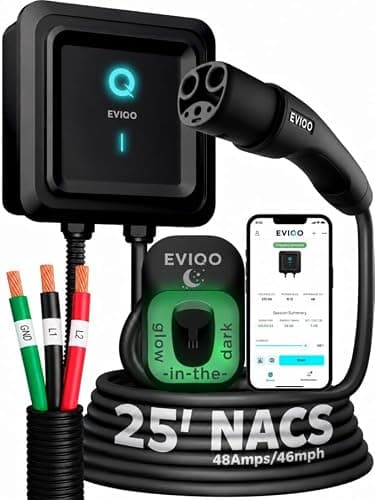
A NACS home charger has the Tesla-style plug built into the cable, so a Tesla - or any of the newer non-Tesla EVs that now ship with a NACS port - charges with no adapter at all. Our pick is the EVIQO NACS 48A: full 48-amp speed, a UL and ETL listing, an IP66 weatherproof shell and app scheduling, for less than the established brands charge. The Emporia NACS is the one to buy if you want to see exactly what charging costs, the ChargePoint Home Flex NACS is the established-brand pick with 16-50 amp adjustability, the EVIQO NACS 40A is the version you can unplug and take with you, and the ELEGRP is the cheapest certified way into the connector.
For a decade there was one answer to "which plug does a home charger use": J1772, unless you drove a Tesla. That has changed. NACS - the connector Tesla designed, now published by SAE as J3400 - is becoming the North American standard, and cars are starting to arrive with it fitted at the factory rather than reached through a dongle. Which raises a question the buying guides have not caught up with: if your car has a NACS port, should the charger on your garage wall have one too? This page ranks the units that do, and is honest about the cases where a plain J1772 charger and a cheap adapter is still the better buy. We compile published manufacturer specifications and do the electrical arithmetic; we do not run a test lab.
The short version
- EVIQO NACS 48A - best overall. A hardwired 48-amp unit with UL, ETL and Energy Star certification, an IP66 / NEMA-4 enclosure and a Wi-Fi app, at a price the established brands do not match. The certification at this price is the reason it wins.
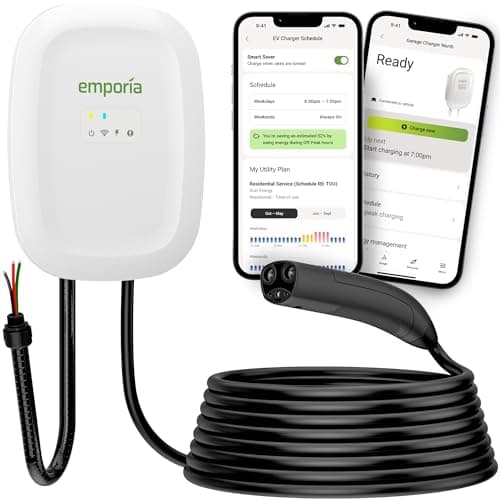
- Emporia NACS - best energy monitoring. The same 48 amps hardwired, plus the most detailed consumption and cost tracking here, on a 24-foot cable. See our full Emporia review for how that app behaves.
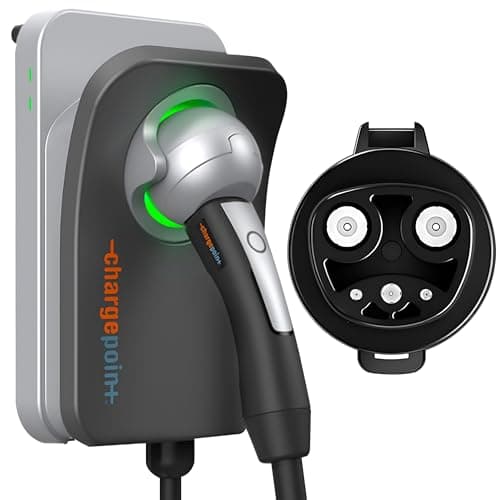
- ChargePoint Home Flex NACS - best established brand. Selectable from 16 to 50 amps and tied to the largest public-charging app in North America. You pay for the maturity.
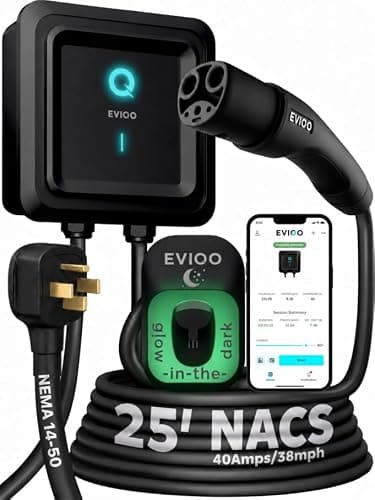
- EVIQO NACS 40A - best plug-in. The same certified hardware on a NEMA 14-50 plug, so there is no hardwiring and it moves house with you.
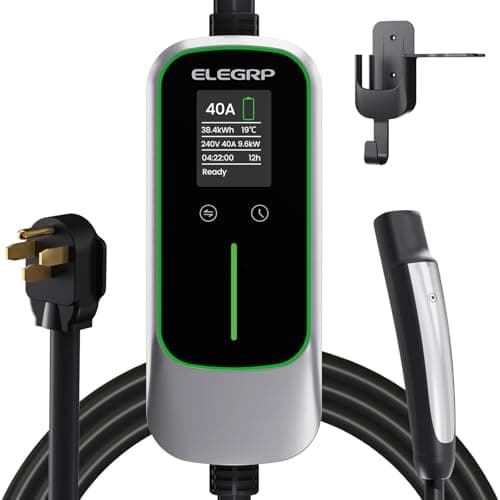
- ELEGRP NACS 40A - the budget pick. 40 amps, a listed certification and a 25-foot cable, with the app left out to hit the price.
First, check that your car actually has a NACS port
This is the step people skip. Every Tesla sold in North America uses NACS, but the rest of the market is mid-transition, and whether a given car has a native NACS port depends on the model and the model year, not the badge. The 2025 Hyundai Ioniq 5 was the first non-Tesla sold with a factory NACS port; Kia, Lucid, BMW and GM models have followed on their own schedules, and plenty of 2025 and 2026 cars from those same brands still ship with the old CCS and J1772 arrangement. Go and look at your charge port before you buy anything - our how to tell if your EV has NACS or J1772 guide shows the physical difference in about thirty seconds.
If your car has a J1772 port, stop here: a NACS charger is the wrong shape for it, and everything on this page would need an adapter to work in your driveway. The main Level 2 roundup is where you want to be.
NACS charger, or a J1772 charger plus an adapter?
Both work. The honest comparison comes down to what your household looks like:
- All your cars are NACS. Buy the native NACS charger. No dongle to lose, no adapter hanging off the handle taking the weight of the cable, and one fewer connection in the path of 40-odd amps for hours at a time.
- Mixed driveway - one NACS car, one J1772. This is the case that argues for a plain J1772 charger. A J1772 charger reaches a NACS car with a small J1772-to-NACS adapter, and those adapters are cheap and widely listed. Going the other way - a NACS charger reaching a J1772 car - needs a NACS-to-J1772 adapter, which is the more expensive of the two and is not included with any charger here.
- You are buying now, replacing the car later. The adapter route is the flexible one, because a J1772 charger plus a $30 adapter covers both worlds. Our future-proofing guide works through that decision in full.
There is one more reason this page exists: Tesla's own Wall Connector and Universal Wall Connector have been intermittently unavailable through Amazon, so "just buy the Tesla one" is not the reliable answer it used to be. Everything ranked here is a third-party unit that was live and in stock when we published.
What the plug does not change
A NACS connector is a shape, not a speed. It does not make your car charge faster, and it does not change any of the electrical work behind the wall. The three numbers that actually set your overnight charge are exactly the same as they are for a J1772 unit:
- Your car's onboard charger. A Tesla Long Range or Performance accepts up to 48 amps; several trims cap near 32. A car that stops at 32 amps gets nothing from a 48-amp charger.
- Your circuit. EV charging is a continuous load, so the breaker is sized at 125 percent of the draw: 40 amps needs a 50-amp circuit, 48 amps needs a 60-amp one. Our wire and breaker size guide has the arithmetic.
- How you install it. Plug-in units are capped at 40 amps by the NEMA 14-50 outlet they use; 48 amps means hardwiring. That trade is the same one covered in hardwired vs plug-in.
Do not buy a NACS charger to make a J1772 car "future-proof." If you replace that car in three years with a NACS one, an adapter bridges the gap in the meantime for a fraction of what you would lose using the wrong plug daily until then. Buy for the car in the driveway, and let the adapter cover the transition.
The picks, in order
Below the summary table each charger gets a full card with its score breakdown, pros and cons and a "don't buy this if" note. In short: the EVIQO 48A is the best combination of speed, certification and price; the Emporia is the one for people who want the data; the ChargePoint buys brand maturity and an app that follows you onto the road; the EVIQO 40A is the one you can unplug; and the ELEGRP is the cheapest certified way to get the connector on your wall.
How to choose a NACS home charger
Once the connector is settled, a NACS charger is bought on the same four things as any other Level 2 unit - in this order.
1. Hardwired or plug-in
This decides more than the brand does. A hardwired unit can run the full 48 amps and looks like part of the house, but it needs an electrician and a 60-amp circuit, and it stays behind when you move. A plug-in unit lives on a NEMA 14-50 outlet, tops out at 40 amps, and comes off the wall with you. If you rent, or you expect to move inside a few years, the plug-in EVIQO is the sane choice even though it is slower on paper. If this is your forever house and your car takes 48 amps, hardwire it.
2. The amperage your car and panel can actually use
Buying 48 amps for a car that accepts 32 is money spent on nothing, and so is buying 48 amps for a panel with no room for a 60-amp circuit. Work out the smaller of the two ceilings and buy to it - our what amperage do I need guide walks through both. An adjustable unit like the ChargePoint helps here, because you can set it to what the panel can carry today and raise it later.
3. The safety listing
Native-NACS chargers are a newer category, and the field includes plenty of listings with no named certification at all. A UL or ETL mark means an independent lab tested the unit to the EVSE standards - UL 2594 for the charger, UL 2251 for the coupler. Every pick on this page names one; a NACS box that does not is not worth the saving on a device that pulls 40 amps through a plastic handle every night. The same argument runs in are cheap EV chargers safe.
4. Cable, weather rating and the app
A 24- or 25-foot cable reaches around a two-car garage and lets you park either way; a shorter one assumes the charge port lands near the wall. If the unit lives outside, look for a real enclosure rating - IP66 or IP67 and a NEMA 4 rating, the distinction our best outdoor chargers page explains. The app is last on this list deliberately: it earns its keep on a time-of-use electricity plan and is close to irrelevant on a flat rate.
So, which one?
Buy the EVIQO NACS 48A if you are hardwiring and want the most charger for the money. Buy the Emporia NACS if you want to watch what every charge costs. Buy the ChargePoint Home Flex NACS if a long-established brand and one app for home and public charging is worth the premium. Buy the EVIQO NACS 40A if you want to avoid an electrician or you might move. And buy the ELEGRP if the connector is all you need and the software is not. If your driveway is mixed, buy a J1772 charger from the main roundup and an adapter instead - that is the cheaper, more flexible answer, and we would rather you spent less.