HUB 03 · Charging Guides
EV Charger Wire and Breaker Size
The 125-percent rule that decides your circuit, a plain sizing table for common charger amperages, and why the wire is the one place never to cut corners.
We earn a commission when you buy through our Amazon links, at no extra cost to you. It never affects our rankings, and we say so when the cheaper product is the better buy. How this works.
EV charging is a continuous load - hours of steady current - so the National Electrical Code requires the circuit to be sized to 125 percentof the charger's maximum draw. That one rule sets your breaker and wire size. Below is the reasoning, a sizing table for common chargers, and the honest caveat that final sizing is your electrician's call, not a table's.
This is a planning aid, not a wiring spec. Actual wire size also depends on wire type, insulation temperature rating, distance, ambient temperature and how conductors are bundled. A licensed electrician sizes the real circuit to NEC and your local code. Never guess with 240-volt wiring.
The rule: 125 percent for continuous loads
Because a car can pull its full charging current for many hours, the NEC treats EVSE as a continuous load and requires the branch circuit (breaker and conductors) to be rated at least 125 percent of the charger's output current. Turn that around and it means a charger may only draw up to 80 percent of its breaker - which is exactly why a 40-amp charger needs a 50-amp circuit.
Common charger sizing at a glance
Typical minimums for 240-volt copper on a dedicated circuit:
- 16A charger -> 20A breaker, ~12 AWG copper (~3.8 kW)
- 24A charger -> 30A breaker, ~10 AWG copper (~5.8 kW)
- 32A charger -> 40A breaker, ~8 AWG copper (~7.7 kW)
- 40A charger -> 50A breaker, ~6 AWG copper (~9.6 kW) - the common NEMA 14-50 plug-in setup
- 48A charger -> 60A breaker, ~6 or 4 AWG copper (~11.5 kW) - hardwired only
Aluminum conductors, long runs and hot attics can push these one gauge heavier - another reason the final call is an electrician's. A plug-in unit also depends on a properly rated NEMA 14-50 outlet, itself a common failure point when a cheap receptacle is used.
Plug-in vs hardwired changes the ceiling
A plug-in charger on a NEMA 14-50 is limited to 40 amps (on a 50-amp circuit) because that is the outlet's continuous rating. To run the full 48 amps you must hardwire onto a 60-amp circuit - there is no 48-amp plug. See hardwired vs plug-in and, for the amperage decision itself, 32 amps vs 48 amps.
Why undersizing is the cardinal sin
Wire that is too small for its continuous current heats up. Over hours of nightly charging that heat degrades insulation and terminations and can start a fire. This is precisely why the 125 percent rule exists and why "it worked when I tested it for five minutes" is not proof of safety. If you take one thing from this page: size the circuit for the continuous load, and let a licensed electrician confirm it. An adjustable charger like the Emporia lets you match the draw to whatever circuit you safely install - and the Level 2 home chargers we rank lists the breaker each pick needs at full output.
The gear
Recommended gear for this guide
The products this guide refers to, with prices pulled live from Amazon and dated on each card.
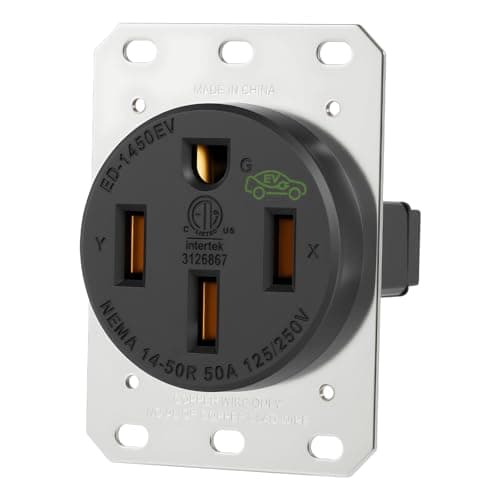
The outlet a plug-in charger needs
Industrial NEMA 14-50 Outlet
The receptacle a plug-in charger actually plugs into — buy the industrial-grade, listed version, because the cheap ones are the exact part that fails.
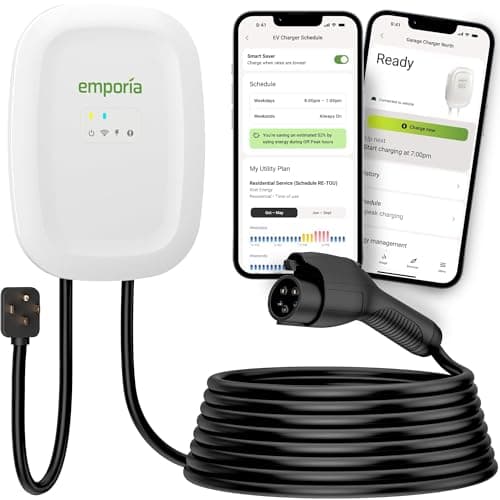
Most homes that want speed and smarts
Emporia Level 2 (48A)
The charger that refuses to charge you extra for being smart: full 48-amp speed and real energy monitoring at roughly the price of a plain plug-in box.
#ad · As an Amazon Associate we earn from qualifying purchases.
Questions
Frequently asked
What size breaker does a 40-amp EV charger need?
A 50-amp breaker. The NEC's 125 percent continuous-load rule means a 40-amp charger draws up to 80 percent of its circuit, so it needs a 50-amp circuit - commonly a NEMA 14-50 plug-in setup with ~6 AWG copper.
What wire gauge do I need for a 48-amp EV charger?
A 48-amp charger needs a 60-amp circuit, typically ~6 or 4 AWG copper depending on wire type and run length, and must be hardwired. Aluminum or a long run can require a heavier gauge - your electrician sizes it to code.
Can I use the same wire for any EV charger?
No - wire must match the circuit amperage. Using 8 AWG (good for ~40A) on a 60-amp circuit is dangerous. Size the conductors and breaker to the charger's continuous draw at 125 percent, and have it inspected.
Keep reading
Related
- EV Charger on a 200-Amp PanelThe common case: when 200 amps is plenty, and the loads that make it tight.
- NEMA 14-50 outlet guideThe receptacle a 40-amp plug-in charger needs.
- 32-amp vs 48-ampWhich amperage - and circuit - to choose.
- Do I need a panel upgrade?Whether your service can carry the circuit.
- 60-amp vs 50-amp circuitThe wire and breaker each charging speed needs.
- Copper vs aluminum wireWhy aluminum has to be upsized for the same circuit.
- Do I need a subpanel?When a full or distant panel calls for one.
More in this section
More Charging Guides
Receipts
Sources
We do not run a testing lab, and we do not pretend to. Where a measured number came from someone else's lab, we name them and link them. Where we could not verify something, we say so on the page rather than quietly leaving it out. Read our full method.