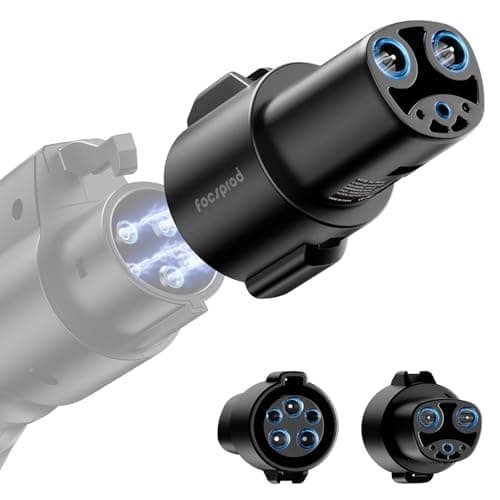
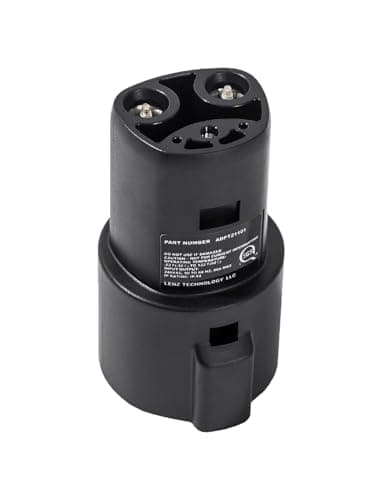
Buy the LENZ if you want the adapter with the strongest safety case in this pair - a UL 2251 listing, a solid build, and a price that still lands at the bottom of the band. Buy the FOCSPROD if you want an even cheaper option that is also UL listed, to UL 2252, the standard written specifically for EV charging adapters. Both are passive J1772-to-NACS adapters that let a Tesla or a 2025-and-later NACS-port car draw AC power from the enormous J1772 network - and both are AC only, so neither one is a Supercharging shortcut.
These two point the same direction: your car has a Tesla-style NACS port, the charger has a J1772 plug, and the adapter lets you tap the huge installed base of J1772 Level 1 and Level 2 stations. If you are not sure your car actually has a NACS port, check how to tell if your EV has NACS or J1772 first, then see the wider field in J1772-to-NACS adapters and the primer in do I need an adapter to charge my EV. We compile published specs and do the arithmetic rather than bench-testing either unit.
Compatibility
A tie in practice. Each is a J1772-to-NACS adapter that lets a Tesla or a 2025-and-later NACS-port car - the direction Ford, GM, Rivian, and Hyundai and Kia are moving - charge from a J1772 station for AC Level 1 or Level 2. That matters because the J1772 network is enormous next to the number of NACS-plug Level 2 chargers in the field: workplaces, apartment garages, shopping-center chargers and older home units are overwhelmingly J1772, so a small adapter roughly multiplies where a Tesla or NACS-port car can plug in overnight. Both are rated to 80 amps, well above any home or public AC circuit, so current is never the bottleneck and your car's onboard charger sets the real speed. And both are AC only: they do not enable DC Supercharging. That last point matters less on this side of the connector, because a Tesla or native-NACS car already Superchargers directly without any adapter; a CCS car is the one that needs a Magic Dock site or an automaker-approved DC adapter, as explained in do NACS adapters work at Superchargers and connector types explained.
Safety listing
This is the one section where they genuinely differ, and it is worth understanding rather than treating either label as a magic word. The LENZ is listed to UL 2251- UL's standard for plugs, receptacles and couplers for electric vehicles, the long-standing listing that governs the physical mating parts carrying the current. The FOCSPROD is listed to UL 2252 - a newer UL standard aimed specifically at EV charging-system adapters, i.e. written directly for this use case rather than for connectors in general. Both are legitimate UL safety listings from the same lab and both are applicable to this kind of hardware. The honest headline is that both are UL listed, which is the thing that actually matters against the many unlisted adapters on the market. In our research-based scoring the LENZ edges ahead on the safety axis, but a listed adapter of either standard is the right call - just confirm the listing is printed on the exact unit you receive, and never use a passive AC adapter for DC fast charging.
Build quality
The LENZ has the small edge. It scores a touch higher on build in our rubric and is inexpensive and pocketable - the only real caveat is that it is small enough to misplace, so keep it clipped in the frunk. The FOCSPROD is the value brand: it does the same job and clears the same kind of safety bar, but inspect it for a snug, rattle-free fit before you rely on it, since a loose seat is what warms up under a continuous load on any adapter. Neither is poorly made; the LENZ is simply the more confident pick if build is your tiebreaker.
Value
Both are cheap, and this is the surprise: the LENZ tends to win on value as well as safety in our scoring, landing at the bottom of the price band while carrying the stronger listing. The FOCSPROD is the also-UL-listed alternative - reach for it when it is the cheaper of the two on the day and you are comfortable with a UL 2252 listing rather than UL 2251. Neither is a wallet decision that should override the safety listing; happily, here the value pick and the safety pick are the same unit.
The verdict
The LENZ is the default of the two - UL 2251, a slightly better build, and the stronger value score - and the FOCSPROD is a fully legitimate, also-UL-listed alternative on UL 2252 when price decides it. Both open the J1772 network to a Tesla or NACS-port car for AC charging, and neither one Superchargers. Confirm your car truly has a NACS port before you buy with how to tell if your EV has NACS or J1772. And if your car is a J1772 model that needs to use Tesla-style chargers - the opposite direction - compare those adapters in Lectron vs EVDANCE.
How to choose between them
What UL 2251 and UL 2252 actually mean
Do not read one as pass and the other as fail - both are real UL listings. UL 2251 is the established standard for plugs, receptacles and couplers used in EV charging, so a UL 2251 adapter is certified on the connector-safety standard that has governed these parts for years. UL 2252 is a newer standard aimed specifically at EV charging-system adapters, so a UL 2252 adapter is certified under a standard written directly for the adapter use case. The LENZ carries the former, the FOCSPROD the latter. The practical takeaway is that both went through UL rather than skipping certification entirely, which is the real dividing line on this crowded market - and you should still verify the printed listing on the unit you actually receive. The market is full of adapters with no listing at all, or with vague marketing claims of being "UL compliant" that name no standard and carry no mark; those are the ones to avoid, because an adapter sits in the current path and a poor connection there is exactly what overheats. Between a genuinely UL 2251 unit and a genuinely UL 2252 unit, either is a defensible buy; the choice below that bar is what should worry you, not the choice between these two.
Do you even need a J1772-to-NACS adapter?
Only if your car has a NACS (Tesla-style) port and you want to use the far larger J1772 network of home, workplace and public Level 2 chargers. A Tesla, or a 2025-and-later NACS-port EV, is exactly that case. If your car uses a J1772 port, you need the opposite direction instead - a NACS-to-J1772 adapter, compared in Lectron vs EVDANCE. Confirm which port you have with how to tell if your EV has NACS or J1772 before buying either.
What neither adapter does
Neither is a DC device. Both are AC-only, so they never turn a Tesla Supercharger into a fill-up for a car that is not already NACS-native - and a Tesla or NACS car does not need an adapter to Supercharge in the first place. Do not carry one of these hoping it doubles as a road-trip DC solution; the DC answer is a Magic Dock Supercharger or an automaker-approved, DC-rated adapter, as laid out in do NACS adapters work at Superchargers.