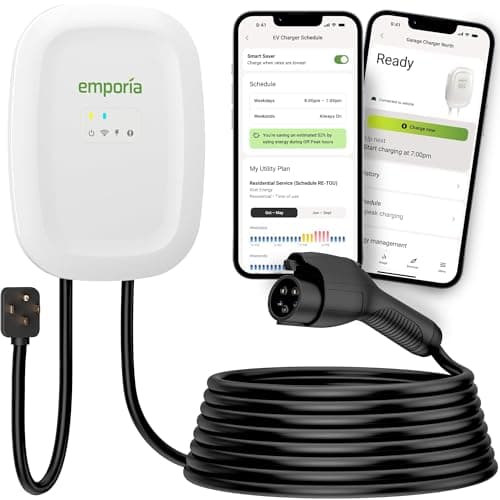
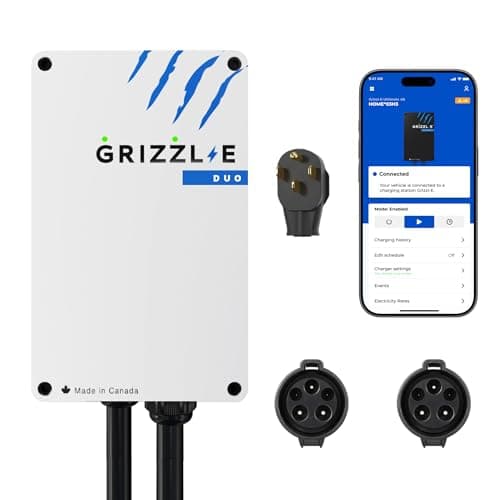
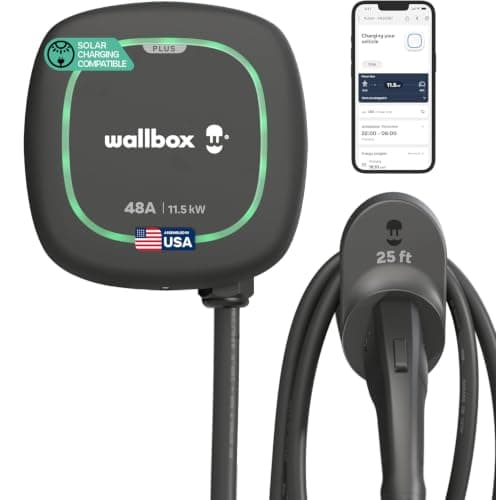
Buy the Wallbox Pulsar Plus at 48 amps and hardwire it. Volvo and Polestar EVs accept roughly 11 kW of AC - the EX90's 11 kW onboard charger sets the family ceiling - so 48 amps at 240 volts (11.5 kW) is the amp class that delivers the car's full rate. The Pulsar Plus is the pick because it does that from the smallest box on this page, which matters in the compact garages these cars actually live in. If you want metering and the option of a reversible plug-in install, the Emporia Level 2. If the car parks outdoors, the Grizzl-E Ultimate in cast aluminum. If there are two EVs and one circuit, the Grizzl-E Duo.
Two of those four show no price below, and we would rather say so than paper over it: the Grizzl-E Ultimate's J1772 version has no buyable Amazon listing at our last price check, and the Emporia Level 2 came back image-only with no buyable offer. Both are still ranked on build and specification, and their cards fall back to a search link rather than to a number we cannot verify.
There is one fact on this page you will not find on most Volvo charger articles, and it comes straight from Volvo: the NACS adapter Volvo supplies is for DC fast charging only.Volvo's own support page states it is not compatible with Level 1 or Level 2 AC charging, including Tesla Destination Chargers and home chargers with NACS connectors. That single sentence eliminates an entire category of purchase - if you own a Volvo or a Polestar, do not buy a native-NACS wall unit and expect the supplied adapter to bridge it.
Why the adapter rule exists
It is not a Volvo quirk. On a CCS1 charge port, AC and DC arrive on different pins: the J1772 part of the inlet carries the AC pair plus the control pilot and proximity signalling, and the two big DC pins below it are separate. A DC fast-charging adapter bridges the DC path only, so it physically cannot carry an AC session. GM's NACS-to-CCS adapter has the same limitation for the same reason.
The practical consequence for your garage is simple and worth stating plainly:
- Your home charger should be J1772. Every pick on this page is.
- If you want to use a Tesla-style AC charger- a Destination Charger at a hotel, a friend's Wall Connector - you need a proper AC NACS-to-J1772 adapter, which is a different device from the DC adapter in your trunk, listed to UL 2252 and rated for continuous AC current.
- Check which you have before a trip. Our NACS adapter compatibility by brand page tracks who ships what, and do NACS adapters work at Superchargers covers the DC side.
The amp class, settled
| Charger size | Power at 240V | What a Volvo or Polestar draws | Circuit required |
|---|
| 32 amps | 7.7 kW | 7.7 kW - roughly 3 kW short | 40-amp breaker |
| 40 amps | 9.6 kW | 9.6 kW - about 1.4 kW short | 50-amp breaker |
| 48 amps | 11.5 kW | The full ~11 kW | 60-amp breaker, hardwired only |
The code rule behind the third column is NEC Article 625 treating EV charging as a continuous load, so the circuit is sized at 125 percent of the charger's rating. A 48-amp charger therefore wants 60 amps of panel capacity, and there is no 48-amp plug - it is a hardwired install by definition. If the load calculation says no, 40 amps costs you about five miles of range an hour and nothing else; see 40 amps vs 48 amps.
The two-EV Scandinavian garage
This family produces more two-EV households than most, because the cars share a platform and people buy the second one from the same brand. That is the situation the Grizzl-E Duo exists for: two J1772 cables from one unit on one NEMA 14-50 plug, sharing 40 amps - 20 amps to each car when both are plugged in. It is slower per car than two dedicated circuits and dramatically cheaper than installing them.
The alternative is load management rather than a dual-port box: two chargers on one circuit that coordinate their draw. Our best dual-port chargers ranks the one-box approach, load-balancing chargers ranks the coordinating approach, and two EV chargers in one garage explains which situation calls for which.
How the four compare
| Charger | Max amps | Install | Cable | Best suited to |
|---|
| Wallbox Pulsar Plus (48A) | 48A | Hardwired | 25 ft | The full rate from the smallest wall box |
| Emporia Level 2 | 48A hardwired / 40A plug-in | Either | 25 ft | Metering, and a reversible install if you want one |
| Grizzl-E Ultimate | 48A, adjustable 16-48A | Hardwired | 25 ft | Outdoors, in cast aluminum rated IP67 |
| Grizzl-E Duo | 40A total, 20A per car when both charge | Plug-in (NEMA 14-50) | Two 25 ft cables | Two EVs, one circuit |
Published manufacturer figures, cited in Sources. All four are J1772 and all four carry a safety listing to UL 2594 - the floor for a continuous 40-to-48-amp load in an attached garage.
If newer models in your driveway have a native NACS inlet rather than J1772, the amp answer above does not change but the connector does. Read how to tell if your EV has NACS or J1772 first, then buy to match - our NACS home charger roundup covers that side.