HUB 03 · Charging Guides
Should I Upgrade to a 48-Amp EV Charger?
You already charge at home and wonder if faster is better. Here is the honest test for whether a 48-amp upgrade pays off - or wastes money on speed you will never use.
We earn a commission when you buy through our Amazon links, at no extra cost to you. It never affects our rankings, and we say so when the cheaper product is the better buy. How this works.
For most owners already charging on a 32- or 40-amp unit, upgrading to 48 amps is not worth it - the slower charger already refills a full day's driving overnight, and the upgrade means a new 60-amp circuit and possibly a panel upgrade. It pays off in a narrow set of cases: a big battery, a genuinely short nightly charging window, or a car that accepts the full 11.5 kW and a panel that can take the circuit. Here is how to tell which camp you are in.
First, do the honest need test
The question is not "is faster better" - it is "do I ever run out of charging time?" Ask yourself:
- Do you routinely wake up to a car that did not finish charging?
- Do you drive enough daily to deplete a large chunk of the battery most nights?
- Do you have a short window - say, a cheap off-peak block of only a few hours - to fit it all in?
If you answered no to all three, your current charger is fine, and 48 amps buys speed you will not use. A 40-amp charger adds ~30 miles per hour; plugged in overnight, that is hundreds of miles - far more than a normal day. Confirm with how fast will my EV charge.
Two things that can make the upgrade pointless
- Your car's onboard charger. If it caps at 32 amps (7.7 kW) or 40 amps, a 48-amp charger simply delivers less than 48 - the extra capability is wasted. Check your vehicle's spec first.
- Your panel. A 48-amp charger needs a 60-amp circuit and a hardwire; on a tight or full panel that can force a costly panel upgrade. If the upgrade costs more than the time it saves is worth, skip it.
When the upgrade does pay off
Upgrade to 48 amps when all three line up: your car accepts 11.5 kW, your panel can take a 60-amp circuit without a major upgrade, and you genuinely need range back fast - a 200 kWh truck, a two-car household sharing one charger, or a tight off-peak window. In those cases the best 48-amp chargers are worth it - the Emporia for value, the Grizzl-E Ultimate for a rugged outdoor install.
The low-risk middle path
If you are buying a new charger anyway, get an adjustable 48-amp-capable unit and run it at your current amperage. You pay a little now for headroom, and if you later upgrade the panel you dial the speed up in software - no second purchase. That beats buying a fixed 32-amp unit you might outgrow. The adjustable range of each unit is in the table at the top of our ranked Level 2 chargers.
The gear
Recommended gear for this guide
The products this guide refers to, with prices pulled live from Amazon and dated on each card.
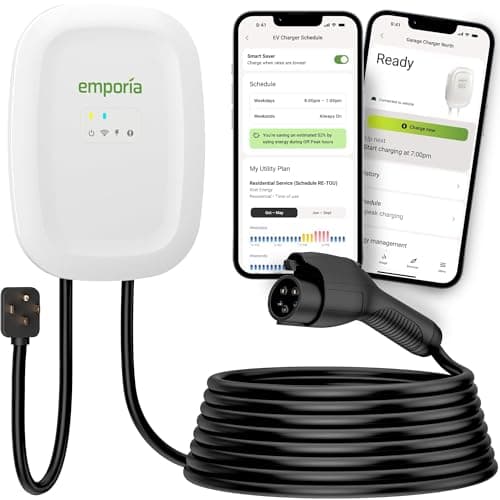
Most homes that want speed and smarts
Emporia Level 2 (48A)
The charger that refuses to charge you extra for being smart: full 48-amp speed and real energy monitoring at roughly the price of a plain plug-in box.
- Guide
A permanent, weatherproof 48A install
Grizzl-E Ultimate (48A)
A dedicated 48-amp charger in a cast-aluminum, IP67 shell - the toughest full-speed box here, built to be hardwired to a wall and left to work.
#ad · As an Amazon Associate we earn from qualifying purchases.
Questions
Frequently asked
Will a 48-amp charger charge my car faster?
Only if your car's onboard charger accepts more than your current charger delivers. If the car caps at 32 or 40 amps, a 48-amp unit charges at that cap - no faster. Check the car's spec before upgrading.
Do I need to rewire to go from 40 amps to 48 amps?
Usually yes - 40-amp charging often runs on a 50-amp plug-in circuit, while 48 amps needs a hardwired 60-amp circuit with heavier wire. That can also mean a panel check. It is a real electrical job, not a swap.
Is 48 amps overkill for a daily driver?
For most daily drivers, yes. A 32- or 40-amp charger refills a normal day's driving several times over during an overnight charge. Reserve 48 amps for big batteries, short charging windows or shared chargers.
Keep reading
Related
More in this section
More Charging Guides
Receipts
Sources
We do not run a testing lab, and we do not pretend to. Where a measured number came from someone else's lab, we name them and link them. Where we could not verify something, we say so on the page rather than quietly leaving it out. Read our full method.