HUB 04 · Charging Costs
How Much Does It Cost to Charge an EV Per Month?
A single formula turns your miles into a monthly number. Here it is worked out for low, average and high mileage - with the calculator to run your own.
We earn a commission when you buy through our Amazon links, at no extra cost to you. It never affects our rankings, and we say so when the cheaper product is the better buy. How this works.
For most drivers, charging an EV at home costs somewhere between $25 and $90 a month - and where you land in that range comes down to three things: how far you drive, your electricity rate, and whether you charge off-peak. One simple formula ties them together, and once you have your own number the monthly cost stops being a mystery. Here it is, worked out.
The formula
Monthly cost is just miles times energy per mile times your rate, adjusted for charging losses:
Monthly cost ~= miles x 0.33 kWh/mi / 0.9 x rate ($/kWh)
The 0.33 kWh/mi is a typical EV efficiency; divide by 0.9 for the roughly 10% lost as heat during charging; the rate is what your utility charges.
Everything else in this guide is just that formula filled in with real numbers. The per-charge version and the assumptions behind 0.33 kWh/mi are in cost to charge at home.
Worked examples at the US average rate
Using the US average residential rate of about $0.16/kWh:
| Monthly miles | Energy at the wall | Monthly cost (~$0.16/kWh) |
|---|---|---|
| 500 (light) | ~185 kWh | about $30 |
| 1,000 (average) | ~370 kWh | about $59 |
| 1,500 (heavy) | ~555 kWh | about $89 |
The average US driver covers roughly 1,000 miles a month, so about $55-60 is the typical home-charging bill at average rates - to replace what would be well over $100 of gasoline. See the side-by-side in EV vs gas.
Your rate changes everything
Electricity prices range from around $0.11/kWh in the cheapest states to $0.30 or more in the most expensive. That alone moves the 1,000-mile bill from roughly $40 to over $110. This is why a flat national number is useless - the only figure that matters is yours. Run it below.
Run it for your car
Cost-to-charge calculator
Put in your electricity rate, your battery size and your car's efficiency. The math is the same one shown above, with a 10% charging loss included so the number is realistic.
- $8.09
- A 10% to 80% charge
- $11.56
- A full (empty to 100%) charge
- $0.05
- Cost per mile
- $5.08
- Cost per 100 miles
Estimate only. Actual cost depends on your exact utility rate (including any time-of-use pricing and fees), your car's real efficiency, temperature, and charging losses. Check your electric bill for your true rate.
Off-peak is the biggest lever
The single most effective way to cut the monthly bill is to charge during off-peak hours on a time-of-use plan, where overnight power can cost a fraction of the daytime rate. Shifting charging to those hours can cut the charging portion of your bill substantially - see off-peak & time-of-use charging. A smart charger like the Emporia automates the timing and shows your monthly kWh; even a rugged unit like the Grizzl-E Ultimate benefits if your car handles the scheduling.
What the monthly cost does not include
Two honest caveats. First, this is home charging - occasional public DC fast charging on a road trip costs more per kWh and would add to the month it happens. Second, it excludes the one-time cost of the charger and its installation, which is a setup cost, not a monthly one. For day-to-day home charging, the formula above is the whole story.
Bottom line: multiply your monthly miles by your rate through the formula, and you have your number - typically $25-90, usually near $55-60 for an average driver at average rates, and lower still if you charge overnight.
The gear
Recommended gear for this guide
The products this guide refers to, with prices pulled live from Amazon and dated on each card.
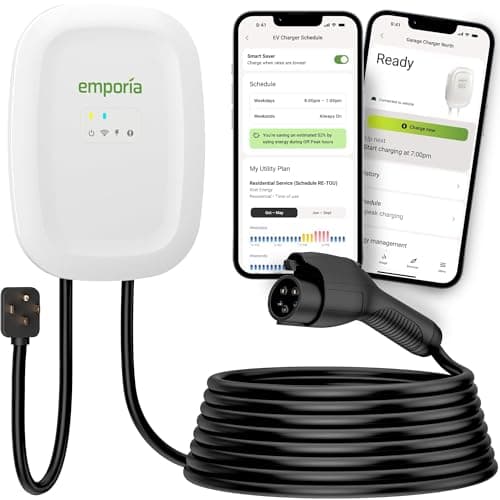
Most homes that want speed and smarts
Emporia Level 2 (48A)
The charger that refuses to charge you extra for being smart: full 48-amp speed and real energy monitoring at roughly the price of a plain plug-in box.
- Guide
A permanent, weatherproof 48A install
Grizzl-E Ultimate (48A)
A dedicated 48-amp charger in a cast-aluminum, IP67 shell - the toughest full-speed box here, built to be hardwired to a wall and left to work.
#ad · As an Amazon Associate we earn from qualifying purchases.
Questions
Frequently asked
How much does it cost to charge an EV per month?
For most drivers, about $25-90 a month at home, and near $55-60 for average mileage (about 1,000 miles) at the US average rate of $0.16/kWh. It scales with your miles and local rate, and drops further with off-peak charging.
Is it cheaper to charge an EV at home than buy gas?
Almost always, yes. Charging 1,000 miles of driving at home runs roughly $55-60 at average rates, versus well over $100 in gasoline for the same distance in a comparable car. The exact gap depends on your electricity rate and local fuel prices - see EV vs gas.
How can I lower my monthly EV charging cost?
Charge off-peak on a time-of-use plan, where overnight electricity can cost a fraction of the daytime rate - the biggest single lever. Home solar can cut it further. A smart charger automates the off-peak timing so you never miss the cheap window.
Keep reading
Related
- Winter EV Charging CostWhat the seasonal efficiency hit does to the bill, and why it is less than the range headline.
- Cost to charge at homeThe per-charge formula this builds on.
- Off-peak & time-of-use chargingThe biggest lever on the monthly bill.
- EV vs gasWhat the monthly cost replaces at the pump.
- EV charging cost by stateWhy the same car costs more to charge in one state than another.
- Cost to charge an EV per yearThe same math rolled up into an annual total to budget against.
More in this section
More Charging Costs
Receipts
Sources
- US EIA - average price of electricity (residential rates)
- US DOE / fueleconomy.gov - EV charging basics
- US DOE / fueleconomy.gov - EVs and cost of driving
- US DOE AFDC - charging at home
We do not run a testing lab, and we do not pretend to. Where a measured number came from someone else's lab, we name them and link them. Where we could not verify something, we say so on the page rather than quietly leaving it out. Read our full method.