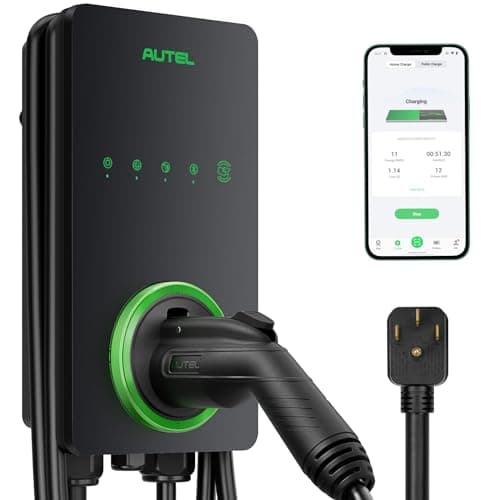
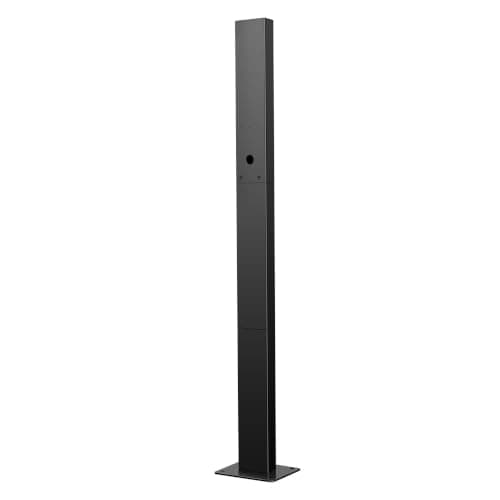
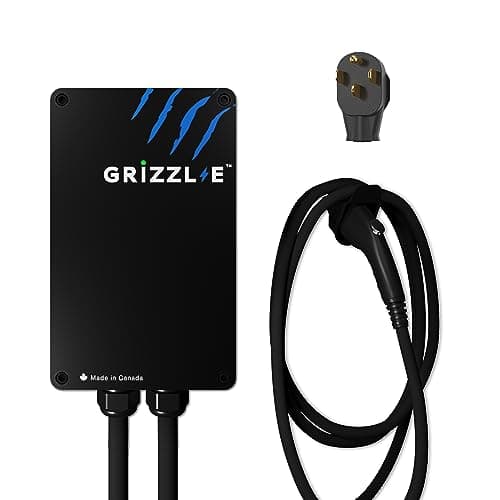
For most hosts, buy the Grizzl-E Classic. It is a sealed cast-aluminum box with no app, no account and no pairing step - a guest plugs in and it charges - it is UL certified, and because it lives on a NEMA 14-50 plug you can unplug and store it between seasons or swap it in ten minutes if a guest damages it. That combination is worth more in a rental than any feature on a spec sheet. If you need to know what each stay cost you in electricity, the Autel MaxiCharger reports per-session kilowatt-hours, cost, amperage and duration, and syncs over Bluetooth when the garage Wi-Fi is down - which in a rental it frequently is. If your guests may arrive in either a Tesla or anything else, the Tesla Universal Wall Connector carries both connectors in one unit. If it must survive outdoors unattended, the Grizzl-E Ultimate. And if the parking spot has no wall to mount anything on, a pedestal solves the problem the charger cannot.
Two of the five show no price below and we would rather say so: the Tesla Universal Wall Connector's Amazon availability is intermittent and the Grizzl-E Ultimate's J1772 version had no buyable listing at our last price check, so those cards fall back to a search link instead of a number we cannot verify.
Every other charger roundup assumes you are the person who will use it. This one does not, and that changes the ranking completely. The site's apartment charger roundup is written for a renter charging their own car; this page is for the owner on the other side of that transaction. Your reader is a stranger, in the dark, after a six-hour drive, and they will not read a sign.
The three things that actually matter
1. You do not know the connector
This is the problem that has no equivalent in a private garage. North America is mid-way through a connector transition: J1772 is the long-standing SAE AC connector, NACS was standardised as SAE J3400, and both are now on cars being driven to your property this month. A J1772 charger will not plug into a NACS inlet and the reverse is equally true.
There are exactly three honest ways to cover both:
- A dual-connector unit. The Tesla Universal Wall Connector carries a NACS connector with a built-in J1772 adapter, so either car plugs in with no accessory to lose. Cleanest, and the most expensive.
- A J1772 charger plus a tethered adapter. A NACS-to-J1772 adapter left on site covers a Tesla arriving at a J1772 charger - but an adapter in a rental is an item that walks off. Buy a listed one, and expect to replace it.
- A J1772 charger and a line in your listing.Most non-Tesla EVs carry their own adapter; many Teslas carry a J1772 adapter in the frunk. Saying "J1772 Level 2 charger on site - Tesla drivers should bring the adapter that came with the car" is honest, costs nothing, and prevents a one-star review. Our how to tell if your EV has NACS or J1772 page is the one to link.
2. Nobody will install an app
A smart charger is a good purchase for a household that will use it for five years. For a guest staying two nights it is a liability: an account to create, a network to join, and a pairing flow to fail in a garage with no signal. Every pick on this page delivers electricity the moment a car is plugged in, with no app, no account and no internet - and the two that have apps keep them on your side of the fence, for your metering, not for the guest's charging.
If you are tempted by access control so guests cannot charge for free, price that against what you would recover. At the US average electricity rate a full overnight on a 40-amp charger is a few dollars of power, and our cost to charge at home page shows the arithmetic. Most hosts conclude it is cheaper to meter and absorb it than to gate it.
3. You will not be there when it stops
Everything on this page is chosen for being boring. A charger in a rental should have no screen to confuse anyone, no firmware update that can brick it unattended, a cord long enough to reach however the guest parks, and an enclosure rated for where it actually hangs. When something does go wrong, the question is not "can it be repaired" - it is "can a handyman swap it on Tuesday". That argues for a plug-in unit on a NEMA 14-50 outlet rather than a hardwired one, which is the reverse of the advice we give homeowners.
How the five compare
| Pick | Connector | Install | App needed to charge? | Why it suits a rental |
|---|
| Grizzl-E Classic | J1772 | Plug-in (NEMA 14-50) | No app exists | Nothing to set up, nothing to update, swaps in minutes |
| Autel MaxiCharger (40A) | J1772 | Plug-in or hardwired | No | Per-session kWh, cost and duration, with Bluetooth sync when Wi-Fi drops |
| Tesla Universal Wall Connector | NACS plus built-in J1772 adapter | Hardwired | No | Covers whichever car turns up |
| Grizzl-E Ultimate | J1772 | Hardwired | No app exists | Cast aluminum, IP67 - the outdoor, nothing-to-unplug option |
| Universal pedestal | n/a - mounts the charger | Concrete anchored | n/a | A parking spot with no wall becomes a charging spot |
Published manufacturer specifications, cited in Sources. Every charger here carries a UL or ETL listing to UL 2594 - which on a rental is not just a safety question but an insurance one, because unlisted equipment and an unpermitted install are the two things most likely to turn a claim into an argument.
The install is where hosts get caught
Two details matter more on a property you rent out than on one you live in.
- Use a licensed electrician and pull the permit. Published insurance guidance is blunt that you may not be covered if a licensed electrician did not install the charging station, and a hard-wired unit is generally treated as part of the dwelling. Our does home insurance cover an EV charger guide goes through that properly, and permits and inspection covers the paperwork.
- Size the circuit for continuous duty.The NEC treats EV charging as a continuous load and sizes the circuit at 125 percent of the charger's rating, so a 40-amp unit wants a 50-amp circuit. A guest will charge for ten hours straight without thinking about it; do EV chargers need their own circuit is the short answer, and installation cost is the long one.
One more thing worth knowing before you commit: 40 amps is the right target for a rental, not 48. A 40-amp charger adds roughly 30 miles of range an hour, which is more than any guest needs overnight, and it keeps the plug-in install that makes the unit replaceable. Read 40 amps vs 48 amps if you want the comparison, and chargers under $500 if the budget per door is the constraint.