HUB 04 · Charging Costs
How Much Does It Cost to Charge an EV Per Year?
Your yearly charging cost is three numbers multiplied together - how far you drive, how efficient your EV is, and your electricity rate. Here is the formula, and a calculator that fills in your rate.
We earn a commission when you buy through our Amazon links, at no extra cost to you. It never affects our rankings, and we say so when the cheaper product is the better buy. How this works.
The yearly cost of charging an EV is not one number - it is three numbers multiplied together: how far you drive in a year, how many miles your car travels on a kilowatt-hour, and what you pay for electricity. Change any one and the total moves. The reason so many "cost per year" articles land on wildly different figures is that they quietly assume a rate and a mileage for you. This page does the opposite: it shows the formula, gives you the energy your car will use in a year, and then hands you a calculator so you supply the one number nobody else can - your own rate.
The formula
Annual charging cost is just the energy your car uses in a year multiplied by what that energy costs. Written out:
Annual cost = (annual miles / efficiency in mi/kWh) / 0.90 x your rate per kWh
The annual miles divided by efficiency gives the kilowatt-hours that actually reach the battery; dividing by 0.90 adds the roughly 10 percent charging loss (energy that leaves the wall as heat and never becomes range); multiplying by your rate turns kilowatt-hours into money.
That 0.90 is not a rounding flourish. About a tenth of the electricity your meter records is lost in the cable and in the car's onboard charger before it reaches the cells, so a calculation that skips it comes out roughly 10 percent too low. We keep it in the table below and in the calculator.
The three levers, one at a time
Annual miles. This is the biggest lever most people control. A common yardstick is around 12,000 miles a year, but a short-commute household might do half that and a long-distance commuter double it. Use your own odometer or a recent service record rather than a national average - the annual figure scales almost linearly with the miles you drive.
Efficiency.How far your EV goes on a kilowatt-hour is the car's equivalent of miles per gallon, and it lives in a fairly narrow band. A heavier SUV or truck sits closer to 3.0 miles per kWh; a small, aerodynamic sedan can reach 4.0 or better; most cars fall somewhere in between, which is why 3 to 4 mi/kWh is the honest assumption to build a table around. Winter, high speeds, and hills all pull the real figure down.
Your rate.This is the number we refuse to invent, because residential electricity prices vary enormously by state, utility, and plan - the US Energy Information Administration (linked in Sources) tracks the range, and it spans a factor of three or more across the country. Whatever a generic article prints as "the average" is almost certainly not your rate, so read it straight off your bill instead.
Electricity used per year, before you apply your rate
Because only miles and efficiency decide how much energy your car pulls in a year, you can read that part off a grid with no assumption about price at all. Here is the electricity a full year of driving pulls from the wall - including the 10 percent loss - across three annual mileages and three efficiencies:
| Annual miles | 3.0 mi/kWh (thirsty SUV/truck) | 3.5 mi/kWh (typical) | 4.0 mi/kWh (efficient sedan) |
|---|---|---|---|
| 8,000 miles | ~2,960 kWh/yr | ~2,540 kWh/yr | ~2,220 kWh/yr |
| 12,000 miles | ~4,440 kWh/yr | ~3,810 kWh/yr | ~3,330 kWh/yr |
| 15,000 miles | ~5,560 kWh/yr | ~4,760 kWh/yr | ~4,170 kWh/yr |
To turn any cell into a yearly cost, multiply the kilowatt-hours by your electricity rate. We deliberately stop one step short of printing a dollar figure here, because your rate is the single number we cannot know for you - and, as the three levers show, it is the one that swings the answer most. Find your row, and the calculator below finishes the arithmetic.
Run it for your car
Cost-to-charge calculator
Put in your electricity rate, your battery size and your car's efficiency. The math is the same one shown above, with a 10% charging loss included so the number is realistic.
- $8.09
- A 10% to 80% charge
- $11.56
- A full (empty to 100%) charge
- $0.05
- Cost per mile
- $5.08
- Cost per 100 miles
Estimate only. Actual cost depends on your exact utility rate (including any time-of-use pricing and fees), your car's real efficiency, temperature, and charging losses. Check your electric bill for your true rate.
Why the rate is where the real variation lives
Notice what the table already tells you: for a typical car and a typical year, an EV uses a few thousand kilowatt-hours of electricity annually - a meaningful but not enormous addition to a home that already uses far more than that for everything else. What decides whether that translates into a modest annual bill or a steep one is almost entirely your local rate. That is why we point you at the EIA figures and, better still, your own utility bill, rather than quoting a single national number that would be wrong for most readers. For how much that rate swings depending on where you live, see EV charging cost by state.
Where a year fits against a month, a mile, and gas
The annual view is the one that answers "is this cheaper than what I drive now?", but it is the same arithmetic as our other cost pages seen over a different horizon. Divide the year by twelve and you have the monthly cost; divide the annual energy by annual miles and you have the cost per mile. For the per-charge breakdown and the full formula behind all of these, start at cost to charge at home. And when you want the number that actually persuades a skeptic - the yearly fuel saving against a gas car, with the gas side laid out the same honest way - that comparison lives in EV vs gas cost.
The one move that lowers the yearly bill
The energy your car needs each year is fixed by your miles and efficiency, so the only real lever on the cost - short of driving less - is the price you pay per kilowatt-hour. Many utilities offer time-of-use plans with a cheaper overnight window, and because an EV charges while you sleep, you can shift almost the entire annual load into that cheap window. A charger with built-in scheduling, like the Emporia below, does it automatically once you set it and forget it.
Scheduling, not hardware, is the saving. Every Level 2 charger delivers identical energy, so no unit is cheaper to run than another at the same rate. What a scheduling charger buys you is a lower effective rate on that annual total - see off-peak and time-of-use charging for whether it pays off for your plan.
We compile published guidance and do the arithmetic in the open; we do not bench-test cars or meter your house, so the calculator's output is only as good as the rate and efficiency you feed it. Read the rate off your bill, use your own annual mileage, and the yearly figure it returns will be close to what you actually pay.
The gear
Recommended gear for this guide
The products this guide refers to, with prices pulled live from Amazon and dated on each card.
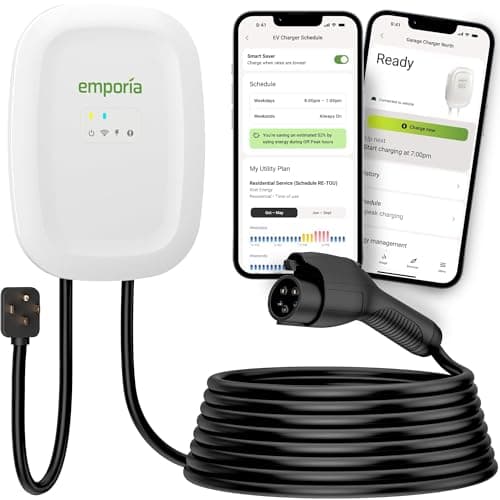
Most homes that want speed and smarts
Emporia Level 2 (48A)
The charger that refuses to charge you extra for being smart: full 48-amp speed and real energy monitoring at roughly the price of a plain plug-in box.
#ad · As an Amazon Associate we earn from qualifying purchases.
Questions
Frequently asked
How much does it cost to charge an EV per year?
It depends on three things: your annual miles, your car's efficiency in miles per kWh, and your electricity rate. For a typical car and a typical year of driving, expect a few thousand kilowatt-hours of electricity annually; multiply that by your own rate to get the cost. Use the calculator above with your figures rather than trusting a single national number.
What is the formula for annual EV charging cost?
(annual miles / efficiency in mi/kWh) / 0.90 x your rate per kWh. The first part is the energy that reaches the battery, the 0.90 accounts for the roughly 10 percent charging loss, and your rate turns kilowatt-hours into money. Every term is one you can read off your own car and bill.
Why won't you just give me a yearly dollar figure?
Because the number that swings the total most - your electricity rate - varies by a factor of three or more across states, utilities, and plans, so any single figure would be wrong for most readers. We give you the energy your car uses in a year and let you apply your own rate in the calculator, which is the only way to get an answer that is actually yours.
Does a bigger battery cost more to charge per year?
No. Your yearly cost tracks the miles you drive, not the size of your battery. A bigger pack lets you charge less often, but the energy per mile - and therefore the annual total - is set by your efficiency and your rate, not by capacity.
Keep reading
Related
- Cost to charge at homeThe full per-charge formula and the calculator behind these figures.
- Cost to charge per monthThe same math over a monthly horizon.
- Cost to charge per mileThe per-mile version, the cleanest way to compare cars.
- EV charging cost by stateHow the rate half of the equation swings by where you live.
- EV vs gas costThe yearly fuel saving against a gas car, laid out the same way.
- Off-peak chargingThe one move that lowers the yearly bill.
More in this section
More Charging Costs
Receipts
Sources
- US EIA - electricity data (residential rates)
- US DOE / fueleconomy.gov - EVs and cost of driving
- US DOE AFDC - charging at home
We do not run a testing lab, and we do not pretend to. Where a measured number came from someone else's lab, we name them and link them. Where we could not verify something, we say so on the page rather than quietly leaving it out. Read our full method.