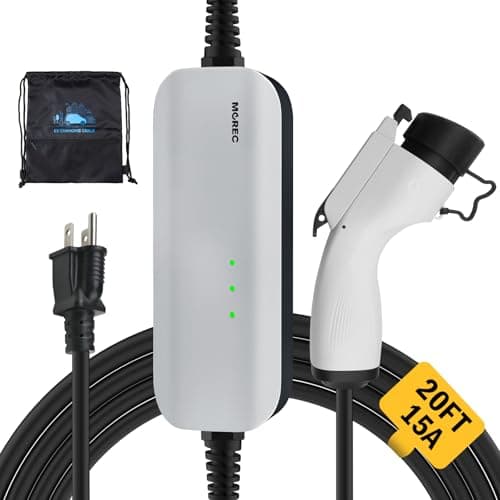
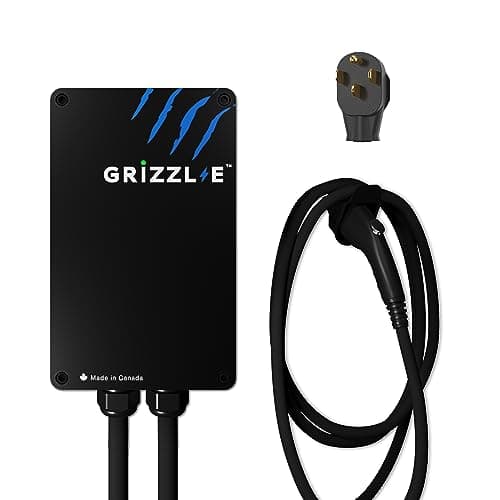
Buy a charger that can deliver 32 amps, and stop there. A plug-in hybrid's onboard charger is the ceiling, not the wall unit, and even the largest mainstream PHEV on sale is published at about 7 kW - roughly 29 amps at 240 volts. A 48-amp charger pours exactly the same energy into that car as a 32-amp one, on a circuit that costs considerably more to install. Our pick is the Grizzl-E Classic set to 32 amps on its internal dial: UL certified, cast aluminum, no app to go stale, and it will outlive the hybrid it was bought for. If your commute is short, read the Level 1 section before you spend anything at all - for a lot of PHEV owners the cord in the trunk is the whole answer.
Why a plug-in hybrid changes the arithmetic
Every other roundup on this site is written for a battery EV with a 60-to-100 kWh pack that wants all the amps it can get. A PHEV inverts both halves of that sentence. The battery is small, and the onboard charger that converts wall AC into DC for the pack is small with it - because the car was designed around a gas engine for the long trips, so a big, heavy, costly charger inside it would be dead weight.
Take the current upper bound of the class. Toyota's 2026 RAV4 Plug-In Hybrid is published with a 23 kWh battery, a 7.0 kW onboard charger, and a 3.5-hour charge time on 240 volts. That is the big one. Plenty of plug-in hybrids are built around 3.3 kW or 6.6 kW chargers instead, which are the common onboard-charger power levels across the industry. The US Department of Energy puts the whole class in the same bracket: recharging a PHEV on a 240-volt charger takes about 1 to 4 hours, against several hours on an ordinary household outlet.
Now compare that with what chargers are sold on. The headline numbers in this category are 40, 48 and even 80 amps. Here is what each one is worth to a car that tops out near 7 kW:
| Charger setting | Power at the wall | What a 7 kW PHEV can actually take | Refill a 23 kWh pack |
|---|
| 12A at 120V (Level 1) | 1.4 kW | All of it | About 16-18 hours |
| 16A at 240V | 3.8 kW | All of it | About 6-7 hours |
| 24A at 240V | 5.8 kW | All of it | About 4-4.5 hours |
| 32A at 240V | 7.7 kW | About 7 kW - the car is now the limit | About 3.5 hours |
| 40A at 240V | 9.6 kW | Still about 7 kW | About 3.5 hours |
| 48A at 240V | 11.5 kW | Still about 7 kW | About 3.5 hours |
The last three rows are the point of this page. Refill times assume about 10 percent charging loss and a pack taken from near-empty, and they land on Toyota's own published 3.5-hour figure at the 32-amp row, which is a good sign the arithmetic is honest. Above 32 amps the column stops moving, because the handshake in the charging cable only ever offers the car a maximum; under the SAE J1772 standard the control pilot signal tells the car how much current is available and the car draws what it can use and no more. Buying amps your car declines is the single most common way money gets wasted in this category.
How we ranked these
Criteria first, because a PHEV buyer is optimizing for something different from everyone else in the showroom:
- Can it reach 32 amps, and can it be set lower? 32 amps covers every PHEV onboard charger we can find a published figure for, with headroom. Adjustability matters more than the top number, because the charger has to match the circuit you can actually get.
- A real safety listing. UL or ETL to UL 2594, from an OSHA-recognized testing laboratory - and ETL is not the lesser mark, it is the same standard tested by Intertek instead of UL Solutions. This unit runs unattended, overnight, for years. It is the one criterion we will not trade away for price.
- The install it demands. A PHEV needs 7 kW. If you already have a dryer outlet or a spare 20-amp circuit, a charger that uses it beats a charger that requires a new 50-amp run and an inspection.
- Cable length you measured.Trivial to get wrong, expensive to fix. Measure from where the box will hang to where the car's port sits when parked.
- Scheduling, but only if it pays. A timer is worth real money on a time-of-use electricity rate and worth nothing on a flat one.
- Price against the cheapest honest option. On this page that benchmark is often a Level 1 cord, not another wall box.
First, the case for buying no Level 2 charger at all
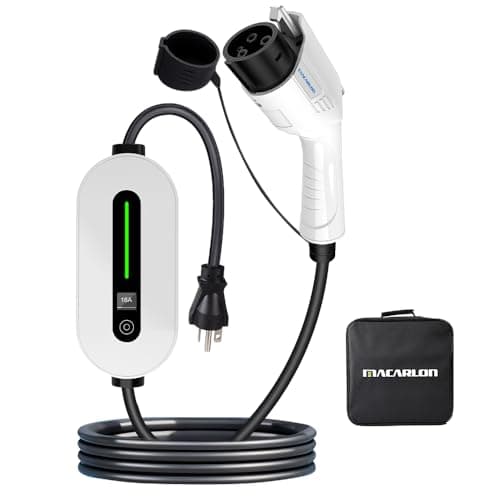
This is the section that other sites skip because nobody earns a commission on it. The DOE is blunt: many owners meet their daily driving range needs by charging overnight on Level 1 equipment, at no additional cost and with no installation, provided there is an outlet on a dedicated branch circuit near where they park. For a battery EV that claim is situational. For a plug-in hybrid it is usually just true.
Run it. Level 1 adds roughly 5 miles of range per hour. Plug in at 7pm, leave at 7am, and that is about 60 miles of electric range recovered overnight - more than the electric-only range of most plug-in hybrids on sale, which means you wake up full every day. And on the days you drive further, the engine does what it was built to do. There is no range anxiety to engineer around here, which is exactly why the hardware case is weaker than the marketing suggests.
So the honest sequence is: run the cordset that came with the car for a month, look at whether you ever started a morning short of charge, and buy hardware only if the answer is yes. If it is, the picks on this page are what to buy. Our best Level 1 chargers page ranks the 120-volt field, and what it costs to charge a PHEV at home has the running-cost math for both levels.
Where a Level 2 charger genuinely pays for a PHEV
Four situations, and they are specific rather than aspirational:
- You drive the electric range more than once a day. School run, then errands, then a commute. A PHEV that can refill in three hours instead of sixteen gets you a second and third electric trip out of the same day, and that is the strongest argument on this list.
- A narrow off-peak window. If your utility gives you cheap power from midnight to 5am, a 1.4 kW cordset cannot fit a full charge inside it and a 7 kW charger can. See off-peak charging.
- Cold winters. In a freeze, some of the energy you pull from the wall goes into warming the pack and the cabin rather than into range, so the slowest option gets slower exactly when you need it. Our winter charging guide covers what actually happens.
- A battery EV is next. If the PHEV is a stepping stone, buy the charger for the car after this one. That is the one case where paying for 40 or 48 amps today is rational - see best chargers for first-time EV owners.
The dryer-outlet route, which suits PHEVs better than anything else
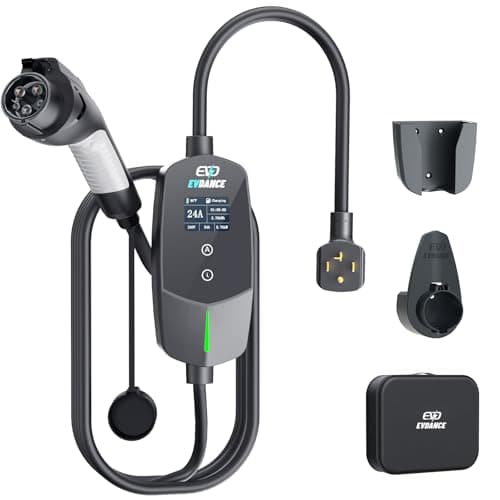
A four-prong NEMA 14-30 dryer receptacle sits on a 30-amp breaker, so EV charging on it is capped at 24 amps - 5.8 kW. For a battery EV that is a compromise. For a plug-in hybrid it is within a whisker of the fastest the car will ever accept, and it needs no new circuit, no trench, no permit and no electrician if the outlet is already where you park. This is the cheapest real Level 2 on this page, and for a PHEV it is close to free performance.
Two rules, both non-negotiable: never run the charger and the dryer at the same time, and never use a three-prong 10-30 outlet without understanding that it has no separate ground. Our best chargers for a 14-30 dryer outlet roundup covers the field, and can I use a dryer outlet for EV charging walks the checks.
What to skip, specifically
- 48 amps and above. It needs a 60-amp circuit, because the NEC treats EV charging as a continuous load and sizes circuits at 125 percent of the draw, and it is hardwire-only. Your PHEV will use about 60 percent of it. The 80-amp tier is further still from making sense here.
- Hardwiring, usually. A plug-in unit on an existing outlet can move house with you and be swapped in ten minutes if it fails. See hardwired vs plug-in.
- Subscriptions. No home charger in our registry needs one, so a monthly fee is a reason to buy something else.
- Solar surplus features, for now. The minimum current a J1772 charger can offer is about 6 amps, and surplus-matching hardware generally needs a separately sold panel monitor. It is a real feature, but it is a battery-EV feature. See solar-compatible chargers.
The short version
- Short commute, outlet where you park: run the Level 1 cord for a month first. It is free and it is often enough.
- Dryer outlet in the garage: a 24-amp 14-30 charger. Nearly full PHEV speed for no electrical work.
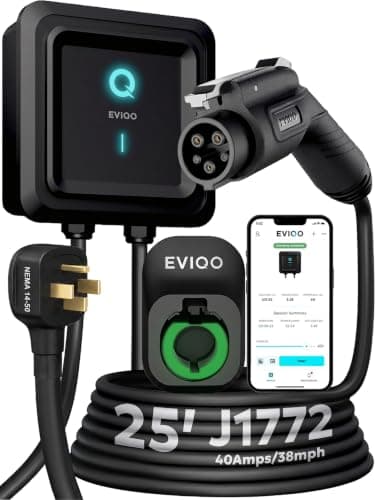
- New circuit going in anyway: a 40-amp-capable unit set to 32 amps, which is every amp your car can use and leaves headroom if the next car is electric.
- Never: 48 amps for a plug-in hybrid. There is no version of the arithmetic where the car can take it.
One brand gets its own page, because it sells the volume plug-in in this class and a battery EV alongside it: our best chargers for a Jeep 4xe works the same arithmetic against Jeep's published 7.2 kW charge rate, and explains why the Wagoneer S is the one Jeep that can use 48 amps.