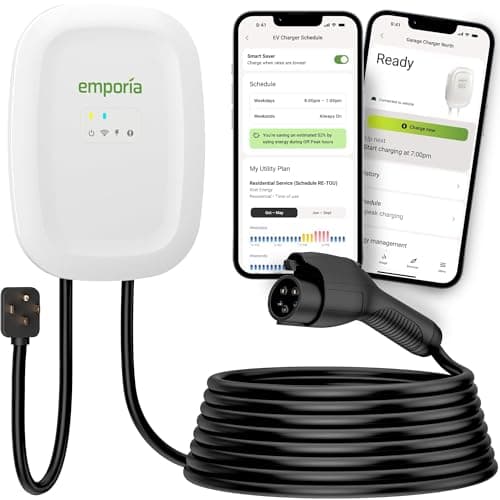
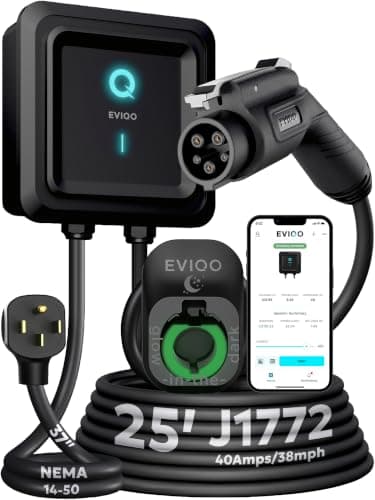
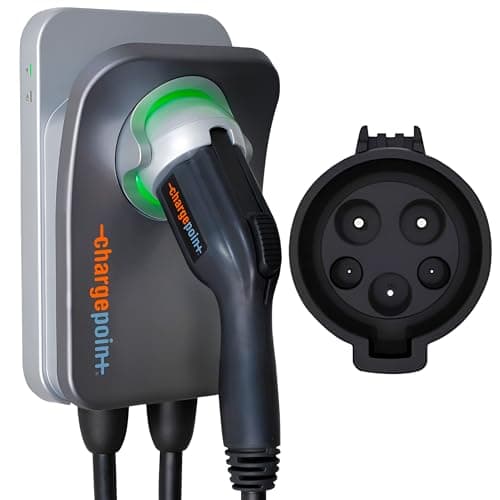
The best adjustable EV charger for most homes is the ChargePoint Home Flex. You set its output anywhere up to 50 amps in the app, so one unit fits whatever breaker you can install today and scales up if you upgrade the panel later - all inside the biggest public-charging app in North America. The Emporia is the value adjustable pick, dialing 6 to 48 amps with real energy monitoring at a plain-box price. The Grizzl-E Ultimate is the rugged 16-to-48-amp fixture in a weatherproof cast-aluminum shell, and the EVIQO is the certified budget unit that dials 6 to 40 amps.
Adjustable amperage is the single most useful feature for a home with a full or older electrical panel. A charger that lets you set its maximum current means you are not forced to pick a unit that exactly matches your breaker - you buy the capable charger and dial it down to whatever your panel can safely spare, then dial it back up if you ever upgrade. It future-proofs the purchase and it keeps a tight panel from ruling out a good charger. We compiled the published adjustment ranges and did the load arithmetic; we have not bench-tested these units, and we say so.
The four picks cover the full useful range. The ChargePoint reaches highest, to 50 amps. The Emporia and Grizzl-E Ultimate both top out at 48 amps but bottom out differently - the Emporia down to 6 amps, the Grizzl-E to 16. The EVIQO caps at 40 amps but still dials down to 6. Which one fits comes down to how much headroom your panel has and whether you value the app, the weatherproofing, or the price.
The short version
If you want one recommendation: buy the ChargePoint Home Flex - it has the widest useful top end and the most mature app. Beyond that:
- ChargePoint Home Flex - best adjustable overall. Set it up to 50 amps in the app, matching whatever breaker you install now and more later, inside a unified home-and-public app. It costs more than newer brands and leans hard on the ChargePoint account. Full ChargePoint Home Flex review.
- Emporia Level 2 - the value adjustable pick. Dials 6 to 48 amps hardwired (6 to 40 on the plug) with genuine energy monitoring at roughly a plain-box price. The full 48 amps needs a hardwired 60-amp circuit, and the app is central to setup. Full Emporia review.
- Grizzl-E Ultimate - the rugged adjustable fixture. Adjustable 16 to 48 amps in a cast-aluminum IP67 shell, so one unit matches a 40-amp or a 60-amp circuit. It is hardwired only, and the heavy cable stiffens in deep cold. Full Grizzl-E Ultimate review.
- EVIQO Level 2 - the certified budget adjustable. Dials 6 to 40 amps, double-listed UL and ETL with an IP66 rating, usually the cheapest here. Its 40-amp ceiling and newer brand are the trade-offs. Full EVIQO review.
Why adjustable amperage is worth having
Three reasons, and any one of them justifies choosing an adjustable unit over a fixed one:
- It fits a panel that cannot spare a big circuit. Many older homes have a 100-amp service already carrying a lot of load. An adjustable charger lets you install a smaller circuit - a 40-amp breaker feeding a charger dialed to 32 amps, say - instead of being forced into a panel upgrade before you can charge at all.
- It future-proofs the purchase. Buy the 48- or 50-amp-capable unit, run it dialed down today, and turn it up later if you upgrade the panel or add a subpanel. You are not buying a second charger when your electrical situation improves.
- It enables sharing and load management. Dialing a charger down is the manual version of what smart load-balancing chargers do automatically - keeping the EV circuit inside what the panel can carry alongside everything else running.
The dial-down math for a 100-amp panel
This is where adjustable earns its keep, and it is the reason the feature exists. EV charging is a continuous load, so the code sizes the circuit to 125 percentof the charger's current: a 40-amp charger needs a 50-amp breaker, a 48-amp charger needs a 60-amp breaker, and a 32-amp charger needs a 40-amp breaker. On a 100-amp service that is already running a central AC, an electric range and a dryer, there may not be room for a 60-amp - or even a 50-amp - EV circuit without tripping the main under an NEC load calculation. An adjustable charger lets your electrician run whatever circuit the panel can carry - often a 40-amp breaker with the charger dialed to 32 amps - and you still get a healthy 7.7 kW, roughly 25 miles of range an hour, without a costly service upgrade. Our 100-amp panel guide works the numbers, and our amperage guidemaps charger current to breaker size. Only your electrician's load calculation confirms what your specific panel can take - do not guess it.
The practical takeaway:the amperage you can set is capped by the smaller of two things - your circuit and your car's onboard charger. An adjustable unit means the charger is never the limiting factor, and you can safely fit a capable charger to a modest panel today and turn it up if your electrical picture changes.
Where the four differ
All four dial down; the differences are at the ceiling and in the extras. The ChargePoint reaches 50 amps hardwired, the highest here, and folds home charging into the same app as public charging. The Emporia matches most of that to 48 amps for less and adds real energy monitoring, though the plug-in version is capped at 40 amps like every plug-in unit. The Grizzl-E Ultimate is the one built for weather - a sealed cast-aluminum IP67 shell adjustable 16 to 48 amps - but it is hardwired only and its cable stiffens in the cold. The EVIQO is the budget certified choice, dialing 6 to 40 amps, giving up only the top-end 48-amp reach and a long brand history. For a straight ranking on raw speed, our best 48-amp roundup covers the same field on top-end output.
Adjustable does not mean unlimited - two ceilings still apply
It is worth being clear about what an adjustable charger does and does not remove. Setting the current is not a way to overload a circuit or force a car to charge faster than it can. Two hard ceilings still govern, and the dial simply lets you stay under whichever is lower:
- The circuit ceiling.Your charger's maximum is 80 percent of the breaker feeding it - 40 amps on a 50-amp breaker, 48 amps on a 60-amp breaker. Dialing higher than the circuit allows is unsafe, which is why the setting is configured at install by the electrician to match the breaker, not turned up casually later.
- The car's onboard ceiling.The car's onboard AC charger caps what it will draw regardless of the dial. Set a charger to 48 amps for a car that accepts 32 and it charges at 32 - the extra setting does nothing. The dial is only useful up to the smaller of the two limits.
One more nuance specific to these picks: the Emporia dials 6 to 48 amps only when hardwired; its plug-in version is capped at 40 amps on the NEMA 14-50, like every plug-in unit. So if you want the full 48-amp range on the Emporia you have to hardwire it. The Grizzl-E Ultimate is hardwired only across its 16-to-48-amp range, the ChargePoint reaches 50 amps hardwired, and the EVIQO tops out at 40 either way. Match the install method to the range you actually need - our plug-in guide and hardwired guide cover the trade-off.
The picks, in order
Below the summary table, each charger gets a full card with its score breakdown, pros and cons, and a "don't buy this if" note. In short: the ChargePoint wins on top-end range and app maturity, the Emporia is the value 48-amp-capable pick with monitoring, the Grizzl-E Ultimate is the rugged weatherproof fixture, and the EVIQO is the certified budget unit that dials to 40. If a full panel is your real constraint, pair this with our plug-in chargers guide and the sibling do I need a subpanel guide - a subpanel is the other way to make room for a bigger EV circuit.
How to choose an adjustable charger
The adjustment range only matters in relation to your panel and your car. Work through these four steps and the right unit falls out.
1. Find out what your panel can spare
Start with the electrical, not the charger. A licensed electrician runs an NEC load calculation on your service and tells you the largest EV circuit it can safely carry alongside everything else. That number - a 60-amp, 50-amp or 40-amp breaker - sets the maximum current you can dial in, because the charger is sized to 80 percent of the breaker. If the panel is tight, an adjustable charger is what lets you install a smaller circuit now instead of paying for a service upgrade first.
2. Match the adjustment range to your circuit
Now line the charger's range up against your circuit. On a 60-amp circuit any of the 48-amp units - Emporia hardwired or Grizzl-E Ultimate - or the ChargePoint to 50 amps makes sense. On a 50-amp circuit you want 40 amps, which every pick here reaches. On a 40-amp circuit you dial to 32 amps, which the Emporia (to 6), Grizzl-E Ultimate (to 16) and EVIQO (to 6) all cover. Pick a unit whose ceiling meets your best-case circuit and whose floor covers a tighter one, so it still fits if your electrical situation changes.
3. Do not forget the car's onboard limit
The charger dials the supply, but the car's onboard AC charger caps what it accepts. Many EVs top out around 7.2 to 9.6 kW on AC - 32 to 40 amps - and cannot use 48 amps no matter what you install. There is no point dialing a charger to 48 amps for a car that accepts 32. Confirm your car's onboard AC rating in the manual before you assume a bigger circuit buys faster charging - our amperage guide explains the onboard limit.
4. Then weigh the extras
With the range sorted, choose on what else matters. Want one app for home and public charging and the longest support history? The ChargePoint. Want energy monitoring and the best value? The Emporia. Mounting outdoors or somewhere exposed? The Grizzl-E Ultimate's sealed IP67 shell. On the tightest budget with a 40-amp ceiling that is plenty for your car? The EVIQO.
5. Adjustable versus automatic load balancing
Dialing a charger to a fixed lower current is the manual way to keep the EV circuit inside what your panel can carry. It is simple and it works, but it is a permanent cap - the charger draws no more than the number you set, even at 3 a.m. when nothing else in the house is running. If your panel is genuinely tight and you want the charger to speed up whenever spare capacity exists and back off when the dryer and oven come on, that is automatic load balancing rather than a static dial, and it is a different feature. Our load-balancing chargers guide covers when the dynamic version is worth it; for most homes a fixed adjustable setting is all you need.
So, which one?
Buy the ChargePoint Home Flex for the widest top end and the most mature app. Want the same flexibility to 48 amps for less, with energy monitoring? The Emporia. Want a rugged, weatherproof, permanent adjustable fixture? The Grizzl-E Ultimate. On a budget with a car that never needs more than 40 amps? The EVIQO. Whichever you pick, get the load calculation done first - the adjustment range is only useful once you know what your panel can carry.