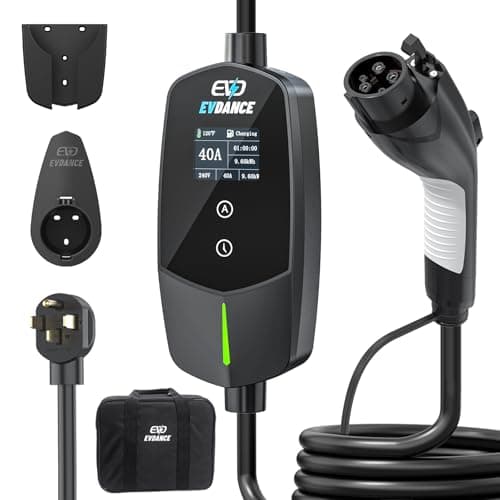
For a renter or apartment dweller, the best charger is the one you can set up without an electrician and take with you when you move: the EVDANCE 40A Portable. It has adjustable current, a built-in delay timer for off-peak rates, a 25-foot cable and a NEMA 14-50 plug, so it charges as fast as a wall unit when a 240-volt outlet is available - then it goes in the trunk when the lease ends. If your outlet situation is uncertain, the WOLFBOX 40A Portable charges from both a 240-volt and a 120-volt outlet via its included adapters, so it works on whatever you have.
Renting changes the charging problem completely. You do not control the wiring, you may not keep the same parking spot next year, and paying to hardwire a fixture into someone else's wall rarely makes sense. So the calculus flips: portability and the outlet you already have matter more than the last few amps of speed. The chargers that win here are the ones you can uninstall in five minutes and reinstall somewhere new - not the fastest hardwired boxes that dominate our main Level 2 roundup. We compile published manufacturer specifications and do the wiring math; we do not run a test lab, and we will not pretend we bench-measured any of this.
The short version
Every pick here is plug-in or fully portable - nothing that needs hardwiring:
- EVDANCE 40A Portable - best for renters overall. Full 9.6 kW when you have a 240-volt outlet, adjustable current for a weaker circuit, and a delay timer to catch off-peak rates without an app. Coils into a trunk when you move.
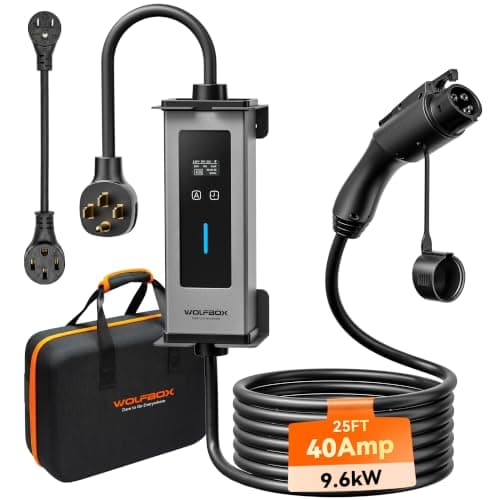
- WOLFBOX 40A Portable - best when the outlet is a question mark. A NEMA 14-50 plug plus included 5-15 and 6-20 adapters, so it charges fast on a 240-volt (14-50) outlet and still trickles from any standard 120-volt wall socket. One charger for any apartment.
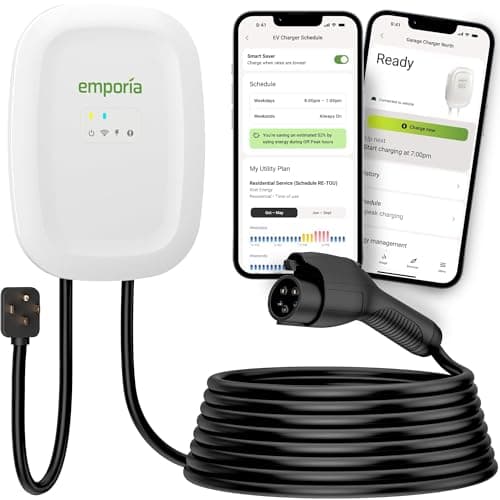
- Emporia Level 2 - best if you have a dedicated 240-volt spot.A plug-in NEMA 14-50 wall unit with real energy monitoring that you can unbolt and take when you move - the closest thing to a "proper" charger a renter should buy. Full Emporia review.
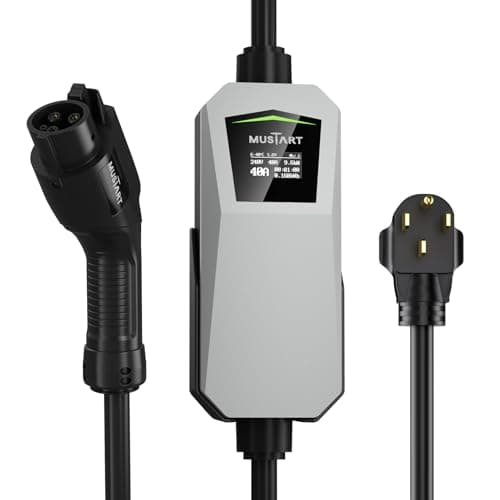
- MUSTART 40A Portable - cheapest capable 240-volt portable. An LCD readout and a true 40-amp draw for less than almost anything else that charges this fast.
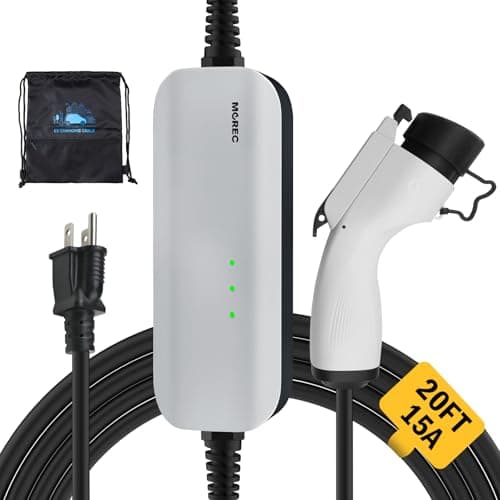
- Morec Level 1 - the 120-volt fallback. When all you have is an ordinary household outlet, this 15-amp Level 1 cord plugs in anywhere and adds a slow but steady charge, with an LCD showing what the outlet is doing. Insurance, not a primary charger for a daily driver.
Why renters should buy portable or plug-in, never hardwired
A hardwired charger is a permanent fixture bolted to a wall and wired straight into a circuit. It is the right answer for a homeowner - cleaner, more secure, and it unlocks the full 48 amps - but it is exactly the wrong answer for a renter. You would be paying an electrician to improve a property you do not own, you cannot take it with you, and you often need the landlord's sign-off to touch the panel at all. A plug-in or portable charger sidesteps all of that: if a suitable outlet already exists you can install it yourself in minutes, and it comes with you when you go. That is why every pick on this page plugs in.
Start with the outlet you actually have
The single thing that decides which charger fits your apartment is the outlet you can reach from your parking spot:
- A 240-volt outlet (NEMA 14-50, or a dryer's 14-30). This is the jackpot - a range or dryer-style receptacle gives you real Level 2 speed. A 40-amp portable like the EVDANCE or a plug-in Emporia charges roughly 25 to 30 miles of range per hour. If the outlet is a 30-amp dryer type rather than a 50-amp range type, dial an adjustable portable down to match it.
- Only a 120-volt household outlet. That is Level 1 - about 3 to 5 miles of range per hour. Slow, but for a short commute topped up every night it can be enough. The WOLFBOX portable covers this and 240 volts both; the Morec is a pure 120-volt option.
- No outlet near the car. Then the honest answer is workplace or public Level 2 charging, plus a conversation with the property manager - some will add a receptacle if you ask, especially as more residents go electric.
The practical takeaway: find out what outlet is within cable reach of where you park before you buy. A 25-foot cable (the EVDANCE and WOLFBOX both carry one) buys you slack, but it is not infinite. Our Level 1 vs Level 2 guide shows whether the outlet you have is already enough for how you drive.
The picks, in order
Below the summary table each charger gets a full card with its score breakdown, pros and cons, and a "don't buy this if" note. In short: the EVDANCE is the portable to buy if you have a 240-volt outlet, the WOLFBOX is the one to buy if you are not sure what you have, the Emporia is the plug-in wall unit for a dedicated spot you can install and later uninstall, the MUSTART is the value 240-volt portable, and the Morec is the 120-volt backstop. None of them needs an electrician if a suitable outlet already exists.
How to choose a charger as a renter
The homeowner questions - 48 amps or 40, hardwired or not - mostly fall away. What is left is four things.
1. Portable over fixed, almost always
Unless you have a long lease, a dedicated spot, and a landlord who is fine with an install, a portable is the safer buy. It installs itself, it cannot be left behind, and it doubles as a travel charger. A plug-in wall unit like the Emporia is the one exception - it mounts and unmounts easily and gives you energy monitoring - and it is worth it only when the spot is genuinely yours for a while.
2. Match the plug to your outlet
Buy for the outlet you can actually reach, not the one you wish you had. A NEMA 14-50 portable needs a 50-amp range-style outlet; a dual-level unit like the WOLFBOX adds a 120-volt option for when there is only a standard socket. If you go plug-in on a 240-volt outlet, confirm it is an industrial-grade, listed receptacle - a cheap one is the exact part that overheats under a continuous draw. Our NEMA 14-50 outlet guide explains why.
3. Adjustable current and a delay timer
Adjustable amperage is worth more to a renter than to anyone else, because you rarely know what circuit you are plugging into. Being able to dial the EVDANCE or WOLFBOX down to 24 or 16 amps lets one charger safely serve a strong outlet at one address and a weaker one at the next. A delay timer, meanwhile, catches cheaper overnight rates without needing a smart panel or an app - see off-peak and time-of-use charging.
4. If all you have is 120 volts
Do not overspend. A Level 1 charge from a household outlet is the same slow rate no matter how premium the cord, so a simple 120-volt unit like the Morec is the sensible buy. If your driving is light and you plug in every night, Level 1 quietly keeps up. If it does not, the fix is a 240-volt outlet, not a fancier 120-volt cord. The best 16-amp chargers page covers the low-power Level 2 middle ground for a small 240-volt circuit.
So, which one?
Have a 240-volt outlet? Buy the EVDANCE portable. Not sure what outlet you will find? The WOLFBOX dual-level covers both. Got a dedicated spot and a cooperative landlord? The plug-in Emporia is the nicest of these to live with. Watching every dollar? The MUSTART. Stuck with only a wall socket? The Morec, and keep your expectations modest.