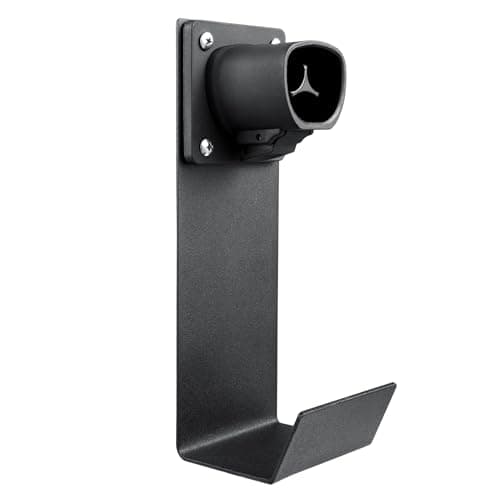
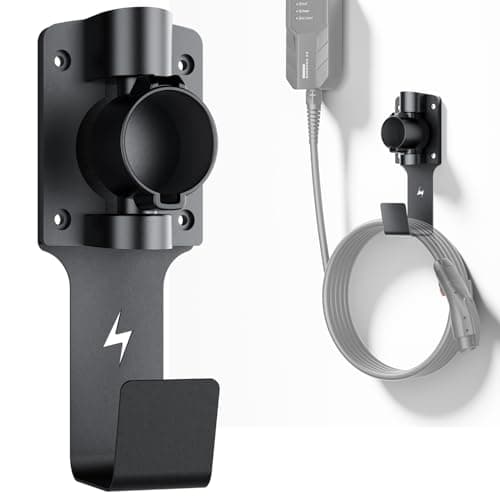
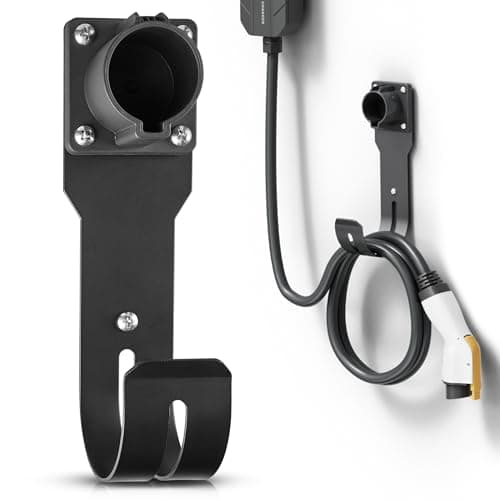
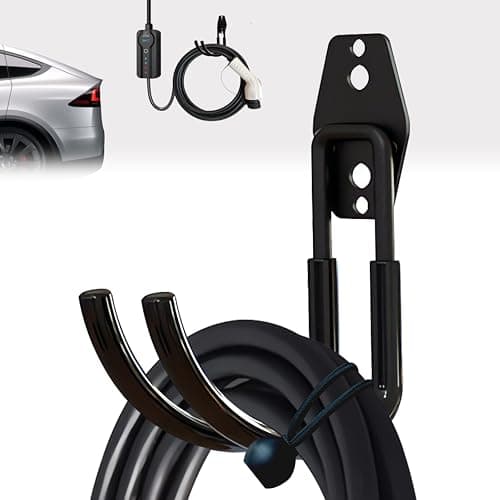
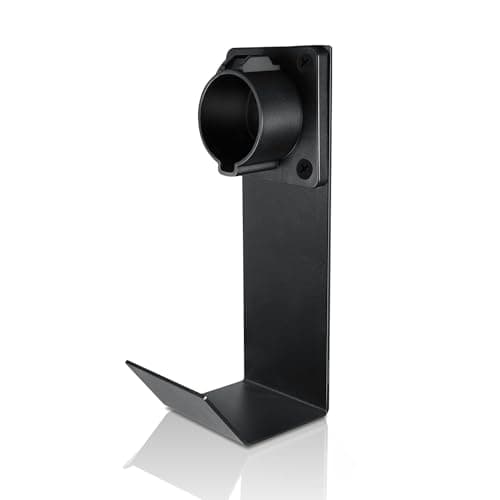
For a J1772 setup, buy the Lectron holster and J-hook combo - it docks the connector and hangs the cable for about twenty dollars, and it is the accessory most likely to still be doing its job in ten years. Tesla and native-NACS owners want the Lectron NACS version of the same thing. If the only wall you can drill faces the wrong way, the FOCSPROD dock rotates through 180 degrees; the MECMO is the value combo for a second bay; and the Nexoroot steel J-hook is the cable half on its own for the price of a coffee.
This is the cheapest category on the site and one of the most worthwhile. A connector left on the garage floor collects dust, grit and water on contacts that are about to carry 40 amps, and a cable pooled on concrete gets kinked, walked on and eventually driven over. Both problems are solved by two parts that cost less than a tank of gas: a holster that cradles the connector nose-down when it is not in the car, and a J-hook that carries the cable in a wide loop off the ground. The technique behind them is in our cable management guide; this page ranks the hardware.
Why a holster is not just tidiness
The connector is a set of precision contacts inside a shroud, and it spends most of its life unplugged. Left hanging by the cable or resting on the floor, it points its contacts at exactly what you do not want in them: concrete dust, road salt off your tires, and standing water. Grit on a contact raises resistance at the one place in the circuit that already runs warmest, and it is a common cause of intermittent charging faults - the kind that send owners to our charger not charging troubleshooting page when the real answer is a dirty plug.
The cable has a separate failure mode. A 25-foot Level 2 cable is heavy, and left in a pile it develops tight bends at the same points every day. Repeated kinking at one spot works-hardens the jacket and eventually cracks it. Hung in wide loops on a hook, the same cable relaxes instead. Neither of these is dramatic on any given day, which is exactly why people skip the fix; both shorten the life of the most expensive part of the charger.
Match the shape: J1772 and NACS holsters are not interchangeable
A holster is a moulded cradle cut to one connector profile. The J1772 connector is the larger, rounder five-pin plug; NACS (the Tesla-style connector, standardised as SAE J3400) is the slim flat-faced one. A NACS plug will not latch in a J1772 cradle and vice versa, so buy the shape your chargerends in - which is not always the shape your car's port is, if you run an adapter. If you are not sure, check how to tell if your EV has NACS or J1772.
The picks
The Lectron J1772 holster and J-hook combo is the default. You get both pieces and the mounting hardware in one box, it latches a standard J1772 connector securely rather than just resting it, and Lectron has sold this exact part long enough that it turns up in hardware stores as well as online. The Lectron NACS holster and J-hook is the identical proposition cut for the NACS connector, and the manufacturer lists it as fitting both the Tesla Mobile Connector and the Wall Connector.
The FOCSPROD rotating dockearns its place on a problem the fixed holsters cannot solve. If the only mounting surface near your parking spot is a stud face, a beam or a side wall, a fixed cradle points the connector away from the car and you end up fighting it every night. FOCSPROD's dock swivels through 180 degrees so the plug still seats naturally, and it uses a metal J-hook rather than a plastic one on the part that carries the cable's weight. It costs about the same as the fixed docks.
The MECMO combo is the value option: the same holster-plus-hook pairing for less, which makes it the sensible buy for a second bay, a second charger, or a portable cordset that also needs a home. The Nexoroot steel J-hook is the cable half alone. Buy it if your charger already came with a connector dock, or buy two and hang the cable in wide loops instead of one tight coil - the gentlest thing you can do to a heavy cable.
Mount it so gravity helps. Put the holster high enough that the connector hangs nose-down and drains, and set the J-hook far enough to the side that the cable falls into a wide loop rather than a tight coil. Outdoors, mount under an eave or beside the unit rather than in the open - the connector is weather-sealed when mated, but there is no reason to leave it collecting rain. More on the outdoor case in weatherproofing an outdoor install.
How the five compare
| Product | Connector | Holster | Cable hook | Adjustable | Mount | Price tier |
|---|
| Lectron J1772 combo | J1772 | Yes | Yes, included | Fixed | Wall, screws supplied | Standard |
| Lectron NACS combo | NACS (J3400) | Yes | Yes, included | Fixed | Wall, screws supplied | Standard |
| FOCSPROD rotating dock | J1772 | Yes | Yes, metal | 180-degree swivel | Wall | Standard |
| MECMO combo | J1772 | Yes | Yes, steel | Fixed | Wall | Budget |
| Nexoroot J-hook | Any (cable only) | No | Yes, steel | Fixed | Wall, indoor or outdoor | Budget |
Features above are as published by each manufacturer on its live listing. We compare documented specifications rather than bench-testing hardware, as our methodology sets out.
How to choose
1. Start with the connector on your charger
Buy for the plug your charger ends in, not the badge on your car. A J1772 wall unit needs a J1772 holster even if you drive a Tesla through an adapter, because it is the charger's connector that sits in the cradle. A Tesla Wall Connector or a native-NACS unit - the kind covered in our best NACS home chargers roundup - needs the NACS cradle. Nothing else about the two products differs.
2. Decide whether you need the hook, the holster, or both
Most chargers ship with neither, so most people want both. Some units include a moulded cradle on the enclosure itself, in which case a bare hook is all that is missing. And if the cable run is long - a 25-footer, or one of the extensions on our extension cable page - two hooks spaced a few feet apart hold the cable in wider, gentler loops than one.
3. Check the wall before you buy a fixed dock
This is the step people skip. Stand where you park, hold the connector where it would live, and look at what you would actually be screwing into. A flat drywall or block wall beside the charger takes any fixed holster. A stud edge, a post, a beam or a wall that faces along the car rather than across it wants the rotating FOCSPROD dock, because a fixed cradle on the wrong plane points the plug away from the port. Also confirm you can reach a stud or use proper anchors: the holster holds a heavy connector, and drywall alone will not.
4. Prefer metal on the part that carries weight
The hook takes the cable's weight for years, in a garage that swings from freezing to hot. Steel or aluminium holds its shape; thin plastic sags and eventually snaps, usually in cold weather when the cable is stiffest. Every hook on this page is metal, which is a large part of why these five and not the cheapest listings on the search page.
5. Outdoors, mount for drainage
An outdoor holster should sit under cover where possible and always hold the connector nose-down, so water runs off the shroud instead of sitting in it. Charging in the wet is safe by design - we cover why in can I charge my EV in the rain - but a plug that spends its idle hours full of rainwater is a different question from a plug that is wet during a session.
So, which one?
J1772 charger, ordinary garage wall: the Lectron combo. Tesla or native-NACS charger: the Lectron NACS combo. Awkward mounting surface: the FOCSPROD rotating dock. Second bay or a tight budget: the MECMO. Already have somewhere for the plug and just need the cable off the floor: one or two Nexoroot J-hooks. There is no wrong answer here that costs more than twenty dollars, and every one of them beats the floor.