HUB 03 · Charging Guides
60-Amp vs 50-Amp Circuit for EV Charging
The circuit decides your ceiling: 50 amps caps you at 40-amp charging, 60 amps unlocks 48. Here is what that gap is actually worth, and when to pay for it.
We earn a commission when you buy through our Amazon links, at no extra cost to you. It never affects our rankings, and we say so when the cheaper product is the better buy. How this works.
The breaker feeding your charger sets its top speed, because of one rule: a continuous load can only use 80 percent of the circuit's rating. So a 50-amp circuit supports 40-amp charging, and a 60-amp circuit supports 48-amp charging. That is the entire difference - and whether it is worth the heavier wire and bigger breaker depends on your car and your battery. Here is the honest trade-off.
The 80 percent rule, in one line
EV charging is a "continuous load" (three-plus hours), and the NEC requires the circuit to be rated for 125 percent of that load - which is the same as saying the load can be at most 80 percent of the breaker. So:
| Circuit breaker | Max continuous charging | Power at 240V | Typical copper wire |
|---|---|---|---|
| 50 amp | 40 amps | ~9.6 kW | 6 AWG |
| 60 amp | 48 amps | ~11.5 kW | 4 AWG |
The exact wire gauge depends on the run and conditions and is the electrician's call - see wire and breaker size - but the pattern holds: 60 amps needs a heavier conductor than 50.
What the speed gap is actually worth
Forty-eight amps versus 40 is about a 20 percent speed increase - roughly 35-40 miles of range per hour instead of about 30. Over a full overnight charge that is real, but for a daily top-up it is often invisible: both refill a normal day's driving with hours to spare. The gap only matters when the battery is genuinely large or you regularly charge from low. We work the numbers in 32-amp vs 48-amp.
The catch that decides it:your car must actually accept 48 amps. Many EVs cap their onboard AC charger at 32 or 40 amps, in which case a 60-amp circuit buys you nothing. Confirm your car's onboard limit before paying for the bigger circuit - it is the whole question.
Plug-in vs hardwired enters here too
There is a practical wrinkle: the NEMA 14-50 plug most plug-in chargers use is rated for a 50-amp circuit and 40-amp charging. To run 48 amps you generally need a hardwiredcharger on the 60-amp circuit - most plug-in units cap at 40 amps regardless. So "go to 60 amps" usually also means "hardwire it," which is part of the cost and covered in hardwired vs plug-in.
Cost and when to size up
A 60-amp install costs a bit more than a 50-amp one - heavier wire, a larger breaker, and hardwiring labor - though the difference is modest next to the whole install. Size up to 60 amps if: your car accepts 48 amps, your battery is large (a big SUV or truck), and your panel has the headroom. Stay at 50 amps if your car caps at 40 or less, your battery is modest, or your panel is tight - a 40-amp plug-in setup is the no-regrets default for most homes.
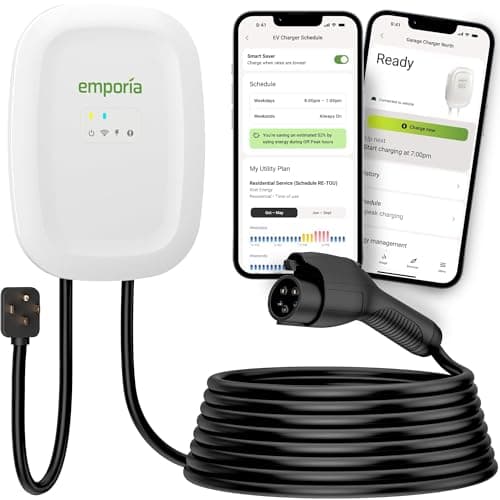
Whichever you choose, a licensed electrician confirms your panel can carry it and sizes the wire. The 48-amp units that reward a 60-amp circuit are in our best 48-amp chargers; the flexible 40-amp value pick is the Emporia, and our ranked Level 2 chargers puts both circuit sizes side by side.
The gear
Recommended gear for this guide
The products this guide refers to, with prices pulled live from Amazon and dated on each card.
- Guide
A permanent, weatherproof 48A install
Grizzl-E Ultimate (48A)
A dedicated 48-amp charger in a cast-aluminum, IP67 shell - the toughest full-speed box here, built to be hardwired to a wall and left to work.
Most homes that want speed and smarts
Emporia Level 2 (48A)
The charger that refuses to charge you extra for being smart: full 48-amp speed and real energy monitoring at roughly the price of a plain plug-in box.
#ad · As an Amazon Associate we earn from qualifying purchases.
Questions
Frequently asked
Do I need a 60-amp circuit for an EV charger?
Only if you want 48-amp charging and your car accepts it. A 50-amp circuit gives 40-amp charging, which is plenty for most homes and cars. Step up to a 60-amp circuit for 48 amps when the battery is large and the car's onboard charger can actually use it.
How many amps can a 50-amp circuit charge at?
40 amps. EV charging is a continuous load, so the NEC limits it to 80 percent of the breaker (50 x 0.8 = 40). That is about 9.6 kW - the rate a standard NEMA 14-50 plug-in charger delivers.
Is 48-amp charging worth the bigger circuit?
It is about 20 percent faster than 40 amps - meaningful on a large battery charged from low, often invisible for a daily top-up. It is worth it if your car accepts 48 amps and your panel has room; otherwise a 40-amp, 50-amp-circuit setup is the smarter buy.
Keep reading
Related
More in this section
More Charging Guides
Receipts
Sources
- EC&M - NEC requirements for EV equipment (Article 625: continuous load, circuit & conductor sizing)
- US DOE AFDC - charging at home
- US DOE / fueleconomy.gov - EV charging basics
We do not run a testing lab, and we do not pretend to. Where a measured number came from someone else's lab, we name them and link them. Where we could not verify something, we say so on the page rather than quietly leaving it out. Read our full method.