Skip to content
The Charge Curve

HUB 01 · Home EV Chargers

The Best Home EV Chargers for a Tesla

A Tesla uses the NACS plug, but it comes with a J1772 adapter - so the whole Level 2 field is open to you. Ranked on speed, build and value, plus when a native NACS wall connector is worth it.

By Stephen V.Updated How we compare
#ad

We earn a commission when you buy through our Amazon links, at no extra cost to you. It never affects our rankings, and we say so when the cheaper product is the better buy. How this works.

The short answer

Quick picks

#ProductBest forScorePrice
01
Emporia Emporia Level 2 (48A)
Emporia Level 2 (48A)

The charger that refuses to charge you extra for being smart: full 48-amp speed and real energy monitoring at roughly the price of a plain plug-in box.

Most homes that want speed and smarts
9.0
$449.00Amazon
02
Tesla Tesla Universal Wall Connector
Tesla Universal Wall Connector

The one wall unit with a built-in NACS plug AND a J1772 adapter — the future-proof pick for a driveway that mixes a Tesla and a non-Tesla EV.

Mixed Tesla + non-Tesla households
8.8
Check priceAmazon
03
Grizzl-E Grizzl-E Ultimate (48A)
Grizzl-E Ultimate (48A)

A dedicated 48-amp charger in a cast-aluminum, IP67 shell - the toughest full-speed box here, built to be hardwired to a wall and left to work.

A permanent, weatherproof 48A install
8.4
$479.99Amazon
04
Wallbox Wallbox Pulsar Plus (48A)
Wallbox Pulsar Plus (48A)

One of the smallest 48-amp chargers you can hang on a wall — full-speed hardwired charging in a box that barely announces itself.

A compact, fast, hardwired install
8.4
$614.99Amazon
05
ChargePoint ChargePoint Home Flex
ChargePoint Home Flex

The mature, well-supported pick — amperage you dial in up to 50A, wired into the biggest public-charging app in North America. You pay for the polish.

Buyers who want the established brand + one app
8.2
$539.00Amazon

#ad · Live prices from the Amazon Product API, as of Jul 25, 2026. Where we have no verified live price, we show none — we would rather leave a gap than print a number that has gone stale.

For most Tesla owners the best home charger is the Emporia Level 2. Your car came with a J1772-to-NACS adapter in the trunk, so a standard J1772 charger like the Emporia plugs straight into a Model 3, Model Y, S or X - and the Emporia is 48-amp capable, which is exactly what a Long Range or Performance Tesla accepts, at roughly the price of a plain plug-in box. If you would rather skip the adapter entirely, the Tesla Universal Wall Connector has a native NACS plug and an integrated J1772 adapter for a second, non-Tesla car - buy that one if a clean, adapter-free install matters more to you than the price.

There is a myth that a Tesla needs a special charger. It does not. Tesla vehicles in North America use the NACS connector (the plug now standardized as SAE J3400), and every Tesla ships with a J1772-to-NACS adapter - the small dongle in the trunk well. That adapter opens the entire installed base of J1772 Level 2 chargers to your car, which is the same field we rank in our main Level 2 roundup. So the real question is not "which Tesla charger" - it is "which Level 2 charger, and do I want to use the adapter or go native NACS." This page answers both. We compile published specs and do the wiring math; we do not run a test lab, and we will not pretend we bench-measured any of this.

The short version

Two clean paths, and the picks split along them:

  • Emporia Level 2 - best for most Teslas. A 48-amp J1772 charger you run with the adapter that came with the car. Genuine energy monitoring and scheduling, priced like a plain charger. Full Emporia review.
  • Tesla Universal Wall Connector - best native NACS pick. A Tesla-made unit with a NACS plug and an integrated J1772 adapter, so it charges your Tesla with no dongle and still handles a non-Tesla second car. Stock comes and goes on Amazon - confirm availability before you count on it.
  • Grizzl-E Ultimate - best no-app durability. A cast-aluminum, IP67, 48-amp box with nothing in the cloud to fail - the rugged pick that just charges. Full Grizzl-E review.
  • Wallbox Pulsar Plus - best compact 48A install.One of the smallest full-speed hardwired chargers you can hang next to a Tesla's charge port.
  • ChargePoint Home Flex - best established brand. Adjustable up to 50 amps and tied to a huge public-charging app. Full ChargePoint review.

The one Tesla spec that sets your speed: 48 amps or 32 amps

Every Tesla can accept Level 2 AC charging, but not at the same rate, and this is where people overbuy. Tesla's own onboard charger determines the ceiling:

  • Long Range and Performance Model 3 and Model Y (and Model S / X) accept up to 11.5 kW - that is 48 amps at 240 volts, which needs a 60-amp circuit.
  • Rear-Wheel-Drive / Standard Model 3 and Model Y accept up to 7.7 kW - that is 32 amps, which runs on a 40-amp circuit.

The arithmetic is fixed: amps times 240 volts is watts, so 48A is 11.5 kW and 32A is 7.7 kW. And because EV charging is a continuous load, code sizes the circuit to 125 percent of the current - a 48-amp charger needs a 60-amp breaker, a 40-amp charger needs a 50-amp breaker, a 32-amp setting needs a 40-amp breaker. If your Tesla is an RWD car that caps at 32 amps, a 48-amp charger will not charge it any faster than a 40-amp one - you would be buying headroom the car cannot use. Check your exact trim's onboard rate before you pick an amperage; our amperage and breaker guide walks the sizing, and confirm the circuit with a licensed electrician.

The practical takeaway: a Long Range or Performance Tesla wants a 48-amp charger on a 60-amp hardwired circuit to hit its full 11.5 kW. A RWD Tesla is fully fed by a 32-to-40-amp charger on a plug. Either way, the charger is the same J1772 field - the car just sets the number.

Adapter route or native NACS?

Both are legitimate; it comes down to whether you mind the dongle:

  • The adapter route (our default). Buy any J1772 charger here and use the J1772-to-NACS adapter that came with your Tesla. It is the cheapest path, it keeps the whole Level 2 market open to you, and if you buy a plug-in unit you can take it with you. If you ever misplace the factory adapter, a replacement is inexpensive - see our J1772-to-NACS adapters ranking, where we sort them by the UL 2251 / UL 2252 safety listing that actually matters on a part carrying full current.
  • The native NACS route. The Tesla Universal Wall Connector plugs into your Tesla with no adapter and, because it also has an integrated J1772 adapter, it can charge a non-Tesla second car too. It is the tidiest single-unit answer for a mixed driveway. The trade-offs are price and Amazon availability, which is why it sits at number two rather than the top here.

New to the connector question entirely? Our connector types explainer lays out NACS versus J1772 in plain English, and what the NACS transition means covers why the standard is consolidating around the plug your Tesla already uses.

The picks, in order

Below the summary table each charger gets a full card with its score breakdown, pros and cons, and a "don't buy this if" note. In short: the Emporia wins on value and speed with the adapter, the Tesla Universal Wall Connector on a native, adapter-free install, the Grizzl-E on durability, the Wallbox on a compact 48-amp footprint, and the ChargePoint on brand and app. Every one charges a Tesla; the trick is matching it to your trim and your wall.

In detail

The picks, in full

01
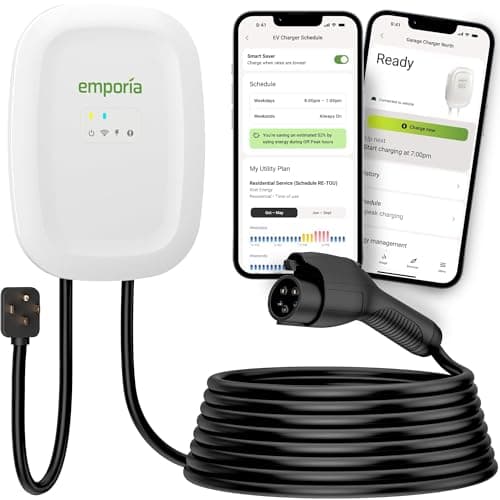
Emporia Emporia Level 2 (48A)

Most homes that want speed and smarts

Emporia Level 2 (48A)

Up to 48A / 11.5kWJ177225ft cableWi-Fi + app
9.0/10

The charger that refuses to charge you extra for being smart: full 48-amp speed and real energy monitoring at roughly the price of a plain plug-in box.

Charge speed
10
Build & weather
8
Smart features
9
Cable & connector
8
Value
10

Pros

  • 48-amp capable when hardwired — quicker than the 40-amp plug-in default most units top out at
  • Genuine energy tracking and scheduling in the app, priced below almost every other smart charger
  • The 25-foot cable reaches either side of a two-car garage

Cons

  • You only get 48 amps hardwired on a 60-amp circuit; the plug-in version is capped at 40A like everything else
  • The app and Wi-Fi are central to the experience, so first-time setup takes longer than a plug-and-go box

Don't buy this if…

you never intend to open an app. A lot of what you are paying for is the software; if a sealed, silent box is what you actually want, the Grizzl-E Classic is the honest call.

$449.00View on Amazon

Price as of Jul 25, 2026. Prices change — Amazon's is the one that counts.

#ad · we may earn a commission from this link to Emporia Level 2 (48A)

02
Tesla Tesla Universal Wall Connector

Mixed Tesla + non-Tesla households

Tesla Universal Wall Connector

Up to 48ANACS + J177224ft cableDual connector
8.8/10

The one wall unit with a built-in NACS plug AND a J1772 adapter — the future-proof pick for a driveway that mixes a Tesla and a non-Tesla EV.

Charge speed
9
Build & weather
9
Smart features
8
Cable & connector
10
Value
8

Pros

  • Charges both NACS (Tesla) and J1772 cars from one unit — no adapter juggling in a two-car household
  • Deep integration with the Tesla app for Tesla owners
  • Well-built, weather-rated enclosure

Cons

  • Its advantage only pays off if you actually own both connector types
  • Hardwired install, and the ecosystem leans toward Tesla vehicles

Don't buy this if…

every car in your driveway uses a J1772 port. You would be paying for a dual-connector trick you'll never use — a straightforward J1772 charger like the Emporia does the same job for less.

Check price on Amazon →

No buyable offer at the last price check (Jul 25, 2026). We show nothing rather than a stale number.

#ad · we may earn a commission from this link to Tesla Universal Wall Connector

03
Grizzl-E Grizzl-E Ultimate (48A)

A permanent, weatherproof 48A install

Grizzl-E Ultimate (48A)

48A / 11.5kWJ177225ft cableCast aluminum IP67 / NEMA 4X
8.4/10

A dedicated 48-amp charger in a cast-aluminum, IP67 shell - the toughest full-speed box here, built to be hardwired to a wall and left to work.

Charge speed
10
Build & weather
10
Smart features
6
Cable & connector
8
Value
8

Pros

  • A dedicated 48-amp / 11.5 kW unit built for the full speed, not a 40-amp charger with a 48-amp mode bolted on
  • Cast-aluminum enclosure rated IP67 and NEMA 4X - the most weather-resistant shell of any 48-amp pick here, listed for indoor or outdoor use
  • UL tested and certified, with built-in GFCI plus over-current, over-voltage and over-temperature protection
  • Amperage is adjustable from 16 to 48 amps, so one unit matches a 40-amp or a 60-amp circuit

Cons

  • Hardwired only - there is no plug-in version, so it is a permanent fixture you cannot unplug and take with you
  • Like every Grizzl-E, the heavy-duty cable stiffens in deep cold, a recurring complaint from northern owners

Don't buy this if…

you want plug-in portability or a polished energy-monitoring app as the centerpiece. This is a rugged, permanent 48-amp fixture; if value and smart features matter more, the Emporia delivers the same 48 amps hardwired for less and adds real monitoring.

$479.99View on Amazon

Price as of Jul 25, 2026. Prices change — Amazon's is the one that counts.

#ad · we may earn a commission from this link to Grizzl-E Ultimate (48A)

04
Wallbox Wallbox Pulsar Plus (48A)

A compact, fast, hardwired install

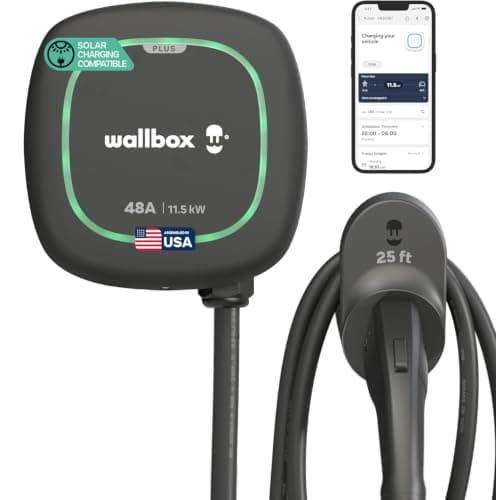
Wallbox Pulsar Plus (48A)

Hardwired 48A / 11.5kWJ177225ft cableEnergy Star + UL
8.4/10

One of the smallest 48-amp chargers you can hang on a wall — full-speed hardwired charging in a box that barely announces itself.

Charge speed
10
Build & weather
8
Smart features
8
Cable & connector
8
Value
8

Pros

  • Physically tiny for a 48-amp unit — the least obtrusive charger in our home roundup
  • Full 48-amp hardwired speed, matching the fastest home chargers
  • Energy Star and UL certified

Cons

  • Hardwired only at 48A — no plug-in convenience if you might move it
  • The app has historically drawn more owner complaints than the hardware itself

Don't buy this if…

you rent or might take the charger with you. This is a permanent fixture — a plug-in unit or a portable EVSE is the right call for anyone who could move.

$614.99View on Amazon

$699.9912% off

Price as of Jul 25, 2026. Prices change — Amazon's is the one that counts.

#ad · we may earn a commission from this link to Wallbox Pulsar Plus (48A)

05
ChargePoint ChargePoint Home Flex

Buyers who want the established brand + one app

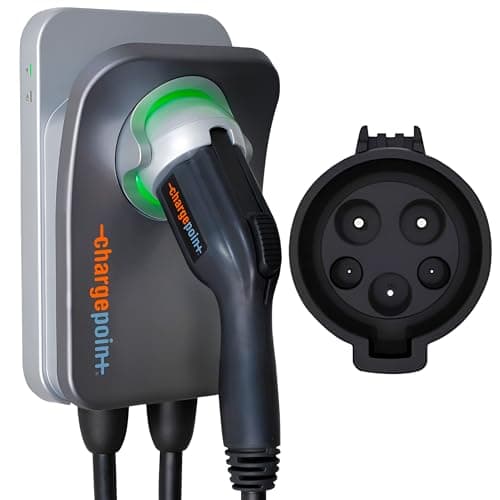
ChargePoint Home Flex

Adjustable to 50AJ1772NEMA 14-50 plugEnergy Star
8.2/10

The mature, well-supported pick — amperage you dial in up to 50A, wired into the biggest public-charging app in North America. You pay for the polish.

Charge speed
9
Build & weather
8
Smart features
9
Cable & connector
8
Value
7

Pros

  • Output is adjustable in the app up to 50A, so it matches whatever breaker you can install today and more later
  • Reports into the same ChargePoint app that maps and pays for a huge public network — home and away in one place
  • Long track record and responsive support that newer budget brands cannot match

Cons

  • Costs more than equally capable chargers from newer brands
  • The experience leans hard on the ChargePoint account and app; skip it and you are paying for an integration you will not use

Don't buy this if…

price is your first filter. The Emporia matches most of what this does for meaningfully less — here you are paying for brand maturity and the unified app, which are real but not free.

$539.00View on Amazon

$657.9918% off

Price as of Jul 25, 2026. Prices change — Amazon's is the one that counts.

#ad · we may earn a commission from this link to ChargePoint Home Flex

How to choose a charger for a Tesla

Once you know your trim's onboard rate, the decision is the same as any Level 2 buy, plus one Tesla-specific call about the connector.

1. Match the amperage to your trim, not the badge

A Long Range or Performance Tesla accepts 48 amps and rewards a 48-amp charger on a 60-amp hardwired circuit. A Rear-Wheel-Drive Tesla caps at 32 amps, so a 40-amp plug-in charger already delivers everything it can take and 48 amps is wasted money. This single check saves more Tesla buyers from overspending than any other.

2. Adapter or native NACS

If you are happy to leave the factory J1772 adapter clipped to the charger, the whole J1772 field is open and you buy on price and features. If you want a plug that mates directly with the car - and especially if a non-Tesla shares the driveway - the Tesla Universal Wall Connector is the native answer. There is no wrong choice; there is only which annoyance you would rather not have.

3. Plug-in or hardwired

Hardwiring unlocks the full 48 amps a Long Range Tesla wants and looks cleaner on the wall; a plug-in NEMA 14-50 unit is capped at 40 amps but stays portable for renters and movers. If you go plug-in, spend on the receptacle - our NEMA 14-50 outlet guide explains why the cheap ones are the part that fails - and if you want the field ranked by that connector, see best NEMA 14-50 chargers.

4. Cable length and smart features

A Tesla's charge port is on the rear driver's side, so measure from the mount to that corner and add slack. The 25-foot cables on the Emporia, Wallbox and ChargePoint reach across a two-car garage and let you park either way around. On features, scheduling earns its keep on a time-of-use plan - though note a Tesla can already schedule charging from the car, so a "dumb" charger like the Grizzl-E loses less here than it would for another brand.

5. Certification, non-negotiable

A home charger pushes 32 to 48 amps for hours, often overnight. Look for a UL or ETL listing - the Grizzl-E is UL certified, the Wallbox is Energy Star and UL, and the Emporia and ChargePoint are listed too. It is the one spec we would not compromise on, and it applies to the adapter as much as the charger.

So, which one?

Buy the Emporia and use your factory adapter unless you have a reason not to. Want an adapter-free, Tesla-made unit that also charges a second non-Tesla car? The Tesla Universal Wall Connector. Want a sealed metal box with nothing to update? The Grizzl-E Ultimate. Need full 48-amp speed in the smallest footprint? The Wallbox. Want the biggest brand and one app for home and public charging? The ChargePoint.
How we picked

We do not run a testing lab

We compiled published specifications from manufacturer manuals and spec sheets, verified the safety listings (UL / ETL), computed the real running and installation costs, checked the wiring math against the NEC continuous-load rule, and read aggregated owner reviews — then scored each product against a published rubric. The scores are judgments from documented research — they are not bench measurements, because we do not have a test lab and we are not going to pretend we do. Every spec and cost figure is cited in Sources.

Questions

Frequently asked

Do I need a special charger for a Tesla?

No. Every Tesla comes with a J1772-to-NACS adapter, so any standard J1772 Level 2 charger - the Emporia, Grizzl-E, Wallbox or ChargePoint here - charges your car. You can also buy a native NACS unit like the Tesla Universal Wall Connector if you would rather not use an adapter. Both routes deliver the same speed; the car's onboard charger, not the plug, sets how fast.

What amperage does a Tesla accept at home?

It depends on the trim. Long Range and Performance Model 3 and Model Y (and Model S / X) accept up to 48 amps / 11.5 kW, which needs a 60-amp circuit and a hardwire. Rear-Wheel-Drive Model 3 and Model Y cap at 32 amps / 7.7 kW, fully fed by a 40-amp circuit. Buying a 48-amp charger for a 32-amp car does not make it charge faster - check your trim's onboard rate first.

Is the Tesla Wall Connector better than a J1772 charger with the adapter?

Not in charging speed - both deliver the same amps your Tesla accepts. A native NACS unit like the Tesla Universal Wall Connector is tidier (no dongle) and can charge a non-Tesla second car through its built-in J1772 adapter. A J1772 charger plus your factory adapter is usually cheaper and keeps the whole Level 2 market open to you. Pick on price, tidiness and whether a second car shares the driveway.

Can I lose the adapter that came with my Tesla?

You can, and replacements are inexpensive. A J1772-to-NACS adapter lets your Tesla use any J1772 charger; we rank them by the UL 2251 / UL 2252 safety listing in our J1772-to-NACS adapters guide. Keep one clipped to the home charger and, ideally, a spare in the frunk for public J1772 stations.

Keep reading

Receipts

Sources

We do not run a testing lab, and we do not pretend to. Where a measured number came from someone else's lab, we name them and link them. Where we could not verify something, we say so on the page rather than quietly leaving it out. Read our full method.