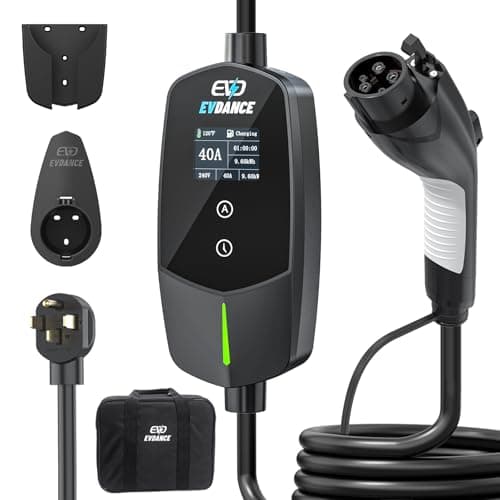
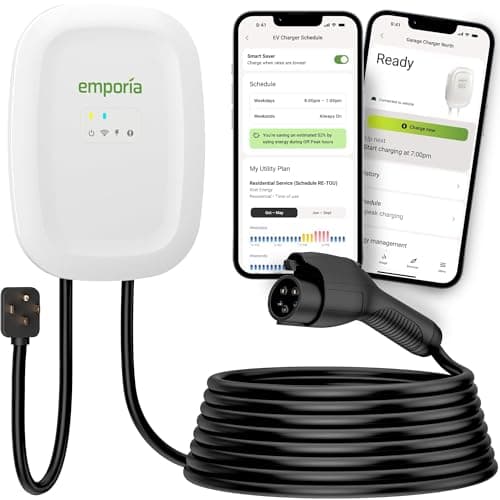
Buy the Emporia Level 2 if you want a charger bolted to the wall, real energy monitoring and scheduling from an app, and the headroom to reach 48 amps when it is hardwired. Buy the EVDANCE 40A portable if you want a charger you can unplug and take anywhere, a built-in delay timer for cheaper overnight rates without an app, and nothing to install beyond a properly rated outlet. One is a fixed, monitored home appliance; the other is a travel-ready tool that lives on a hook or in the trunk.
These two both charge over the same J1772 field at Level 2, but they answer opposite questions: permanent-and-monitored versus take-it-anywhere. The Emporia is a wall unit you can plug in or hardwire; the EVDANCE is a portable that plugs into a NEMA 14-50 outlet and packs away. Both are also budget-friendly, so this is not a value-versus-premium fight - it is a fixture-versus-portable fight. We compile published specs and do the arithmetic rather than bench-testing either unit.
Speed
On paper the Emporia wins, but only under one condition. It is rated up to 48 amps / 11.5 kW, while the EVDANCE tops out at 40 amps / 9.6 kW. The catch is that the Emporia only reaches 48 amps when it is hardwired to a 60-amp circuit(48 x 1.25, because EV charging is a continuous load) and only when your car's onboard AC charger actually accepts 11.5 kW. The plug-in version of the Emporia is capped at 40 amps like almost every other plug-in unit - so an Emporia on a NEMA 14-50 and the EVDANCE add range at exactly the same rate. Plenty of EVs also cap AC charging at or below 40 amps to begin with. Our amperage guidecovers whether your panel and car can even use the Emporia's hardwired headroom.
App and features
The Emporia takes this one decisively. It brings a genuine Wi-Fi app with energy tracking and scheduling, priced below almost every other smart charger - the reason it is our value smart pick. On a time-of-use electricity plan that lets you watch consumption and shift charging to the cheap overnight window from your phone. The EVDANCE answers with a built-in delay timer and adjustable current, so it can start on a cheaper overnight rate with no app and no smart wiring - but the timer is the whole of its scheduling, and there is no remote monitoring. The honest Emporia caveat cuts the other way: the app and Wi-Fi are central to the experience, so first-time setup takes longer than the plug-and-go EVDANCE, and if garage Wi-Fi is weak you will fight it. See do I need Wi-Fi for an EV charger if you are not sure the smarts are worth it.
Build and durability
The Emporia is the more solid long-term fixture. It is a weather-rated wall unit with a 25-foot cable that reaches either side of a two-car garage, built to hang in one spot for a decade. The EVDANCE is a value-brand portable with an outdoor-rated connector, built to function rather than to impress - it lives on a hook or in the trunk and has a shorter track record than an established wall charger. Neither is fragile, but a mounted appliance and a travel brick are built for different lives, and the EVDANCE is honestly the more basic object of the two.
Install and portability
The EVDANCE wins here, and it is the whole point of it. There is nothing to install: you plug into any properly rated NEMA 14-50 and charge, at home or on the road, then unplug and move on. The Emporia is the opposite instinct - the plug-in version can technically be moved, but it is meant to be mounted, and the 48-amp speed only exists when it is hardwired by a licensed electrician, which makes it a permanent fixture. Renters, movers, and anyone who wants one charger that covers the garage and a trip lean EVDANCE; an owner settling in who wants a clean, monitored wall install leans Emporia. Our portable vs wall-mounted guide and hardwired vs plug-in guide walk through that trade-off in detail.
Value
Both are strong value; the winner is whichever job you actually have. The Emporia is the most certified, fastest-capable set of smarts you can get for the money in a permanent charger - it refuses to charge extra for being smart. The EVDANCE is one of the least expensive ways to get a real 40-amp Level 2 charge that travels with you. Spending more on the Emporia only pays off if you will mount it and use the app and, ideally, the hardwired speed; spending on the EVDANCE pays off the first time you charge somewhere that is not your own garage. See where the portable field lands in our best portable chargers guide and where the wall units land in best plug-in chargers.
The verdict
Emporia for a permanent, monitored home charger with an app and hardwired speed headroom; EVDANCE for take-it-anywhere portability and an off-peak delay timer that needs no app. If you rent, might move, or want a second charger for the road, the EVDANCE is the honest call; if this is the one charger for a garage you own, the Emporia does more for the money. Read the full Emporia review and EVDANCE portable review, and if you want to weigh the Emporia against the other big wall brands see Grizzl-E vs Emporia or see how it ranks against the field.
How to choose between them
Are you staying put, or might you move?
This is the question that usually settles it. If you own the home and the charger will live in one spot, the Emporia is built to be mounted and monitored there for years. If you rent, expect to move, or want a charger that also travels, the EVDANCE unplugs from a NEMA 14-50 and goes with you - no de-install, no electrician, no fixture left on someone else's wall. A portable is also the easy answer if you want one charger to cover both a home outlet and a friend's or a rental's.
Do you want app monitoring, or just a timer?
The Emporia's energy tracking and scheduling app is the reason to buy it - it is genuinely useful on a time-of-use plan and it undercuts other smart chargers on price. But it is also something you have to set up and keep on Wi-Fi. The EVDANCE's delay timer starts charging on a cheaper overnight window with none of that: no app, no account, no signal. If you want to watch consumption and control the charger from your phone, buy the Emporia; if you just want to shift charging to the cheap hours and forget it, the EVDANCE's timer already does that.
Can you actually use 48 amps?
The Emporia's speed advantage only exists when it is hardwired to a 60-amp circuit and your car accepts 11.5 kW. Plugged into a NEMA 14-50, it is a 40-amp charger - the same real-world speed as the EVDANCE. The Emporia can also be dialed down to fit a tighter breaker, which is why it turns up in our best adjustable chargersguide; the EVDANCE's adjustable current does the same for the portable. So do not pay for the Emporia purely for speed unless you can install that circuit and your car can pull it; pay for it for the app and the permanent install. If a 40-amp overnight charge is plenty for your daily miles, either unit keeps up, and portability may matter more than the ceiling.