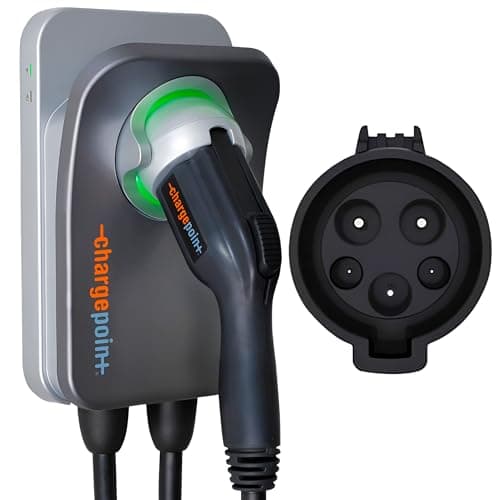
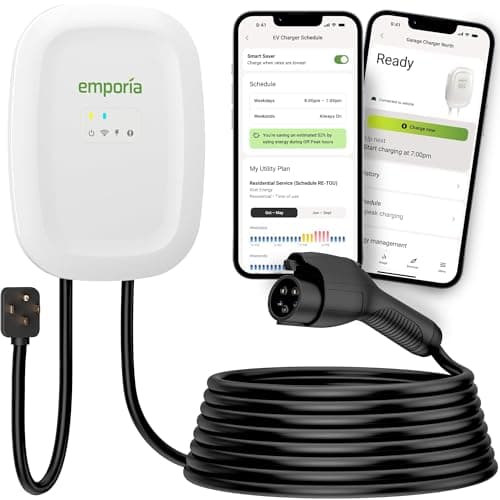
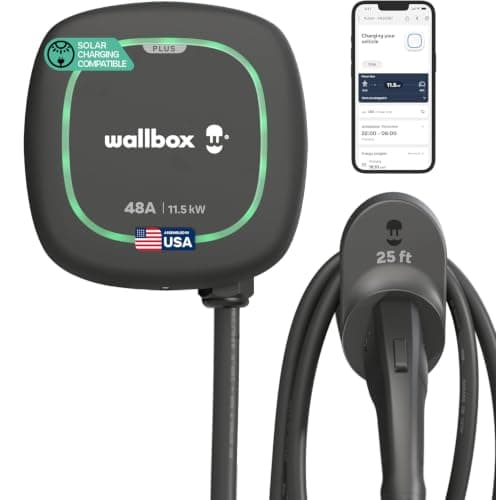
Buy the Wallbox Pulsar Plus and hardwire it at 48 amps. Porsche states an 11 kW onboard AC charger on the Taycan, and the official Porsche research hub quotes the same 11 kW for the Macan Electric - so 48 amps (11.5 kW at 240 volts) is the smallest charger that gives the car everything it will accept, and the largest that is not wasted on it. The Pulsar Plus delivers it from the smallest box on this page, UL listed and Energy Star rated, on a 25-foot cable. If you want the most established brand and one app for home and the road, the ChargePoint Home Flex, whose output is selectable up to 50 amps. If the car parks outside, the Grizzl-E Ultimate in cast aluminum. And the Emporia Level 2 is the value route to the same 48 amps with per-session energy data, when it is in stock.
One honesty note before the table, because it affects two of these picks: the Grizzl-E Ultimate's J1772 version has no buyable Amazon listing at our last price check, and the Emporia Level 2 came back image-only with no buyable offer, so neither shows a price here. We still rank them, on build and on specification, and both cards fall back to a search link rather than to an invented number.
Porsche buyers get sold the wrong charger more often than almost anyone, because the headline number attached to these cars is a DC number. The Taycan's 800-volt architecture is genuinely among the quickest things on sale at a fast charger, and none of that reaches your garage. At home the car charges on AC, through an onboard charger, at a rate Porsche publishes - and that rate is a hard ceiling no wall unit can lift. Our Taycan home charging page does the time and cost math on the big pack, and 400V vs 800V charging explains why the two numbers have nothing to do with each other.
The one number that decides this
Porsche Newsroom USA puts it in a single sentence: "An on-board AC charger with 11 kW for charging using alternating current is also installed." The Macan Electric guide published through Porsche's dealer research hub calls the 11 kW onboard AC charger "the workhorse" of that car. Work backwards from 11 kW at a nominal 240 volts and you get about 46 amps - which in practice means the 48-amp amp class, because that is the step the industry builds.
| Charger size | Power at 240V | What a Porsche does with it |
|---|
| 32 amps | 7.7 kW | Works, and leaves roughly 3 kW of the car's capability unused |
| 40 amps | 9.6 kW | Close. Gives up about 1.4 kW against the car's ceiling |
| 48 amps | 11.5 kW | The match - the car draws its full 11 kW and stops there |
| 80 amps | 19.2 kW | Nothing. The onboard charger caps the draw, so the extra circuit and hardware are wasted |
That bottom row is the expensive mistake on this page. An 80-amp charger is a real product with a real use case, and a Porsche is not it - the car simply declines the amps. Our how fast will my EV charge guide states the rule that governs every one of these pages: the lowest of the three limits wins, and on a Porsche at home the limit is the car.
What 48 amps costs you at the panel
The National Electrical Code treats EV charging as a continuous load and sizes the circuit at 125 percent of the charger's rating. A 48-amp charger therefore needs a 60-amp circuit, and 48-amp units are hardwire-only - there is no 48-amp plug. That is two commitments at once: panel capacity you may not have, and a permanent install.
- If the panel can spare 60 amps, take it. The install is the same job as a 50-amp circuit plus a gauge of wire, and our installation cost guide shows where the money actually goes.
- If it cannot, a 40-amp plug-in charger on a 50-amp circuit and a NEMA 14-50 outlet gives up about 1.4 kW and roughly five miles of range per hour. On an overnight that is nothing. See 40 amps vs 48 amps for the full comparison, and chargers for a 100-amp panel if the service is the constraint.
- Do not buy a fixed 32-amp unit. It is the only choice here that closes a door permanently for no saving worth having.
Connector: J1772, and check your build
US Porsches charge on AC through a J1772 inlet, the SAE connector every charger on this page carries. The NACS connector standardised as SAE J3400 is arriving across the industry, and Porsche-specific adapter arrangements vary by model year, so confirm your car's inlet before you buy a native-NACS wall unit. If you end up wanting to use Tesla-style AC equipment with a J1772 car, that is what a NACS-to-J1772 adapter is for, and future-proofing your charger for NACS covers the transition without panic-buying.
How the four compare
| Charger | Max amps | Install | Cable | Enclosure / listing |
|---|
| Wallbox Pulsar Plus (48A) | 48A | Hardwired | 25 ft | UL listed, Energy Star |
| ChargePoint Home Flex | Selectable up to 50A | Either | 23 ft | UL listed, Energy Star |
| Grizzl-E Ultimate | 48A, adjustable 16-48A | Hardwired | 25 ft | Cast aluminum, IP67 / NEMA 4X |
| Emporia Level 2 | 48A hardwired / 40A plug-in | Either | 25 ft | UL listed, Energy Star |
Those are published manufacturer figures, not our measurements - every one is cited in Sources. All four are listed by a Nationally Recognized Testing Laboratory to UL 2594, which is the floor for a device that pulls 48 amps unattended for hours in an attached garage.
Cable length is the Porsche-specific detail
Both of these cars put the charge port on the front quarter panel rather than the rear, and garages are usually laid out for a fuel filler. Measure from the wall box to where the port will actually sit, then add slack for the cable to hang rather than stretch. A 25-foot cable covers nearly every single-bay garage; a 23-foot one covers most. If the car parks nose-out, or in the far bay, read the cable length guide and where to mount an EV charger before the electrician picks a spot, because moving the box later costs more than buying the right cable now.
If the car lives outside, the enclosure matters more than the amps. The Grizzl-E Ultimate's cast aluminum IP67 body is the pick there, and our outdoor charger roundup and weatherproofing guide cover the rest of that install.