HUB 04 · Charging Costs
Tesla Model S & Model X: Home Charging Time and Cost
What a Model S or Model X costs to charge overnight, how long its ~100 kWh pack takes at the 48-amp onboard limit, and the charger that fits its NACS port.
We earn a commission when you buy through our Amazon links, at no extra cost to you. It never affects our rankings, and we say so when the cheaper product is the better buy. How this works.
A Tesla Model S or Model X charges at home for roughly twelve dollarsfor a typical 10-to-80-percent top-up on its ~100 kWh pack, overnight. The one number that decides how fast is the car's onboard charger: both accept up to 11.5 kW, or 48 amps, so a charger rated above that adds nothing. Here is the time, the cost and the charger that fits the car's NACS port - with the arithmetic shown.
The 48-amp ceiling is the car, not the charger
The Model S and Model X accept up to 11.5 kW (48 amps at 240 volts) of AC at home. That cap lives in the car, not the wall unit - feed it from a bigger commercial charger and it still draws 48. A 48-amp Level 2 charger on a 60-amp circuit is the sweet spot; the units that hit it are in our best 48-amp chargers roundup. A 40-amp charger works fine and simply adds range a touch slower.
How long it takes
At the full 11.5 kW, a Model S or Model X adds roughly 30 to 36 miles of range per hour, depending on wheels, weight and trim. A daily top-up is far quicker than a full charge - you rarely run the battery flat or fill to 100 percent.
Roughly, at 48 amps / 11.5 kW:
- Overnight 10 to 80 percent (~70 kWh): about 6 hours
- A 40-mile daily commute back: about 1 to 1.5 hours
- Empty to full (~100 kWh): about 9 hours - which is why you schedule it overnight
Plugged in nightly, the car is full every morning. The full-charge figure only matters before a road trip, and even then you top up at a Supercharger on the way rather than wait at home.
What it costs
Cost follows the same formula as any EV: energy into the battery, divided by ~0.90 for charging losses, times your electricity rate. For a Model S/X refilled 10 to 80 percent (~70 kWh into the pack):
- Energy drawn from the wall: 70 / 0.90 = ~77.8 kWh
- At the US average of about $0.16/kWh: 77.8 x $0.16 = about $12.45
- Cost per mile at ~3.1 mi/kWh: about 5.2 cents, or ~$5.20 per 100 miles
Your rate is the whole story - it varies widely by utility, and charging overnight on a time-of-use plan can cut it further. Run your own numbers below, then see off-peak charging for the lowest rate.
Run it for your car
Cost-to-charge calculator
Put in your electricity rate, your battery size and your car's efficiency. The math is the same one shown above, with a 10% charging loss included so the number is realistic.
- $8.09
- A 10% to 80% charge
- $11.56
- A full (empty to 100%) charge
- $0.05
- Cost per mile
- $5.08
- Cost per 100 miles
Estimate only. Actual cost depends on your exact utility rate (including any time-of-use pricing and fees), your car's real efficiency, temperature, and charging losses. Check your electric bill for your true rate.
The charger: NACS port, so use the right connector
The Model S and Model X have a NACS port. The native answer is the Tesla Wall Connector - see the picks in our best chargers for a Tesla roundup. You are not locked in: any J1772 Level 2 charger works with the J1772-to-NACS adapter Tesla includes, or a third-party J1772-to-NACS adapter - handy if you want a smart charger Tesla does not make, or you own a second, non-Tesla EV and want one unit for both. A mixed Tesla-and-J1772 driveway is exactly what the Emporia vs Tesla Wall Connector comparison settles.
The gear
Recommended gear for this guide
The products this guide refers to, with prices pulled live from Amazon and dated on each card.
- Guide
Mixed Tesla + non-Tesla households
Tesla Universal Wall Connector
The one wall unit with a built-in NACS plug AND a J1772 adapter — the future-proof pick for a driveway that mixes a Tesla and a non-Tesla EV.
Most homes that want speed and smarts
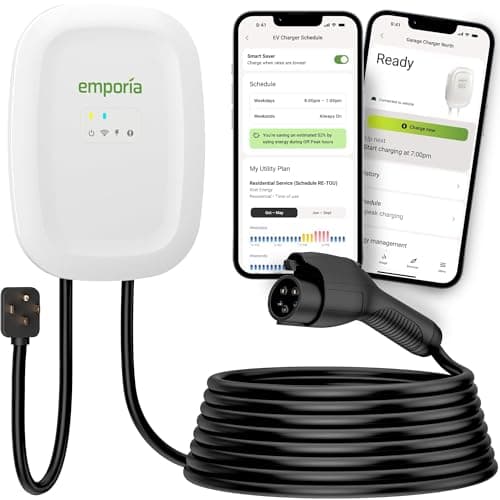
Emporia Level 2 (48A)
The charger that refuses to charge you extra for being smart: full 48-amp speed and real energy monitoring at roughly the price of a plain plug-in box.
#ad · As an Amazon Associate we earn from qualifying purchases.
Questions
Frequently asked
What amp charger does a Tesla Model S or Model X need?
Up to 48 amps (11.5 kW) - the onboard limit both accept, so a 48-amp charger on a 60-amp circuit is the fastest useful option. A bigger charger cannot push more into the car; a 40-amp unit is a little slower and perfectly usable.
Do I have to use a Tesla charger for a Model S or X at home?
No. The Tesla Wall Connector is the tidy native-NACS option, but any J1772 Level 2 charger works with the adapter Tesla includes. If you want smart features Tesla does not offer, a J1772 unit like the Emporia plus the adapter is a fine choice.
How much does it cost to charge a Model S or X at home?
Roughly $12 for a 10-to-80-percent top-up at the US-average electricity rate, or about 5 cents a mile - a fraction of gasoline. Your own rate decides the exact figure; the calculator above runs it for you.
Keep reading
Related
More in this section
More Charging Costs
Receipts
Sources
- Tesla - onboard charger (Model S / Model X accept up to 11.5 kW / 48A AC)
- US EIA - average price of electricity (residential rates)
- US DOE / fueleconomy.gov - EV charging basics
- US DOE AFDC - charging at home
We do not run a testing lab, and we do not pretend to. Where a measured number came from someone else's lab, we name them and link them. Where we could not verify something, we say so on the page rather than quietly leaving it out. Read our full method.