The best home charger for a Nissan Leaf or Ariya is the EVIQO Level 2. A Nissan's onboard AC charger is the real speed limit here - a Leaf accepts about 6.6 kW on most trims and an Ariya about 7.2 kW - so a well-certified 40-amp J1772 charger already has more headroom than the car can use, and paying up for a 48-amp unit buys speed a Nissan simply cannot accept on AC. The EVIQO delivers that 40 amps with double UL and ETL listing at the bottom of the price band. The Emporia is the smart step-up with energy monitoring, and the EVDANCE and MUSTART portables are the flexible, renter-friendly picks.
Every Nissan EV sold in North America charges at home through a J1772connector, the standard AC plug on nearly every non-Tesla EV - so any J1772 Level 2 charger on this site fits a Leaf or an Ariya directly, no adapter needed. What decides your real charging speed is not the wall unit but the car's onboard AC charger, and that is where a Nissan is distinctive. We compiled the published vehicle and charger specs and did the arithmetic; we have not bench-tested anything, and we do not invent per-model charge times.
Because the onboard charger caps the AC rate, the honest advice for a Nissan is to spend on certification, cable and smarts rather than on amps you cannot use. All four picks here are 40-amp J1772 units - two wall chargers and two portables - which is exactly the right target for this brand. If a 2025-or-newer Nissan in your driveway has a native NACS port instead, it still uses any J1772 charger with a simple adapter; confirm your car's port either way.
The short version
If you want one recommendation: buy the EVIQO - it gives a Nissan everything it can use for the least money. Beyond that:
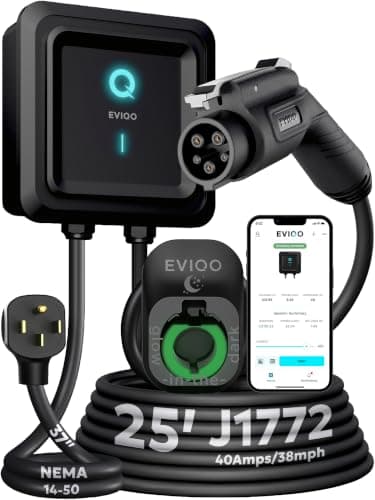
- EVIQO Level 2 - best for a Nissan overall. A 40-amp J1772 charger, double-listed UL and ETL, IP66 weatherproof, 25-foot cable, usually cheapest. It has all the headroom a Leaf or Ariya can use; its shorter brand history is the only caveat. Full EVIQO review.
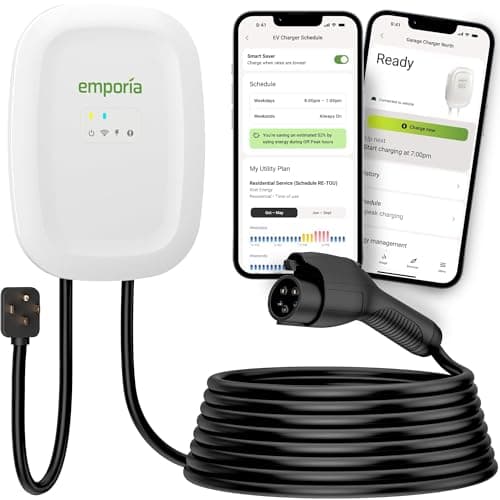
- Emporia Level 2 - the smart step-up.Real energy monitoring and scheduling at a plain-box price. Its 48-amp headroom is wasted on a Nissan's onboard limit, and the app is central to setup - but the monitoring is genuinely useful. Full Emporia review.
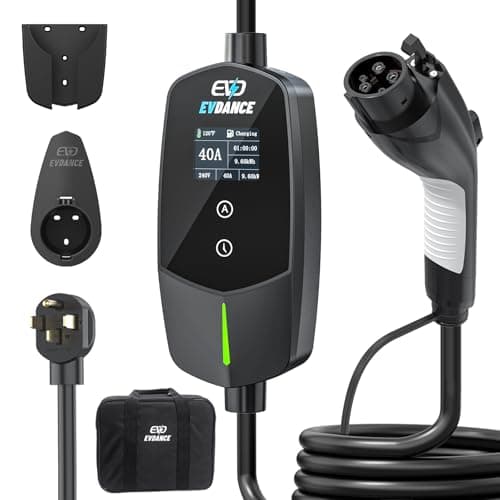
- EVDANCE 40A Portable - best for renters. A 40-amp J1772 portable with a delay timer for off-peak charging on a 25-foot cable, unplug-and-go. No app monitoring - the timer is the whole of the scheduling.
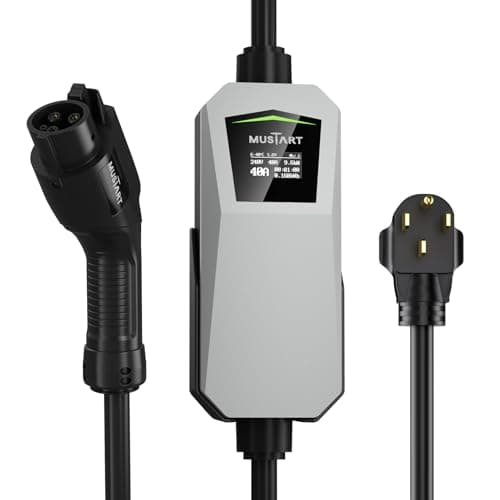
- MUSTART 40A Portable - the cheapest capable pick. A true 40-amp J1772 portable with an LCD readout at the lowest price. Its 21-foot cable is shorter and it is a value brand.
What a Nissan can actually use
This is the whole decision for a Nissan, so it is worth being precise about the numbers, all of which are published vehicle specs rather than anything we measured:
- Nissan Leaf. Charges on AC through a J1772 port. Its onboard AC charger is about 6.6 kW on most trims - roughly what a 32-amp charger supplies - while some base or early S trims are limited to about 3.6 kW. That means a 40-amp / 9.6 kW charger has headroom the Leaf cannot fully use on AC, and even a 32-amp / 7.7 kW unit already meets or exceeds most trims. Confirm your specific trim before assuming the higher rate.
- Nissan Ariya. Also J1772 for AC, with an onboard AC charger up to about 7.2 kW - so a 40-amp charger covers it with a little headroom to spare and a 32-amp unit is close to its ceiling.
- DC fast charging differs by model. The Leaf uses CHAdeMO for DC fast charging - a legacy standard now being phased out at public sites, worth knowing honestly if road-trip charging matters to you - while the Ariya uses the current CCS standard. Neither affects home charging: DC fast charging is a separate, public-only topic covered in our DC fast charging explainer.
The upshot is clean: for a Nissan, a 40-amp J1772 charger is the sweet spot, and there is no charging reason to pay for 48 amps. Spend the difference on certification, a long cable, or the install done right.
Why 40 amps is the right target - and 48 is wasted
The charger only supplies current; the car's onboard charger decides how much of it becomes charging speed. Since a Leaf accepts about 6.6 kW and an Ariya about 7.2 kW on AC, a 40-amp / 9.6 kW charger already delivers more than either can pull - the extra capacity sits unused. A 48-amp / 11.5 kW unit would deliver even more the car cannot touch. That is why every pick here is a 40-amp unit and none is a 48-amp one: the money is better spent on a double-listed enclosure, a 25-foot cable, or a portable's flexibility than on amperage a Nissan cannot convert. Our amperage guide explains the onboard-limit rule in full, and the best 40-amp roundup ranks the broader 40-amp field.
How long a Nissan takes to charge at home
Home charging time follows a simple relationship - energy added divided by power - and for a Nissan the power is set by the car's onboard charger, not the wall unit. At its typical 6.6 kW rate a Leaf adds on the order of 25 miles of range an hour, which turns an overnight into a full battery for almost any commute; the Ariya charges at a similar rate and, with its larger battery, simply takes a few more hours for a full fill from low - still comfortably an overnight job. We do not publish exact per-model hours, because real time depends on your battery's starting state, its temperature, and the trim's onboard rating - but the shape is clear: plug in at night, wake up full.
This is also why the trim matters. A base or early S Leaf limited to about 3.6 kW adds roughly half the range per hour of a 6.6 kW trim - still enough overnight for a normal commute, and a good reason not to overspend on amperage or even circuit size for that car. If your panel can only spare a 32-amp circuit, a Leaf loses nothing; if you rent and cannot install a circuit at all, a portable on an existing 14-50 covers the same nightly fill. Confirm your trim's onboard AC rating before sizing anything - it is the number that decides your real speed.
Running costs for a Nissan at home
A Leaf and an Ariya are both efficient, so home charging is cheap - covering a typical week of driving costs only a few dollars at normal residential rates, well under the equivalent gasoline. We work the numbers specifically for these cars, with a calculator you can run at your own rate, in our Nissan Ariya and Leaf home charging guide - the natural companion to this page. Charging at a lower amperage does not change what a full charge costs, only how many hours it takes, so a Leaf on a 32-amp circuit spends the same on electricity as one on 40 amps. The general method, for any car, is in our cost to charge at home guide.
The picks, in order
Below the summary table, each charger gets a full card with its score breakdown, pros and cons, and a "don't buy this if" note. In short: the EVIQO is the certified value winner for a Nissan, the Emporia adds energy monitoring for owners who want it, and the EVDANCE and MUSTART portables suit renters and anyone who wants to take the charger along - the EVDANCE with a delay timer and longer cable, the MUSTART on price. If you rent or move often, start with the plug-in chargers guide; a different-brand driveway is covered on our best chargers for a VW page, where the higher onboard limit changes the answer.
How to choose a charger for a Nissan
A Nissan makes this simpler than most brands, because the car's onboard limit removes the top-end speed question entirely. Work through these steps.
1. Confirm the connector - J1772
A Leaf and an Ariya charge on AC through a J1772 port, so every charger on this page fits directly with no adapter. If yours is a 2025-or-newer Nissan that ships with a native NACS port, it still uses any J1772 charger through a NACS-to-J1772 adapter - the hardware choice does not change. Confirm your port in the manual; through 2024 it is J1772.
2. Match the amps to the onboard charger, not the panel
For most brands you size the charger to your panel. For a Nissan, the car is the bottleneck: a Leaf accepts about 6.6 kW - near a 32-amp supply - and an Ariya about 7.2 kW. A 40-amp charger covers either with headroom to spare, and there is no benefit to a 48-amp unit because the onboard charger cannot use it. If your panel only supports a 32-amp circuit, that is still enough for most Leaf trims. Confirm your trim - base and early S Leafs are limited to about 3.6 kW, so a smaller circuit fully serves them.
3. Wall unit or portable
Both charge a Nissan at the same 40-amp ceiling, so choose on lifestyle. A wall unit (EVIQO or Emporia) is tidier and stays mounted, with the Emporia adding energy monitoring. A portable (EVDANCE or MUSTART) plugs into a NEMA 14-50, unplugs to travel, and suits renters or anyone who might move - the natural pick if you cannot install a fixed charger. Our best portable chargers guide covers the travel case.
4. Spend on certification and cable, not amps
With the amperage question settled at 40, put the budget where it matters: an explicit UL or ETL listing on a unit that runs for hours unattended, a weatherproof rating if it mounts outside, and a cable long enough to reach your Nissan's port however you park. The EVIQO's double UL and ETL listing and IP66 rating is the clearest value here; the MUSTART's low price comes with a shorter 21-foot cable to check against your parking spot.
5. Future-proofing for a NACS Nissan
Nissan, like several automakers, is moving toward the NACS port on newer models, and that shift does not change what you buy today. A J1772 charger is the right choice for any current Leaf or Ariya, and if a future or 2025-and-newer Nissan in your driveway has a native NACS port, it still uses the same J1772 charger through an inexpensive NACS-to-J1772 adapter. In other words, none of these picks becomes obsolete when the connector changes - you keep the charger and add a small passive adapter. Confirm your car's actual port in the manual rather than assuming; through 2024 every Nissan EV is J1772.
So, which one?
Buy the EVIQO for the best certified value a Nissan can fully use. Want energy monitoring and scheduling? The Emporia. Renting, moving, or wanting off-peak timing without an app? The EVDANCE portable. Just want the lowest price on a capable 40-amp portable? The MUSTART, if its 21-foot cable reaches. For a Nissan, none of these leaves speed on the table - the car's onboard charger is the ceiling, and every pick clears it.