Skip to content
The Charge Curve

HUB 01 · Home EV Chargers

Grizzl-E Duo Connect Review

One box, two cables, one circuit. The cheapest honest way to charge two EVs at home - as long as you understand that both cars at once means 20 amps each.

By Stephen V.Updated How we compare
#ad

We earn a commission when you buy through our Amazon links, at no extra cost to you. It never affects our rankings, and we say so when the cheaper product is the better buy. How this works.

Grizzl-E Grizzl-E Duo (dual 40A)

Our top pick

Grizzl-E Duo (dual 40A)

8.4/10
$899.99Check Price

In stock at Amazon as of October 18, 2026.

#ad · we may earn a commission

Best for: Two EVs sharing one circuit

Two 25-foot cables splitting one circuit — the honest answer for a two-EV household that isn't going to run a second line.

Read the full review ↓Compare all 3 picks ↓

The short answer

Quick picks

  • Grizzl-E Grizzl-E Duo (dual 40A)
    01 Grizzl-E Duo (dual 40A)
    8.4

    Two 25-foot cables splitting one circuit — the honest answer for a two-EV household that isn't going to run a second line.

    Best for: Two EVs sharing one circuit

    $899.99Amazon
  • Grizzl-E Grizzl-E Classic (40A)
    02 Grizzl-E Classic (40A)
    8.0

    A UL-certified cast-aluminum box with no app to update and nothing in the cloud to fail — the durability default for people who want a charger, not a gadget.

    Best for: People who want a charger, not an app

    $299.99Amazon
  • Wallbox Wallbox Pulsar Plus (40A)
    03 Wallbox Pulsar Plus (40A)
    7.6

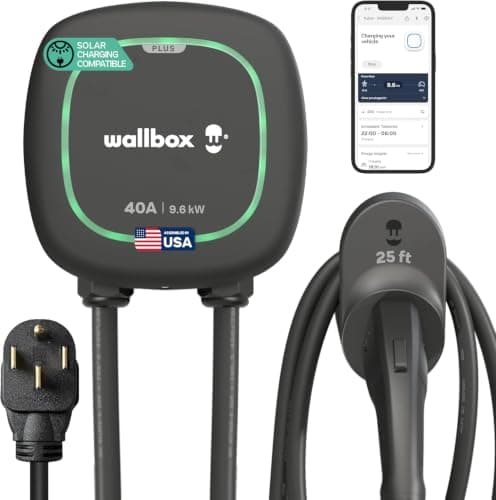
    The smallest wall face we can document - 7.9 by 7.8 inches - in the plug-in 40-amp version that is reliably in stock.

    Best for: The smallest possible box on the wall

    $649.99Amazon

#ad · Live prices from the Amazon Product API, as of October 18, 2026. Where we have no verified live price, we show none — we would rather leave a gap than print a number that has gone stale.

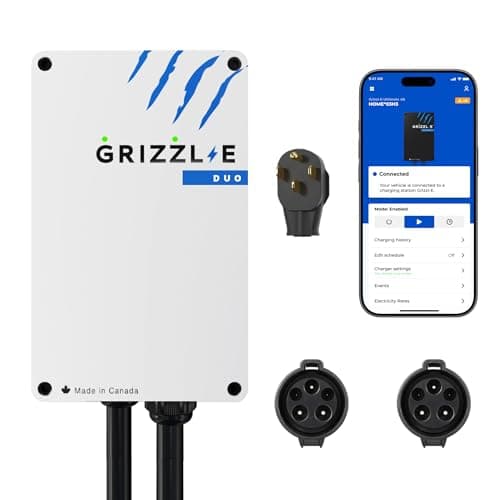
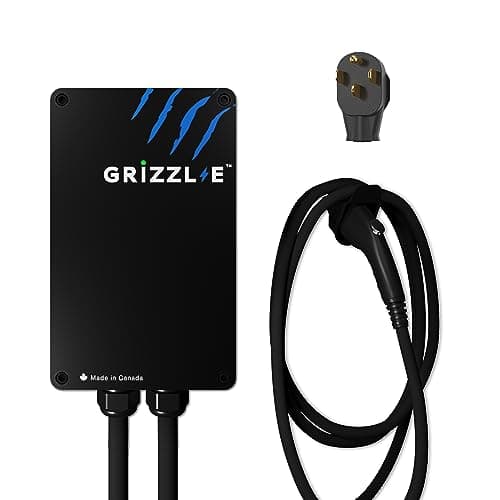
Buy the Grizzl-E Duo Connect if you have two EVs, one 50-amp circuit, and no appetite for a second electrical job. It puts two 25-foot cables on a single NEMA 14-50 plug, delivers 40 amps total - the full 40 to one car when it is alone, 20 amps to each when both are plugged in - and it is UL and cUL certified in a Type 4 indoor/outdoor enclosure, adjustable from 40 amps down to 16. The honest caveat is the split: 20 amps is 4.8 kW, roughly 17 miles of range an hour. For two commuters parked for ten hours that is ample. For two high-mileage drivers it is not.

We do not run a testing lab. What follows is compiled from United Chargers' published specifications for the Duo Connect 40A and the live Amazon listing, both checked on 6 October 2026, with the overnight arithmetic done against the NEC continuous-load rule. Everything is cited in Sources.

What you actually get

SpecAs published
Total current40 A (9.6 kW at 240 V), adjustable down to 16 A
With two cars charging20 A to each
CablesTwo, 25 ft each
ConnectorsJ1772 and/or NACS, depending on configuration
SupplyNEMA 14-50 plug, one 50 A circuit
EnclosureUL Type 4, indoor/outdoor; 10.25 x 6.25 x 3.75 in
CertificationUL / cUL, file E510712
Operating range-22F to 122F (-30C to +50C)
Weight26.46 lb
ConnectivityWi-Fi 2.4 GHz and a mobile app
Warranty3-year, with a 5-year option

One buying note: United Chargers lists the Duo Connect in several connector configurations - two J1772, two NACS, or one of each - but the Amazon listing we link is the two-J1772 white version. If you want a mixed pair for a Tesla plus a J1772 car, check the configuration before you order, or read chargers for a mixed Tesla and J1772 household, where an ordinary charger plus a listed adapter is usually the cheaper route.

The 20-amp split, and whether it matters

This is the whole product, so it is worth doing the arithmetic rather than hand-waving. The Duo does not add capacity - it shares one circuit, which is exactly why it needs no second electrical job. What that means in practice:

SituationCurrent per carPower per carRange per hourOver 10 hours
One car plugged in40 A9.6 kWAbout 33 milesAbout 330 miles
Both cars plugged in20 A each4.8 kW eachAbout 17 miles eachAbout 170 miles each

Range figures assume roughly 3.5 miles per kilowatt-hour. The reason this is usually fine is that two cars in one household rarely both need a big charge on the same night: 170 miles each is far more than two average commutes. And when only one car is home, it gets the full 40 amps, so the shared design costs you nothing on the nights it does not need to.

It stops being fine in three cases. Two genuinely high-mileage drivers. A household where one car comes home nearly empty and leaves early. And a winter where cold weather eats range and some of the charge goes to conditioning the battery rather than filling it - see cold weather range loss. In any of those, two separate chargers that power-share, or two circuits, is the better answer. Our can two EVs share one charger guide works through that decision in full.

What it gets right

One plug, one circuit, no second install

The economics are the point. A second charger usually means a second circuit - a breaker, a cable run, a box, an inspection - and in an older house it can mean a panel conversation you did not want to have. The Duo takes one existing 50-amp circuit with a NEMA 14-50 receptacle and serves two bays from it. Against the cost of a second circuit, the premium over a single-port charger is usually the cheaper half of the comparison, and our installation cost guide shows what you are avoiding.

Two 25-foot cables is the right length

Twenty-five feet is what it takes to reach either bay of a two-car garage, and you get two of them. This is the spec that makes the Duo a genuine two-bay product rather than a box with two cables that both only reach one car. It is also 26 pounds of hardware, so mount it into structure, not drywall anchors - see where to mount an EV charger, and holsters, because two cables on the floor is twice the tripping and twice the grit in the connectors.

The Grizzl-E build, with a UL file number you can look up

UL and cUL certified under file E510712, a Type 4 indoor/outdoor enclosure and a published -22F to 122F operating range. A metal-cased, properly listed unit is what you want on a device carrying 40 amps continuously in a garage, and a file number is the thing that lets you verify the claim rather than trust the copy - see our UL-listed roundup.

Adjustable to 16 amps

The full 40-to-16 range means the Duo also fits a smaller circuit. On a 40-amp breaker you set 32 amps total, which is 16 amps per car when both charge - slower, but it still turns a tight panel into a two-EV garage, which is a genuinely useful thing to be able to do.

What it gives up

It is expensive for a 40-amp charger

Judge it against two chargers plus a circuit, not against one charger. Priced against a single 40-amp wall unit it looks dear, because you are buying a second cable, a second connector and the sharing electronics. Priced against the alternative that actually serves two cars, it is usually ahead. If only one of your two cars is electric today, buy a single-port unit now - the Grizzl-E Classic is the same family at a fraction of the price - and revisit this when the second EV arrives.

No more total power than a single 40-amp charger

Worth repeating because the marketing of dual-port chargers invites the wrong conclusion: this is a sharing device, not a capacity device. If what you want is two cars at full speed simultaneously, you need two circuits or real load management across two units, not one box.

One box is one failure point

Two separate chargers degrade gracefully - if one fails, the other car still charges. A dual-port unit that fails takes both cars with it until it is replaced. That is a real consideration for a household with no public charging nearby, and it is the honest argument for two cheaper single-port units where the second circuit already exists.

Hardwiring is not an option here

The Duo Connect is a 14-50 plug-in unit. For most people that is a positive - it means no hardwire labor and the ability to unplug and take it along - but it does cap the whole unit at 40 amps total, and it makes the receptacle a part you should not economize on. A cheap 14-50 is the single most common failure in home charging under a sustained 40-amp draw; best NEMA 14-50 outlets covers the ones worth fitting.

Who should buy it

Buy it if you have two EVs now, one 50-amp circuit with a rated 14-50 outlet, two bays within 25 feet of one mounting point, and ordinary commuting mileage. In that house it is the cheapest honest answer, and the 20-amp split will never bother you.

Skip it if only one car is electric today, if both drivers cover high mileage, if you want hardwired 48-amp charging, or if you would rather have two independent units. Where the budget allows two chargers, two Wallbox Pulsar Plus units on Power Sharing give each car its own connector at full speed when the other is idle - that is the premium version of the same idea, and it is in our dual-port roundup alongside this unit.

We quote price brackets rather than numbers in prose on purpose: the live figure in the buy row above carries the date we checked it, and it is the only price on this page we stand behind.
In detail

The picks, in full

01
Grizzl-E Grizzl-E Duo (dual 40A)

Two EVs sharing one circuit

Grizzl-E Duo (dual 40A)

Dual J1772Up to 40A sharedTwo 25ft cablesNEMA 14-50 plug
8.4/10

Two 25-foot cables splitting one circuit — the honest answer for a two-EV household that isn't going to run a second line.

Charge speed
7
Build & weather
10
Smart features
8
Cable & connector
9
Value
8

Pros

  • Charges two vehicles from a single circuit by dividing the available current between them
  • Two long 25-foot cables reach both bays of most garages
  • The same rugged cast-aluminum Grizzl-E enclosure as the Classic
  • Wi-Fi connected: the Grizzl-E Connect app adds charge scheduling, real-time monitoring and energy statistics, and charging still works with the connection down

Cons

  • The two cars share the circuit's amperage — plug in the second and the rate to the first drops
  • Overkill and more expensive if you only ever charge one vehicle
  • The advanced OCPP integration is a paid unlock — Grizzl-E charges a one-time activation fee on top of the hardware

Don't buy this if…

…you only charge one car. You are paying for a second cable you will never use — buy the single-cable Classic and keep the difference.

$899.99View on Amazon

Price as of October 18, 2026. Prices change — Amazon's is the one that counts.

#ad · we may earn a commission from this link to Grizzl-E Duo (dual 40A)

02
Grizzl-E Grizzl-E Classic (40A)

People who want a charger, not an app

Grizzl-E Classic (40A)

40A / 9.6kWJ1772NEMA 14-50 plugUL certified
8.0/10

A UL-certified cast-aluminum box with no app to update and nothing in the cloud to fail — the durability default for people who want a charger, not a gadget.

Charge speed
8
Build & weather
10
Smart features
5
Cable & connector
8
Value
9

Pros

  • Cast-aluminum enclosure rated for indoor and outdoor use — genuinely built to outlast plastic-bodied rivals
  • UL certified, which plenty of budget chargers on Amazon cannot claim
  • No mandatory app or Wi-Fi: it charges the day it arrives and keeps working if a server goes dark

Cons

  • No scheduling or energy monitoring — if you want off-peak automation or load sharing, look elsewhere
  • The stock cable stiffens in the cold, a recurring owner note in northern climates

Don't buy this if…

…you want app scheduling, energy tracking, or load sharing between two cars. The Grizzl-E is deliberately dumb, and if smart features are the point for you, the Emporia is the better buy.

$299.99View on Amazon

$399.0025% off

Price as of October 18, 2026. Prices change — Amazon's is the one that counts.

#ad · we may earn a commission from this link to Grizzl-E Classic (40A)

03
Wallbox Wallbox Pulsar Plus (40A)

The smallest possible box on the wall

Wallbox Pulsar Plus (40A)

40A / 9.6kWJ1772NEMA 14-50 or hardwired7.9 x 7.8 x 3.9 in
7.6/10

The smallest wall face we can document - 7.9 by 7.8 inches - in the plug-in 40-amp version that is reliably in stock.

Charge speed
8
Build & weather
8
Smart features
8
Cable & connector
7
Value
7

Pros

  • Published 7.9 x 7.8 x 3.9 in - the smallest wall FACE of any Level 2 charger we track, which is what matters beside a door or in a narrow bay
  • UL and Energy Star certified, and assembled in the US
  • Wi-Fi and Bluetooth both, with scheduling and monitoring in the myWallbox app
  • The NEMA 14-50 version installs in minutes where a rated outlet already exists

Cons

  • 40-amp ceiling - the 48-amp Pulsar Plus is the same body but hardwired, and stock on it comes and goes
  • The Wallbox app has historically drawn more owner complaints than the hardware

Don't buy this if…

…you want 48 amps. This is the 40-amp variant; it is here because it is the small one that is reliably buyable, not because 40 amps is the ceiling of the design.

$649.99View on Amazon

$749.0013% off

Price as of October 18, 2026. Prices change — Amazon's is the one that counts.

#ad · we may earn a commission from this link to Wallbox Pulsar Plus (40A)

How we picked

We do not run a testing lab

We compiled published specifications from manufacturer manuals and spec sheets, verified the safety listings (UL / ETL), computed the real running and installation costs, checked the wiring math against the NEC continuous-load rule, and read aggregated owner reviews — then scored each product against a published rubric. The scores are judgments from documented research — they are not bench measurements, because we do not have a test lab and we are not going to pretend we do. Every spec and cost figure is cited in Sources.

Questions

Frequently asked

Can the Grizzl-E Duo charge two cars at the same time?

Yes, at 20 amps each. The unit delivers 40 amps total: the full 40 to a single car, split to 20 amps each when both are plugged in. Twenty amps is 4.8 kW, roughly 17 miles of range per hour, so about 170 miles each over a ten-hour night - comfortably more than two average commutes.

Does the Grizzl-E Duo need two circuits?

No, and that is the point of it. It runs from one 50-amp circuit through a single NEMA 14-50 plug, sharing that circuit between the two cables. Avoiding the second circuit - breaker, cable run, box and inspection - is where the money it costs comes back.

Is the Duo worth it over two separate chargers?

It depends on whether the second circuit exists. If it does, two single-port chargers are cheaper in hardware and fail more gracefully. If it does not, the Duo is almost always the cheaper total: one circuit, one install, one inspection. Two units that power-share are the premium option - each car gets full speed when the other is idle. See can two EVs share one charger.

Will the Duo work with a Tesla?

Depends on the configuration you buy. United Chargers lists the Duo Connect with two J1772 connectors, two NACS, or one of each - but the Amazon listing we link is the two-J1772 version, so a Tesla needs a J1772-to-NACS adapter on that one. Our adapter roundup ranks the listed options, which is usually the cheaper route anyway.

Can I use the Duo on a 40-amp circuit?

Yes. It adjusts from 40 amps down to 16, so on a 40-amp breaker you set it to 32 amps total - which is 16 amps to each car when both charge. Slower, but it makes a two-EV garage possible on a circuit that could not feed a 40-amp charger. See 32 amps vs 40 amps for the circuit math.

Is the Duo weatherproof enough for an outside wall?

United Chargers publishes a UL Type 4 indoor/outdoor rating and a -22F to 122F operating range, so yes on the enclosure. The usual caveats apply regardless of rating: shade and a bit of cover extend the life of any charger, and the heavy Grizzl-E cable stiffens in deep cold - see weatherproofing an outdoor install and best cold-weather chargers.

How long does a charger like this last?

A listed, properly installed unit is a decade-plus appliance - the Duo carries a 3-year warranty with a 5-year option. On a plug-in install like this one, the part most likely to fail is the NEMA 14-50 receptacle rather than the charger, and with two cables there is twice as much cable and connector handling to look after. Our how long do EV chargers last guide names what actually fails first.

Keep reading

More in this section

More Home EV Chargers

All home ev chargers →

Receipts

Sources

We do not run a testing lab, and we do not pretend to. Where a measured number came from someone else's lab, we name them and link them. Where we could not verify something, we say so on the page rather than quietly leaving it out. Read our full method.