HUB 04 · Charging Costs
Home vs Public Charging: The Cost Difference
Home charging is the reason EVs are cheap to run; public fast charging is the convenience you pay a premium for. Here is how far apart the two are and why the mix matters.
We earn a commission when you buy through our Amazon links, at no extra cost to you. It never affects our rankings, and we say so when the cheaper product is the better buy. How this works.
The single biggest lever on what an EV costs to run is where you charge it. Home charging on residential electricity is the cheapest fuel most people will ever buy; public DC fast charging, priced for speed and convenience, can cost several times more per kWh. The EV cost story you hear - pennies per mile - assumes you do most of your charging at home. Here is how far apart the two really are and how to think about the mix.
Why home is so much cheaper
At home you pay your ordinary residential electricity rate, and on an off-peak plan even less. There is no markup for hardware, no site operator, no session fee - just kWh at your utility rate. That is why home charging lands around a few cents per mile, worked out in cost to charge at home and normalized in cost per mile. Charging overnight while you sleep also means the "fill-up" costs you no time at all.
Why public fast charging costs more
Public DC fast charging carries a premium for good reasons: the hardware is expensive high-power equipment, the operator pays commercial electricity rates and demand charges, and you are paying for the speed and the location. The result is a per-kWh price often well above home rates, sometimes with an added session or idle fee, and Level 2 public stations sit somewhere in between. The public pricing landscape - per-kWh vs per-minute, memberships, idle fees - is detailed in public charging cost and public charging networks.
The mix is what matters
Most owners charge at home the large majority of the time and use public fast charging only on trips, and that mix is what keeps the average cost low. Flip it - rely mostly on public DC fast charging because you cannot charge at home - and an EV's running cost can climb toward, or even past, the cost of gas. This is the honest asterisk on "EVs are cheap to run": they are cheap to run at home. If you can install home charging, it is the single biggest cost win available, which is the core of is a home EV charger worth it.
| Home (Level 2) | Public DC fast | |
|---|---|---|
| You pay | Your residential rate (off-peak even less) | A premium per-kWh (or per-minute) price |
| Extra fees | None | Possible session/idle fees |
| Best for | Daily, overnight charging | Road trips and quick top-ups |
Getting the cheap side set up
The way to bank the savings is to make home your default: a Level 2 charger on a dedicated circuit, ideally on an off-peak schedule. A value smart unit like the Emporia handles the scheduling, and the running-cost pages show what to expect. Then treat public fast charging as the trip tool it is, priced for when you cannot wait. For the deeper home-vs-public speed story, see DC fast charging vs Level 2.
Bottom line: home charging is where EVs earn their cheap-to-run reputation; public fast charging is a convenience you pay a premium for. Charge at home for daily driving, use public DC for trips, and the average stays low.
The gear
Recommended gear for this guide
The products this guide refers to, with prices pulled live from Amazon and dated on each card.
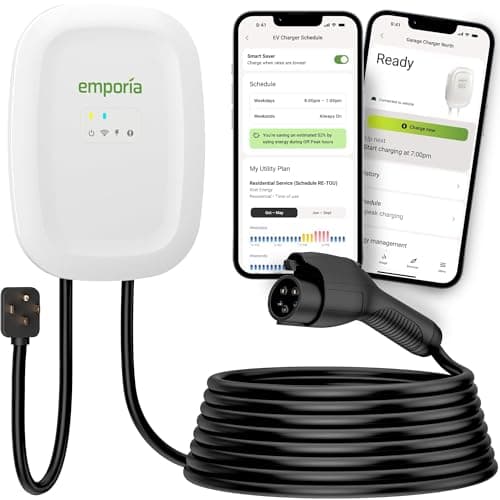
Most homes that want speed and smarts
Emporia Level 2 (48A)
The charger that refuses to charge you extra for being smart: full 48-amp speed and real energy monitoring at roughly the price of a plain plug-in box.
#ad · As an Amazon Associate we earn from qualifying purchases.
Questions
Frequently asked
Is home charging really cheaper than public charging?
Yes, substantially. At home you pay your residential rate with no markup; public DC fast charging is priced for speed and can cost several times more per kWh, sometimes with added fees. Level 2 public sits in between.
How much more does public DC fast charging cost?
It varies by network and location, but the per-kWh price is typically well above home rates, and idle or session fees can add more. See public charging cost for how the pricing models work.
Can an EV be expensive to run if I only use public charging?
It can. Relying mostly on public DC fast charging removes the home-charging savings and can push running cost toward gas territory. The cheap-to-run case assumes most charging happens at home.
How do I keep my charging costs low?
Charge at home for daily driving, ideally on an off-peak time-of-use rate, and use public fast charging only on trips. A home Level 2 charger on a dedicated circuit is the biggest single cost win.
Keep reading
Related
- Can You Own an EV Without Home Charging?The honest cost and routine for owning one with no charger at home.
- Workplace Charging CostFree, subsidized or per-hour - how to value what your employer offers.
- Public Charging CostHow per-kWh, per-minute and idle fees actually price a session.
- Cost to Charge at HomeThe cheap side, with a calculator for your own rate.
- EV vs Gas CostWhere the home-charged per-mile figure beats gasoline.
- Is a Home EV Charger Worth It?Why home charging is the biggest running-cost win.
- DC Fast Charging vs Level 2The speed-and-cost split behind home vs public.
More in this section
More Charging Costs
Receipts
Sources
- US DOE AFDC - charging an EV at home
- US EIA - average residential electricity price by state
- US DOE AFDC - EV charging infrastructure & levels
We do not run a testing lab, and we do not pretend to. Where a measured number came from someone else's lab, we name them and link them. Where we could not verify something, we say so on the page rather than quietly leaving it out. Read our full method.