HUB 04 · Charging Costs
EV Charging Cost by State: What You'll Pay
Your electricity rate - not the car or the charger - is what moves the bill most, and it varies widely by state. Here is how to size it for where you live.
We earn a commission when you buy through our Amazon links, at no extra cost to you. It never affects our rankings, and we say so when the cheaper product is the better buy. How this works.
There is one number that decides what charging your EV costs, and it is not on the window sticker or the charger box - it is your electricity rate. And that rate swings enormously depending on where you live and which utility serves you. The same 10-to-80 percent charge that costs about five dollars in one state can cost three times that in another. This page shows the range, points you to the exact figure for your state, and explains why home charging still wins almost everywhere.
Why rate is the whole story
The energy your car needs does not change when you move - a 65 kWh battery holds 65 kWh in Oregon or in Connecticut. What changes is the price you pay per kilowatt-hour. Unlike gasoline, where the pump price varies within a fairly narrow band nationally, home electricity rates vary by a factor of three or more across the country. That makes your local rate the single biggest lever on your charging cost, ahead of your car, your charger, and everything else.
The cost across a range of rates
Rather than print exact per-state cents - which drift constantly and depend on your specific plan - here is a band table. It shows a 10-to-80 percent charge on a typical 65 kWh EV (that is 45.5 kWh into the battery, or about 50.6 kWh from the wall once you add the ~10 percent loss), plus the resulting cost per mile at 3.5 mi/kWh, across four rate points that bracket most of the country:
| Electricity rate | Cost of a 10-80% charge (65 kWh EV) | Approx. cost per mile (3.5 mi/kWh) |
|---|---|---|
| $0.10 / kWh (low) | ~$5.06 | ~$0.032 |
| $0.16 / kWh (near US average) | ~$8.10 | ~$0.051 |
| $0.25 / kWh (high) | ~$12.64 | ~$0.079 |
| $0.35 / kWh (very high) | ~$17.70 | ~$0.111 |
Find the row nearest your rate and you have your ballpark. To pin it down, read the rate off a recent bill, or use the calculator below.
Which states run high, which run low
Without inventing precise numbers, some well-established patterns hold. Electricity tends to be well below the national average across much of the Pacific Northwest - where abundant hydro power keeps rates low - and across parts of the South. It tends to run well above average in California, much of the Northeast, and especially Hawaii, which is the most expensive state for electricity by a wide margin. Most other states sit somewhere in the middle, near that 16-to-17-cent national average.
Get your state's real number.For the actual average residential price where you live, use the EIA's state table (linked in Sources below) - it is updated regularly and broken out by state. Better still, read the rate straight off your own utility bill, since your specific plan can differ from the state average.
Run it for your car
Cost-to-charge calculator
Put in your electricity rate, your battery size and your car's efficiency. The math is the same one shown above, with a 10% charging loss included so the number is realistic.
- $8.09
- A 10% to 80% charge
- $11.56
- A full (empty to 100%) charge
- $0.05
- Cost per mile
- $5.08
- Cost per 100 miles
Estimate only. Actual cost depends on your exact utility rate (including any time-of-use pricing and fees), your car's real efficiency, temperature, and charging losses. Check your electric bill for your true rate.
Off-peak charging cuts the bill in any state
Wherever you live, when you charge can matter as much as your headline rate. Many utilities offer time-of-use plans with a cheaper overnight window, and because an EV charges while you sleep, you can shift almost all of its load into that cheap window. On the right plan this lowers your effective rate no matter which state you are in - see off-peak and time-of-use charging for how to set it up and whether it pays off for your household.
Even at a high rate, home still wins
Here is the reassuring part: even in the most expensive states, home charging beats the alternatives for most drivers. Public DC fast charging is priced at a premium per kWh - see public charging cost - so your expensive home rate is usually still cheaper than the road-trip network. And measured against gasoline, an efficient EV stays competitive even at 35 cents per kWh; the full comparison, with the assumptions shown, is in EV vs gas cost. For the underlying formula and a per-charge breakdown, see cost to charge at home, and if you are worried about what all this adds to your power bill, do EV chargers use a lot of electricity puts it in context.
The gear
Recommended gear for this guide
The products this guide refers to, with prices pulled live from Amazon and dated on each card.
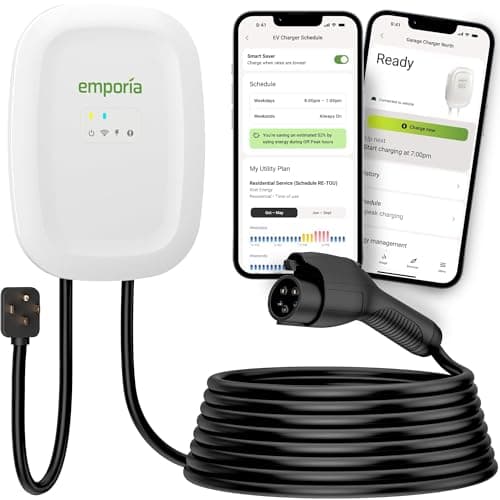
Most homes that want speed and smarts
Emporia Level 2 (48A)
The charger that refuses to charge you extra for being smart: full 48-amp speed and real energy monitoring at roughly the price of a plain plug-in box.
#ad · As an Amazon Associate we earn from qualifying purchases.
Questions
Frequently asked
Which state has the cheapest EV charging?
Charging is cheapest where residential electricity is cheapest, which tends to be parts of the Pacific Northwest and the South. Rather than a single ranking that goes stale, check the EIA state price table linked below for the current figure where you live, then run it through the calculator.
Why is EV charging so expensive in California and the Northeast?
Because their residential electricity rates are well above the national average, and charging cost tracks that rate almost directly. Hawaii is higher still. In those areas a time-of-use plan and overnight charging make a bigger difference than anywhere else - and home charging is usually still cheaper than public fast charging.
How do I find my state's electricity rate?
The EIA publishes average residential electricity prices by state (linked in Sources), updated regularly. Even better, read the rate directly off a recent utility bill - your specific plan can differ from the state average, and that is the number the calculator wants.
Does the state I live in change how fast my EV charges?
No - charging speed is set by your car's onboard charger and your circuit, not your location. Your state only changes the price of the electricity, not the rate of energy transfer. Cost varies by state; charging time does not.
Keep reading
Related
- Cost to charge at homeThe formula and calculator behind these figures.
- Cost to charge per mileThe per-mile version of the same math.
- Off-peak chargingHow to cut the bill regardless of your state.
- Public charging costWhy home still wins even at a high home rate.
- Do chargers use a lot of power?What the charge adds to your home electricity use.
More in this section
More Charging Costs
Receipts
Sources
- US EIA - electricity data (residential rates)
- US EIA - average price of electricity by state (Electric Power Monthly, Table 5.6.A)
- US DOE AFDC - charging at home
We do not run a testing lab, and we do not pretend to. Where a measured number came from someone else's lab, we name them and link them. Where we could not verify something, we say so on the page rather than quietly leaving it out. Read our full method.