HUB 03 · Charging Guides
Copper vs Aluminum Wire for an EV Charger
Copper is the default; aluminum can save money on long runs - if it is upsized and terminated correctly. Here is the ampacity math and the fine print.
We earn a commission when you buy through our Amazon links, at no extra cost to you. It never affects our rankings, and we say so when the cheaper product is the better buy. How this works.
For most home EV charger circuits the wire is copper, and copper is the default for a reason - it carries more current per gauge and terminates without special handling. Aluminum is not wrong; it is simply different. It carries less current for the same gauge, so it has to be upsized, and it needs terminations and installation practices copper does not. On a long run, upsized aluminum can be meaningfully cheaper. Which one goes in your wall is a licensed electrician's call, but here is the reasoning behind it.
Why aluminum has to be a size bigger
The property that decides this is ampacity - how much current a conductor can carry continuously without overheating, as set out in the NEC ampacity tables (Table 310.16). Aluminum has lower ampacity than copper of the same gauge, so you cannot swap one for the other at the same size. A typical 50-amp EV circuit - the one a 40-amp charger needs - is usually 6 AWG in copper. Do the same job in aluminum and it must be upsized to roughly 4 AWG. The exact gauge always comes from the electrician reading the ampacity table against your breaker size, the run length, and the conditions, but the direction is fixed: aluminum goes up a size or two versus copper.
This is why you cannot look at a copper spec and assume aluminum follows the same number. The breaker size stays the same - a 50-amp circuit is a 50-amp circuit - but the conductor gauge that satisfies it is larger in aluminum. We keep the copper-based sizing in EV charger wire and breaker size as the baseline, and aluminum is the upsized variant of it.
The catch: aluminum needs the right terminations
Aluminum's discount comes with conditions, and they are not optional. Aluminum expands and contracts more than copper as it heats and cools, and it can form an oxide layer, so a connection that is fine for copper can loosen over time on aluminum. To handle that safely, aluminum conductors must land on terminals rated for aluminum - marked AL/CU or, on receptacles and devices, CO/ALR - be coated with an antioxidant compound where the installer specifies, and be torqued to the manufacturer's exact specification. A loose aluminum termination is the classic cause of an overheating connection.
That last point matters especially for a plug-in charger, where the conductors land on a NEMA 14-50 receptacle. The receptacle itself has to be rated for the conductor material and torqued correctly - one more reason to fit an industrial-grade 14-50 outlet rather than a bargain one. We spell out what the receptacle needs in the NEMA 14-50 outlet guide. None of this is a reason to fear aluminum; it is a reason to insist the person installing it treats it as aluminum.
When aluminum is the smart choice
Aluminum earns its keep on long runs. Because copper is denser and pricier per foot, a run from the panel to a detached garage or the far side of the house can cost noticeably more in copper than in upsized aluminum - even after paying for the larger aluminum gauge. That is exactly the scenario where distance is already pushing the conductor larger for voltage-drop reasons; see how far an EV charger can be from the panel. It is also why aluminum shows up frequently in feeders to a subpanel, covered in do I need a subpanel for an EV charger. On a short run inside an attached garage, the copper premium is small and copper's simpler terminations usually win.
When copper is the better default
For a typical attached-garage install with a short run to the panel, copper is the straightforward choice: a common gauge, no special terminations, and a connection that stays tight with less fuss. Many electricians simply prefer copper for home charger circuits for that reason, and many homeowners are happy to pay the small premium on a short run for the simplicity. Neither metal is unsafe when installed to code - the failures you read about almost always trace back to an aluminum connection that was treated like copper, not to aluminum itself.
Choosing the conductor material and gauge, reading the NEC ampacity tables, and terminating aluminum with the correct AL/CU-rated devices, antioxidant, and torque is standard NEC work and a job for a licensed electrician - never a DIY project. An aluminum conductor sized like copper, or landed on a copper-only terminal, can overheat at the connection. Use this guide to understand the trade-off, then let a pro size and terminate the circuit to code.
The bottom line: copper is the simple default on a short run; aluminum is the cost-saver on a long one, provided it is upsized and terminated as aluminum. Tell your electrician the run length and let the ampacity table and your budget decide. Either way the breaker size is set by the charger and the receptacle, if any, must match - which is where a properly rated conductor count and receptacle type come back into the picture. The amperage - and so the breaker - for each unit is listed in the best Level 2 chargers for home, which is the number your electrician sizes the run to.
The gear
Recommended gear for this guide
The products this guide refers to, with prices pulled live from Amazon and dated on each card.
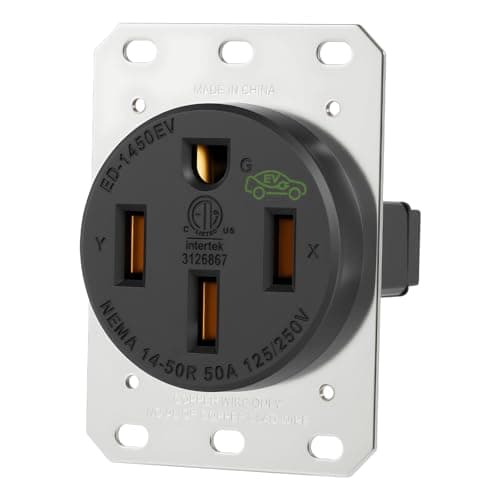
The outlet a plug-in charger needs
Industrial NEMA 14-50 Outlet
The receptacle a plug-in charger actually plugs into — buy the industrial-grade, listed version, because the cheap ones are the exact part that fails.
#ad · As an Amazon Associate we earn from qualifying purchases.
Questions
Frequently asked
Is aluminum wire safe for an EV charger?
Yes, when it is installed as aluminum: upsized to the correct gauge, landed on AL/CU or CO/ALR-rated terminals, coated with antioxidant where specified, and torqued to spec. The problems people hear about come from aluminum treated like copper, not from the metal itself. Your electrician makes that call.
Why does aluminum have to be a bigger gauge than copper?
Because aluminum has lower ampacity than copper of the same size, per the NEC ampacity tables. A 50-amp circuit that uses 6 AWG copper needs roughly 4 AWG aluminum to carry the same current safely. The breaker size does not change - only the conductor gauge does.
Which is cheaper for a home EV charger?
It depends on the run. On a short run in an attached garage, copper is cheap enough that its simpler terminations usually win. On a long run to a detached garage or across the house, upsized aluminum is often the cheaper conductor even after buying the larger gauge.
Can I mix copper and aluminum on the same circuit?
Only through connectors and terminals rated for both materials (marked AL/CU) and installed to their listing. You never twist copper and aluminum together directly. This is exactly the kind of detail that keeps the work with a licensed electrician.
Keep reading
Related
- EV Charger Wire and Breaker SizeThe copper-based baseline aluminum is upsized from.
- How Far Can an EV Charger Be From the Panel?The long runs where aluminum starts to pay off.
- Do I Need a Subpanel for an EV Charger?Where an aluminum feeder often does the distance work.
- The NEMA 14-50 Outlet GuideThe receptacle a plug-in charger's conductors must terminate on.
- Best NEMA 14-50 ChargersPlug-in units that ride on a properly terminated circuit.
More in this section
More Charging Guides
Receipts
Sources
- EC&M - NEC requirements for EV equipment (Article 625: continuous load, circuit sizing, GFCI, disconnect)
- US DOE AFDC - charging at home
- US DOE / fueleconomy.gov - EV charging basics
We do not run a testing lab, and we do not pretend to. Where a measured number came from someone else's lab, we name them and link them. Where we could not verify something, we say so on the page rather than quietly leaving it out. Read our full method.