The short answer
| # | Product | Best for | Score | Price |
|---|
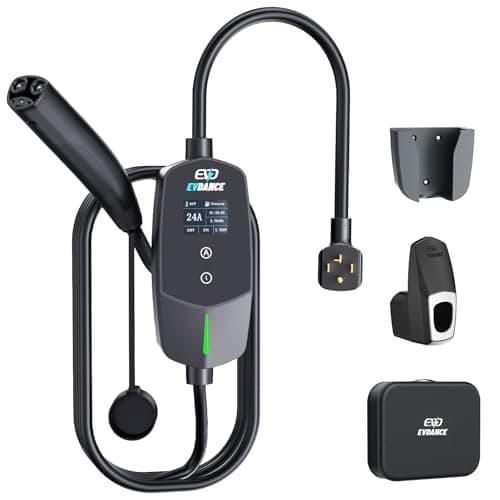
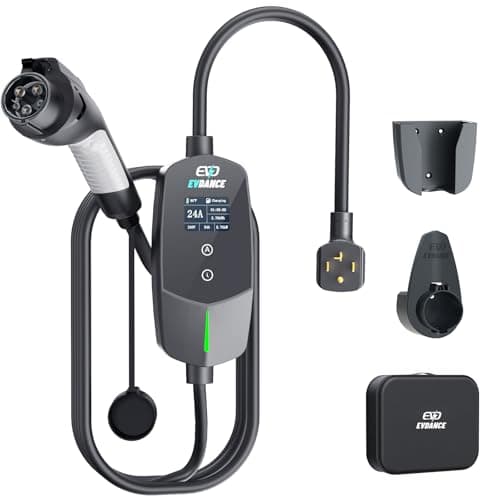
| 01 | EVDANCE 24A NEMA 14-30 (J1772)Built for the dryer outlet rather than adapted to it: a 14-30 plug on the cord and a 24-amp ceiling, so even its highest setting stays inside what a 30-amp circuit may carry continuously. | Most J1772 cars on a dryer outlet | | $269.99·Amazon |
| 02 | EVDANCE 24A NEMA 14-30 (NACS)The same 24-amp dryer-outlet charger with a NACS handle - the straightforward pick for a Tesla, or any newer car with a NACS port, when there is no Mobile Connector to adapt. | Tesla and NACS-port cars | | $251.99·Amazon |
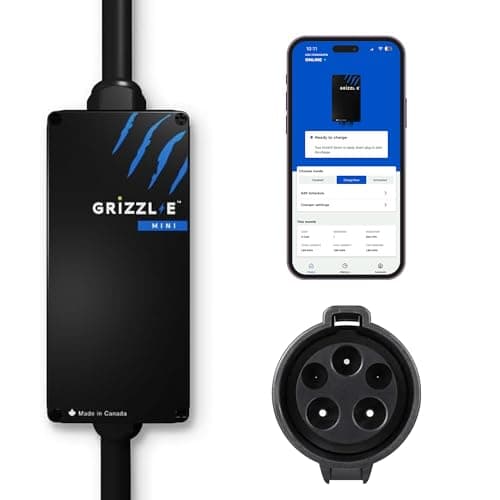
| 03 | Grizzl-E Mini (40A Portable)A UL-certified, cast-aluminum 40-amp portable that ships with a NEMA 14-30P adapter - the one to buy if the dryer outlet is a stopgap and a 50-amp circuit is in your future. | A dryer outlet now, a 14-50 later | | $479.99·Amazon |
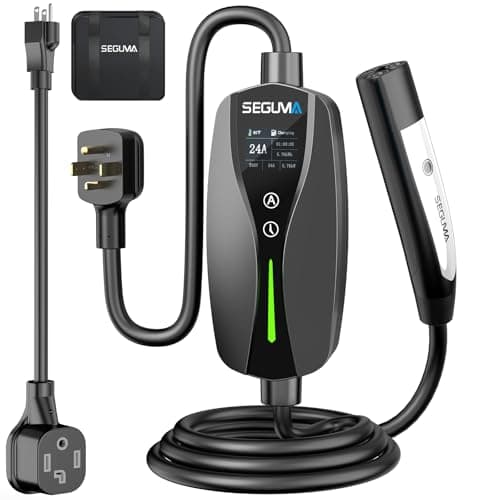
| 04 | SEGUMA Level 1/2 NACS (14-30)A NACS dryer-outlet charger with a NEMA 5-15 adapter in the box, so the same cord charges at Level 2 at home and at Level 1 from an ordinary outlet on the road. | NACS cars that need a Level 1 backup | | $279.99·Amazon |
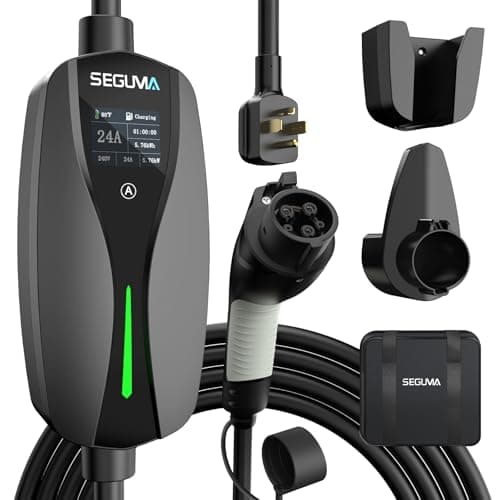
| 05 | SEGUMA 24A NEMA 14-30 (J1772)A plain J1772 alternative to the EVDANCE: the same 24-amp ceiling on a 14-30 plug, a 25-foot cable and a status screen - the one to check if the EVDANCE is out of stock or priced higher on the day. | A J1772 alternative to the EVDANCE | | $242.99·Amazon |
01 EVDANCE 24A NEMA 14-30 (J1772)Built for the dryer outlet rather than adapted to it: a 14-30 plug on the cord and a 24-amp ceiling, so even its highest setting stays inside what a 30-amp circuit may carry continuously.
Best for: Most J1772 cars on a dryer outlet
02 EVDANCE 24A NEMA 14-30 (NACS)The same 24-amp dryer-outlet charger with a NACS handle - the straightforward pick for a Tesla, or any newer car with a NACS port, when there is no Mobile Connector to adapt.
Best for: Tesla and NACS-port cars
03 Grizzl-E Mini (40A Portable)A UL-certified, cast-aluminum 40-amp portable that ships with a NEMA 14-30P adapter - the one to buy if the dryer outlet is a stopgap and a 50-amp circuit is in your future.
Best for: A dryer outlet now, a 14-50 later
04 SEGUMA Level 1/2 NACS (14-30)A NACS dryer-outlet charger with a NEMA 5-15 adapter in the box, so the same cord charges at Level 2 at home and at Level 1 from an ordinary outlet on the road.
Best for: NACS cars that need a Level 1 backup
05 SEGUMA 24A NEMA 14-30 (J1772)A plain J1772 alternative to the EVDANCE: the same 24-amp ceiling on a 14-30 plug, a 25-foot cable and a status screen - the one to check if the EVDANCE is out of stock or priced higher on the day.
Best for: A J1772 alternative to the EVDANCE
#ad · Live prices from the Amazon Product API, as of Sep 18, 2026. Where we have no verified live price, we show none — we would rather leave a gap than print a number that has gone stale.
For most homes with a 4-prong NEMA 14-30 dryer outlet, the EVDANCE 24A NEMA 14-30 is the charger to buy. It is built for exactly that outlet: the 14-30 plug is on the cord rather than on an adapter, and its highest setting is 24 amps - the most a 30-amp circuit may carry for hours - so there is no setting that can overload it. Tesla and other NACS-port drivers want the NACS version of the same unit. If the dryer outlet is only a stopgap until you add a 50-amp circuit, spend more on the UL-certified Grizzl-E Mini, which ships with a 14-30 adapter and grows into 40 amps later.
A dryer outlet is the cheapest way into Level 2 charging, because in many garages and laundry rooms the 240-volt circuit is already there. The catch is that it is a 30-amp circuit, not the 50-amp circuit a typical plug-in charger expects, and that changes what you should buy. Most "Level 2 charger" listings are 32, 40 or 48-amp units with a NEMA 14-50 plug. Put one on a dryer circuit through a plug adapter and nothing in the adapter stops it from pulling more current than the circuit is built to carry. This page ranks the chargers that respect the 24-amp limit - either because they cannot exceed it, or because they can be set to it - and it is plain about the ones that make you do the setting yourself. We compile published manufacturer specifications and retailer listings; we do not run a test lab.
The short version
- EVDANCE 24A NEMA 14-30 (J1772) - best for most. A native 14-30 plug, a hard 24-amp ceiling, a delay timer for off-peak rates, a 25-foot cable, and an ETL listing per EVDANCE. Our winner.
- EVDANCE 24A NEMA 14-30 (NACS) - best for a Tesla or NACS-port car. The same charger with a NACS handle and a button that opens a Tesla charge port. Read the Tesla note below before you buy it.
- Grizzl-E Mini - best if a 14-50 is in your future. UL and cUL certified, cast aluminum, a 3-year warranty and a 14-30P adapter in the box - but you set it to 24 amps yourself, and it costs far more.
- SEGUMA Level 1/2 NACS - best NACS charger with a Level 1 backup. Adds a NEMA 5-15 adapter and a charging schedule; its listing does not claim a safety listing for the charger itself.
- SEGUMA 24A NEMA 14-30 (J1772) - the J1772 alternative. The same 24-amp ceiling and cable length as the EVDANCE, but no timer on its listing and the same listing gap as its NACS sibling.
What a 14-30 outlet can actually do: the 24-amp rule
A NEMA 14-30 is the four-prong, 240-volt dryer receptacle on a 30-amp breaker. The electrical code treats EV charging as a continuous load, so the circuit's overcurrent protection has to be rated at 125 percent of the charger's maximum draw. Run that the other way and a 30-amp breaker allows 24 amps of continuous charging - the same 80 percent rule that caps a 50-amp NEMA 14-50 at 40 amps. Our NEMA 14-30 vs 14-50 guide walks through the difference between the two outlets.
At 240 volts, 24 amps is 5.76 kW. That is genuine Level 2: an eight-hour overnight window delivers about 46 kWh before charging losses. If your building supplies 208 volts rather than 240, the same 24 amps is about 5 kW. The makers of the 24-amp units on this page quote roughly 15 to 20 miles of range per hour of charging; your own figure depends on the car's efficiency, and our home charging time guide shows how to work it out. What 24 amps will not do is match a 40-amp charger on a 50-amp circuit. If you need that speed, you need a NEMA 14-50 charger and the circuit behind it.
A charger running above 24 amps does not belong on a 30-amp dryer circuit. While researching this page we found listings advertising 25 and even 32 amps on a NEMA 14-30 plug, and we left every one of them out. If a charger cannot be set to 24 amps or less, do not plug it into a dryer outlet.
How we chose: five criteria, in order
- The 24-amp ceiling. Best is a charger whose maximum is 24 amps, so it cannot overload the circuit at any setting. Second-best is a higher-amp charger you can reliably set to 24 before it goes near the outlet. A charger that could do neither was disqualified.
- A safety listing on the charger itself.A UL or ETL listing means an independent lab evaluated the whole unit. We read those claims closely: "UL 94 V-0" is a flammability rating for the housing plastic, and a "UL-listed cable" covers the cord - neither is a listing of the charger. Our safety-certified chargers roundup explains the difference.
- A native 14-30 plug, or an honest adapter story. A 14-30 plug molded onto the cord cannot be confused with anything else. A 14-50 charger on a 14-30 adapter is fine only if you set its current first - for most chargers, a plug adapter changes the plug shape and tells the charger nothing.
- The right connector for your car. J1772 for most non-Tesla cars, NACS for Teslas and the newer models built with a NACS port. An adapter can bridge the gap, but one fewer adapter is one fewer part to lose or wear out.
- Cable, timer and warranty. A dryer outlet is rarely next to the parking spot, so a 25-foot cable matters more here than usual. A delay timer or schedule lets you charge on cheaper off-peak rates without an app. And warranty length separates the budget units (1 year) from the Grizzl-E (3 years).
Before you plug in: the outlet, the circuit and the dryer
The charger is the easy part. Three things about the outlet decide whether this is safe:
- It must be a 4-prong 14-30, not a 3-prong 10-30. The older 10-30 has no separate ground, and an EV charger relies on the ground for fault protection. Several brands sell 10-30-plug versions of these same chargers; we left them off on purpose. Our dryer-outlet charging guide covers why, and what to do instead.
- The outlet and wiring must be sound. A dryer cycle is short; a car can draw 24 amps for eight hours or more. A worn receptacle or a loose terminal that never troubled the dryer can overheat under that load. If the outlet is old, discolored or loose, have an electrician check it before you start - and know what a hot plug is telling you.
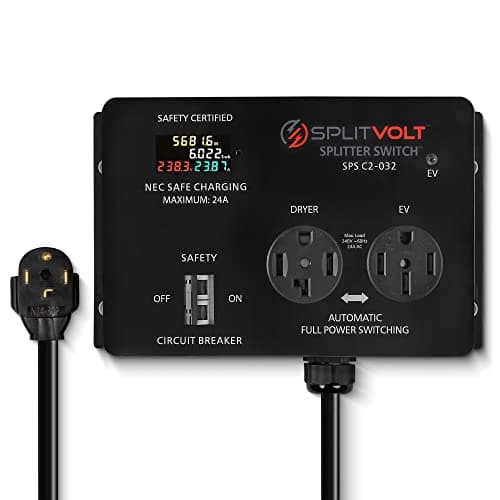
- The car and the dryer can never draw at the same time. Either unplug the dryer on charging nights, or use a listed device that switches the circuit between the two, such as the Splitvolt splitter switch in the gear section below. A homemade Y-splitter is never acceptable.
Tesla owners: check what you already own
If you drive a Tesla and already have a Tesla Mobile Connector, you may not need a new charger at all. Adapters made for the Gen 2 Mobile Connector let it plug into a 14-30 outlet, and NeoCharge, for one, says its adapter automatically sets the 24-amp limit - check that any adapter you buy says the same. That route costs a fraction of any charger on this page. The two NACS picks here are for NACS drivers without a Mobile Connector, or for anyone who wants a dedicated charger to leave by the dryer. Not sure which port your car has? See how to tell if your EV has NACS or J1772.
The picks, in order
Below the summary table each charger gets a full card with its score breakdown, pros and cons, and a "don't buy this if" note. In short: the EVDANCE wins because it is the hardest charger to set up wrong on this outlet, its NACS twin does the same for Tesla drivers, the Grizzl-E buys a stronger safety listing and a future on a bigger circuit at a higher price, and the two SEGUMA units offer a Level 1 adapter or a second J1772 option without a listing claim for the charger itself. Scores are our judgments against the published rubric; on a 14-30 every pick charges at the same 24 amps, so the speed scores sit close together by design.
In detail
Most J1772 cars on a dryer outlet
24A max / 5.76kWJ1772NEMA 14-30 plug25ft, delay timer
Built for the dryer outlet rather than adapted to it: a 14-30 plug on the cord and a 24-amp ceiling, so even its highest setting stays inside what a 30-amp circuit may carry continuously.
- Charge speed
- 6
- Build & weather
- 8
- Smart features
- 6
- Cable & connector
- 9
- Value
- 9
Pros
- +Tops out at 24 amps - the continuous limit of a 30-amp circuit - so there is no higher setting to get wrong
- +Adjustable from 10 to 24 amps for older or doubtful wiring, and a 1-12 hour delay start shifts charging to off-peak hours without an app
- +EVDANCE's product page lists it as ETL Listed to UL 2594 / UL 2251, with an IP66 control box rated from -22 to 122 degrees F
- +25 feet of total cable reaches from a laundry-room outlet to a parking spot
Cons
- −24 amps is its ceiling for good - if you later add a 50-amp circuit, this charger cannot use the extra capacity
- −No Wi-Fi app or charging history - the on-screen readout is the whole of the monitoring
- −1-year warranty, and the plug end is not waterproof; the listing says to keep the connector capped when idle
Don't buy this if…
…you drive a Tesla or another NACS-port car (the NACS version is the one to buy), or you expect to add a 50-amp circuit soon - then a 40-amp charger you can dial down today, like the Grizzl-E Mini, is the better long-term buy.
Tesla and NACS-port cars
24A max / 5.76kWNACS (Tesla)NEMA 14-30 plug25ft, port-open button
The same 24-amp dryer-outlet charger with a NACS handle - the straightforward pick for a Tesla, or any newer car with a NACS port, when there is no Mobile Connector to adapt.
- Charge speed
- 6
- Build & weather
- 8
- Smart features
- 6
- Cable & connector
- 9
- Value
- 9
Pros
- +Native NACS connector, so no adapter sits between the handle and a Tesla or NACS-port car
- +A button on the handle opens a Tesla charge port door, the way Tesla's own connectors do
- +Same 24-amp ceiling, adjustable current, delay start, IP66 control box and 25-foot cable as the J1772 version
Cons
- −Will not charge a J1772 car without a separate NACS-to-J1772 adapter - a poor fit for a mixed-connector household
- −No Wi-Fi app, and a 1-year warranty
- −If you already own a Tesla Mobile Connector, a 14-30 adapter for it is a far cheaper route to the same 24 amps
Don't buy this if…
…you already have a Tesla Mobile Connector. A NEMA 14-30 adapter made for it costs a fraction of this charger and does the same job on the same outlet.
A dryer outlet now, a 14-50 later
7-40A adjustableJ177214-50 plug + 14-30P adapterUL certified, 3-yr warranty
A UL-certified, cast-aluminum 40-amp portable that ships with a NEMA 14-30P adapter - the one to buy if the dryer outlet is a stopgap and a 50-amp circuit is in your future.
- Charge speed
- 7
- Build & weather
- 10
- Smart features
- 7
- Cable & connector
- 8
- Value
- 5
Pros
- +Grizzl-E states the Mini is UL and cUL certified - the strongest safety-listing story on this page
- +A native 14-50 plug plus four adapters (NEMA 14-30P, 6-50P, TT-30P and 5-15P), so it grows into a 40-amp circuit instead of being replaced
- +Cast-aluminum NEMA 4X enclosure and built-in GFCI per the listing, and a 3-year replacement warranty against the 1-year norm of the budget units
Cons
- −You must set it to 24 amps yourself before using the 14-30 adapter - its maximum is set with internal DIP switches or the app, and Grizzl-E does not say the adapter limits the current for you
- −Costs far more than the 24-amp units here, for speed a 30-amp circuit cannot deliver
- −Its app features are local - the listing says you connect within range of the charger, not from anywhere
Don't buy this if…
…the dryer outlet is your permanent answer. On a 30-amp circuit it charges no faster than the EVDANCE, and the extra money buys headroom you may never plug into.
NACS cars that need a Level 1 backup
10-24A on 14-30NACS (Tesla)14-30 plug + 5-15 adapter25ft, scheduling
A NACS dryer-outlet charger with a NEMA 5-15 adapter in the box, so the same cord charges at Level 2 at home and at Level 1 from an ordinary outlet on the road.
- Charge speed
- 6
- Build & weather
- 7
- Smart features
- 7
- Cable & connector
- 8
- Value
- 8
Pros
- +Includes a NEMA 5-15 adapter for 120-volt Level 1 charging at 10 or 12 amps, so one cord covers home and travel
- +Five settings on the 14-30 plug - 10, 12, 16, 20 and 24 amps - that top out at the 30-amp circuit's continuous limit
- +Built-in charging schedule and a 1.77-inch color screen showing voltage, current, power, time and energy
Cons
- −The listing claims UL 94 V-0 flame-retardant materials and an IP66 rating, but not a UL or ETL listing for the charger itself - unlike SEGUMA's own ETL-certified 32A and 40A models
- −NACS only - a J1772 car needs an adapter
- −Small screen and no Wi-Fi app
Don't buy this if…
…a third-party safety listing on the charger itself is non-negotiable for you. EVDANCE lists ETL certification for its 14-30 units and Grizzl-E lists UL; this listing does not claim one.
A J1772 alternative to the EVDANCE
24A max / 5.76kWJ1772NEMA 14-30 plug25ft UL-listed cable
A plain J1772 alternative to the EVDANCE: the same 24-amp ceiling on a 14-30 plug, a 25-foot cable and a status screen - the one to check if the EVDANCE is out of stock or priced higher on the day.
- Charge speed
- 6
- Build & weather
- 7
- Smart features
- 5
- Cable & connector
- 8
- Value
- 8
Pros
- +Four settings - 10, 16, 20 and 24 amps - so its top setting is the 30-amp circuit's continuous limit
- +25-foot cable the listing describes as UL listed, plus a storage bag for travel
- +1.77-inch screen shows charging rate, voltage and time; IP66 control box rated from -22 to 122 degrees F
Cons
- −Like its NACS sibling, the listing claims a UL-listed cable and UL 94 V-0 housing material, not a UL or ETL listing for the charger as a whole
- −The listing is inconsistent about 120 volts: the title names a NEMA 5-15 plug while a bullet says 5-15 outlets need an extra adapter - confirm what is in the box before counting on Level 1
- −No delay timer or charging schedule is described on this listing
Don't buy this if…
…you want off-peak charging without an app. The EVDANCE's delay start does that; this listing describes no timer.
How to choose a charger for a 14-30 dryer outlet
The outlet has already set the speed. What is left is matching the charger to the circuit, the car, and how long you plan to rely on a dryer outlet. Here is how we weighed it.
1. Confirm the circuit first
Find the breaker: a 14-30 receptacle should sit on a 30-amp, two-pole breaker. If the breaker is any other size, or the receptacle is a 3-prong 10-30, stop and have a licensed electrician look before you charge. A charger that trips the breaker on a correctly wired 14-30 is usually set above 24 amps or sharing the circuit - our breaker-tripping guide covers the other causes.
2. Decide how long the dryer outlet is your answer
If it is the long-term plan - a rental, a condo, or a house where a new circuit is impractical - buy a charger that tops out at 24 amps, like the EVDANCE or SEGUMA units. Paying for 40-amp capability you can never use is wasted money. If you expect to add a 50-amp circuit soon, the Grizzl-E Mini costs more now but runs at 40 amps on a 14-50 later, where a 24-amp unit would need replacing. Renters weighing the options should also see our chargers for apartments and renters.
3. Match the connector to the car you charge most
Most non-Tesla EVs built before the NACS switch use J1772, while Teslas and a growing list of newer models use NACS. An adapter bridges either direction, but buy the native connector for the car that plugs in most nights. In a one-of-each household, a J1772 charger plus a J1772-to-NACS adapter for the Tesla is the usual arrangement.
4. Read the safety claim, not the badge
On this outlet the charger runs at or near its limit for hours, so the listing matters. EVDANCE lists ETL certification for its 14-30 units, and Grizzl-E states UL and cUL certification for the Mini. The SEGUMA listings cite a UL-listed cable and UL 94 V-0 housing material - real, but not a listing of the charger - which is why they rank last despite useful features. Our guide to whether cheap EV chargers are safe goes deeper.
5. Plan for off-peak charging
If your utility has a time-of-use rate, the EVDANCE delay start and the SEGUMA NACS schedule both let you begin charging after the peak window without an app - and your car's own charging schedule may do the same job for free. The off-peak charging guide shows what that timing is worth.
When to stop using the dryer outlet
A dryer outlet is a legitimate way to charge, not a hack to apologize for. But if you swap plugs with the dryer every week, the car regularly is not full by morning, or the outlet turns out to be a 10-30, the better fix is a dedicated circuit: a NEMA 14-50 outlet on a 50-amp circuit, or a hardwired charger. The installation guide covers what that job involves and costs, and our 40-amp charger rankings cover what to plug into it afterward.
So, which one?
Buy the EVDANCE 24A (J1772) if you drive a J1772 car and the dryer outlet is your plan. Buy the EVDANCE 24A (NACS) if you drive a Tesla or NACS-port car and do not already own a Tesla Mobile Connector. Buy the Grizzl-E Mini if you want the strongest safety listing and a charger that outlives the dryer outlet - and set it to 24 amps before it goes anywhere near a 14-30. Consider the SEGUMA units when their Level 1 adapter, or simple availability on the day, matters more to you than a listed charger.
The gear
The products this guide refers to, with prices pulled live from Amazon and dated on each card.
Sharing one outlet with the dryer
Splitvolt 14-30/14-50 Splitter Switch
The listed way to keep the dryer and charge the car from one 14-30 outlet: it switches the circuit's power automatically between a dryer socket and an EV socket, behind its own 24-amp breaker.
#ad · As an Amazon Associate we earn from qualifying purchases.
How we picked
We compiled published specifications from manufacturer manuals and spec sheets, verified the safety listings (UL / ETL), computed the real running and installation costs, checked the wiring math against the NEC continuous-load rule, and read aggregated owner reviews — then scored each product against a published rubric. The scores are judgments from documented research — they are not bench measurements, because we do not have a test lab and we are not going to pretend we do. Every spec and cost figure is cited in Sources.
Questions
What is the best EV charger for a NEMA 14-30 outlet?+
For most J1772 cars, a charger built for the outlet with a 24-amp maximum - our pick is the EVDANCE 24A NEMA 14-30 - because no setting on it can overload a 30-amp circuit. Tesla and NACS-port drivers should look at its NACS version, or at a 14-30 adapter for a Tesla Mobile Connector they already own. If you plan to add a 50-amp circuit later, the UL-certified Grizzl-E Mini covers both outlets, provided you set it to 24 amps for the 14-30.
How many amps can I charge at on a 14-30 dryer outlet?+
24 amps. A 14-30 sits on a 30-amp breaker, and because EV charging is a continuous load the charger may draw no more than 80 percent of that rating. At 240 volts, 24 amps is 5.76 kW; on a 208-volt supply it is about 5 kW. See NEMA 14-30 vs 14-50 for how that compares with a 50-amp outlet.
Can I use a 40-amp charger with a 14-30 adapter?+
Only if the charger is set to 24 amps or less before you plug it in. For most chargers a plug adapter changes the shape of the plug and nothing else - it does not tell the charger it is on a smaller circuit. The Grizzl-E Mini, for example, sets its maximum with internal DIP switches or its app. If a charger cannot be set that low, do not use it on a dryer outlet.
Can I charge my EV and run the dryer on the same outlet?+
Not at the same time. Either unplug the dryer on charging nights, or use a listed automatic splitter switch - the Splitvolt 14-30/14-50 model is cETLus listed, switches power between a dryer socket and an EV socket, and has its own 24-amp breaker - with the charger set to 24 amps. A homemade Y-splitter that lets both draw at once is dangerous. Our dryer-outlet guide covers the rules.
Can I use a charger with a 10-30 plug on my old 3-prong dryer outlet?+
We would not. A NEMA 10-30 has no separate ground wire, and EV chargers rely on the ground for fault protection. Some brands sell 10-30-plug versions of their 24-amp chargers, but the right move on a 3-prong dryer outlet is to have an electrician add a properly grounded circuit.
Do I need an electrician to use a NEMA 14-30 charger?+
Not to plug a portable charger into a sound, correctly wired 14-30 that already exists. Do have one check an old, loose or discolored outlet before it carries hours of 24-amp charging, and anything that adds or changes a circuit is a licensed electrician's job. Our DIY installation guide draws the line.
Receipts
- EC&M - NEC requirements for EV equipment (Article 625: continuous load, circuit sizing, GFCI)
- US DOE AFDC - charging at home
- EVDANCE - Level 2 NEMA 14-30 24A J1772 portable EV charger (24A max, 5.76 kW at 240V, NEMA 14-30 plug, 25 ft cable, ETL Listed to UL 2594 / UL 2251, IP66, -22 to 122 F, delay start, 1-year warranty)
- EVDANCE - Level 2 NEMA 14-30 24A NACS portable EV charger (24A max, NACS connector, short press opens a Tesla charge port door, 25 ft cable, ETL Listed, IP66, delayed start)
- United Chargers - Grizzl-E FAQ (Classic, Smart, Duo and Mini top out at 40A with 16/24/32/40A settings; Ultimate is 48A or 80A and hardwire-only; every model uses the same air-tight UL Type 4 cast-aluminium enclosure and is UL and cUL certified under file E510712; only the Smart and the Ultimate carry Wi-Fi for the Grizzl-E Connect app)
- Grizzl-E Mini user manual (DIP switches set a 40A, 32A, 24A or 16A maximum; works with NEMA 6-50P, 5-15P and 14-30P adapters; NEMA 4 cast-aluminum enclosure; 3-year replacement warranty)
- EV Charging Stations - Grizzl-E Mini Connect 40A review (7-40A adjustable via internal DIP switches, adapters for NEMA 5-15, 6-50, 14-30 and TT-30 on a 14-50 plug, UL safety certified)
- Splitvolt - Splitter Switch NEMA 14-30/14-50 (automated switching between a 14-30 dryer socket and a 14-50 EV socket, integrated 24A breaker, cETLus listed by Intertek; the charger must be set to 24A max)
- NeoCharge - NEMA 14-30 adapter for the Tesla Gen 2 Mobile Connector (states it automatically sets charging to the required 24A on a 30A circuit)
We do not run a testing lab, and we do not pretend to. Where a measured number came from someone else's lab, we name them and link them. Where we could not verify something, we say so on the page rather than quietly leaving it out. Read our full method.