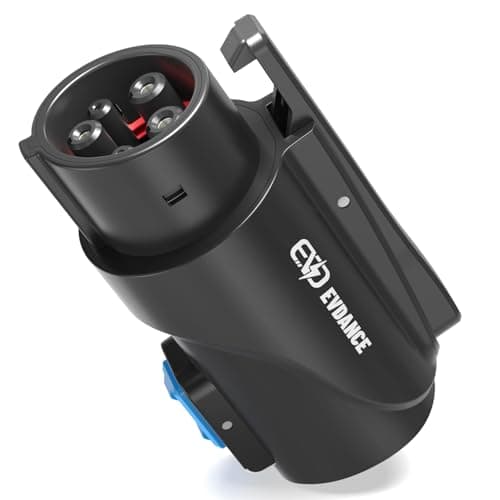
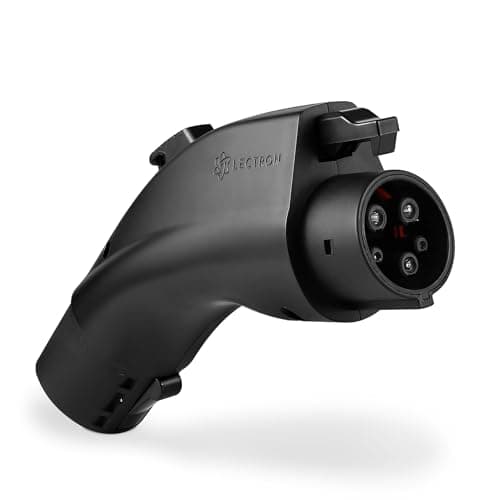
Buy the Lectron if you want the longer track record and the more established name on the adapter you clip to your cable every day. Buy the EVDANCE if you want the same job for less money and a higher current rating on paper. Both are passive NACS-to-J1772 adapters that let a non-Tesla, J1772 car charge from a Tesla Wall Connector, Destination Charger or Mobile Connector - and both are AC only, so neither one turns a Supercharger into a fill-up.
These two point the same direction: your car has a J1772 port, the charger has a Tesla-style NACSplug, and the adapter bridges the two so you can draw AC power from Tesla's home and destination equipment. That is a useful trick to have, because nearly every non-Tesla EV sold in the US through 2024 uses J1772 for AC charging, while a growing share of Level 2 chargers in the wild - a friend's Tesla Wall Connector, a hotel Destination Charger, a Tesla Mobile Connector on a trip - carry the NACS plug. A small adapter turns all of that hardware into a place your J1772 car can top up overnight. If you are not certain which port your car has, start with how to tell if your EV has NACS or J1772, then see the wider field in our NACS-to-J1772 adapters guide and do I need an adapter to charge my EV. We compile published specs and do the arithmetic rather than bench-testing either unit.
Compatibility
A near-tie, because both do the same thing. Each is a NACS-to-J1772 adapter compatible with Tesla Wall Connectors, Destination Chargers and Mobile Connectors, letting a J1772 car use that equipment for AC charging. The only spec difference is the current rating: the Lectron is rated for 48 amps at 240 volts, the EVDANCE for up to 80 amps at 250 volts. Since a home or public AC circuit tops out around 40 to 48 amps, the EVDANCE's higher number is headroom you will not actually use - both pass the full current your circuit can deliver, and your car's onboard AC charger caps the real rate anyway. In everyday terms, that means either adapter lets the same J1772 car reach the same Level 2 speed on the same Tesla-style outlet; the rating on the shell does not change how fast you charge. The hard limit both share is that they are AC only: neither unlocks DC Supercharging, which is a passive-adapter fact worth understanding before a road trip - see do NACS adapters work at Superchargers.
Safety listing
Evenly matched on our research-based safety scoring, and worth a word of honesty. Unlike the reverse-direction J1772-to-NACS adapters - where one publishes a UL 2251 listing and another a UL 2252 listing, which we break down in LENZ vs FOCSPROD - neither of these NACS-to-J1772 units leads with an explicit UL number in its catalog specs. Both are widely used for AC home charging and rate the same on our safety axis. Because an adapter carries the full charging current through a mated connector, the sensible move is to confirm the current safety listing printed on the exact unit you receive, inspect for a snug, rattle-free fit before you rely on it, and never press a passive AC adapter into DC fast charging. Treat the AC-only boundary as the real safety line here.
Build quality
The Lectron has a small edge. It is the more established, longer-reviewed unit and scores a touch higher on build in our rubric - a reassuring pick for a part you plug and unplug constantly. The EVDANCE is the value brand: functionally the same adapter, but confirm the fit is snug on your specific connector, since a loose seat on any adapter is the thing that gets warm under a continuous load. Neither is poorly made, but the Lectron is the more conservative choice if a long track record is what reassures you. In day-to-day use the things that matter on either unit are the same: a firm, positive click when it seats onto the charger's plug, contacts that stay clean and dry, and no play or wobble once your car's connector latches through it. Store it out of grit and moisture, do not force a connection that does not seat cleanly, and give the housing a quick look for cracks or heat discoloration now and then - simple habits that keep any passive adapter safe well past the point where brand name stops mattering.
Value
The EVDANCE, clearly. It typically undercuts the Lectron for the identical NACS-to-J1772 function while carrying the higher current rating on the label. The Lectron costs a little more - the price of the established name and the slightly stronger build. If you want the cheapest capable adapter that does exactly this job, the EVDANCE is the value pick; if you would rather pay for the track record, the Lectron is the default. Because both sit at the low end of the accessory band, the gap between them is small in absolute terms - this is not a case where spending more buys a materially better charge, only a longer reputation and a marginally sturdier housing. For a part you leave clipped to a cable and forget, plenty of owners reasonably choose the cheaper one; for a part they plug and unplug daily, others prefer the one with the longer paper trail. Neither instinct is wrong.
The verdict
Both adapters do the same job equally well for AC home charging, so this comes down to priorities: Lectron for the established name and marginally better build, EVDANCE for the lower price and the amp headroom. Neither one unlocks a Supercharger - for that distinction read do NACS adapters work at Superchargers. And if your car is actually a Tesla or a NACS-port model that needs to use the J1772 network - the opposite direction - you want a J1772-to-NACS adapter instead; compare those in LENZ vs FOCSPROD.
How to choose between them
Which way does your adapter need to point?
Both of these are for a J1772 car using a Tesla-style (NACS) charger - the car side is J1772, the charger side is NACS. If your car is a Tesla or a 2025-and-later NACS-port model and you want to use the huge installed base of J1772 chargers, you need the opposite adapter, a J1772-to-NACS unit, covered in our J1772-to-NACS adapters guide. Confirm your port first with how to tell if your EV has NACS or J1772 so you buy the right direction.
How much does the amp rating matter?
Less than the label suggests. The EVDANCE is rated to 80 amps and the Lectron to 48, but a home NEMA 14-50 circuit delivers 40 amps and a fast hardwired circuit 48 - so both adapters comfortably pass whatever your wall can supply. The higher rating is margin, not extra speed. Do not choose on the amp number alone; choose on price, build and the track record, because at real-world AC current the two behave identically.
What this adapter will never do
Neither passive adapter enables DC Supercharging - they are AC-only devices, full stop. A cheap passive adapter must never be used at a DC fast charger. If DC road-trip charging is your question, read do NACS adapters work at Superchargers and the background in connector types explained - a CCS car needs a Magic Dock site or an automaker-approved DC adapter, which is a different, DC-rated product entirely.