HUB 03 · Charging Guides
Does a New EV Come With a Charger?
Usually a portable travel cable, sometimes nothing - but almost never a proper wall charger. What is actually in the trunk, and why most owners still buy a Level 2 unit.
We earn a commission when you buy through our Amazon links, at no extra cost to you. It never affects our rankings, and we say so when the cheaper product is the better buy. How this works.
Most new EVs come with a portable charging cable in the trunk - but it is not the wall charger people picture, and a growing number of automakers now include no cable at all to cut costs. Knowing exactly what ships with the car (and what does not) tells you what, if anything, you still need to buy. The honest summary: what is included is a travel-and-emergency tool, and most owners are happier with a dedicated Level 2 charger for daily use.
What is usually in the box
The typical included item is a portable EVSE - a charging cable with a control box - that plugs into a standard 120-volt household outlet for Level 1 charging. Some brands include a dual-level unit that also accepts a 240-volt plug for Level 2, and Teslas ship with a Mobile Connector plus a J1772 adapter. The key point is that the included cable is a portable, not a mounted wall charger, and on 120 volts it is slow - roughly 3-5 miles of range per hour. That is fine as a backup or for a very low-mileage driver, but it is not built to be the daily charger for most commutes.
The trend: fewer cars include one
Be aware that inclusion is shrinking. Several automakers have quietly stopped including the portable cable, or made it a paid accessory, to save money - so "my EV will come with a charger" is no longer a safe assumption. Check your specific model and trim; do not count on finding a cable in the trunk. If yours does not include one, a portable is an inexpensive first purchase, and the picks are in best portable EV chargers.
Why the included cable is not enough for most people
Even when a car includes a portable, most owners end up wanting a proper Level 2 setup, for three reasons. Speed: a 240-volt Level 2 charger adds ~20-30 miles per hour versus ~3-5 on the included 120-volt cable, so it actually refills a daily commute overnight. Convenience: a mounted wall unit with a holster is tidier than a portable coiled on the floor. And the included unit is best kept in the trunk as a 120-volt backup for travel rather than doubling as your home charger. The full case is in is a home EV charger worth it.
What to buy, then
If you want the flexibility of a unit that both charges fast at home and travels, a dual-level portable like the EVDANCE or the Emporia (a plug-in wall unit) covers it. If you would rather leave the included cable in the trunk and mount a dedicated charger, start with how to choose an EV charger and what amp charger do I need. Either way, plan for a dedicated 240-volt circuit, since that - not the cable - is what makes home charging quick.
So: probably a portable cable, possibly nothing, almost never a wall charger. Treat whatever ships with the car as a travel and backup tool, and buy a Level 2 charger for the daily job - the Level 2 home chargers we rank is the shortlist.
The gear
Recommended gear for this guide
The products this guide refers to, with prices pulled live from Amazon and dated on each card.
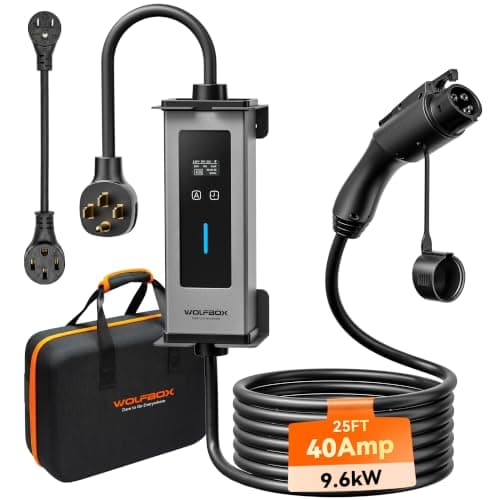
One charger for home and travel
WOLFBOX 40A Portable (Level 1/2)
A dual-level portable that doubles as a wall box — 40 amps on a NEMA 14-50, or Level 1 on a standard outlet with the included adapters. One weatherproof charger for the garage and the road.
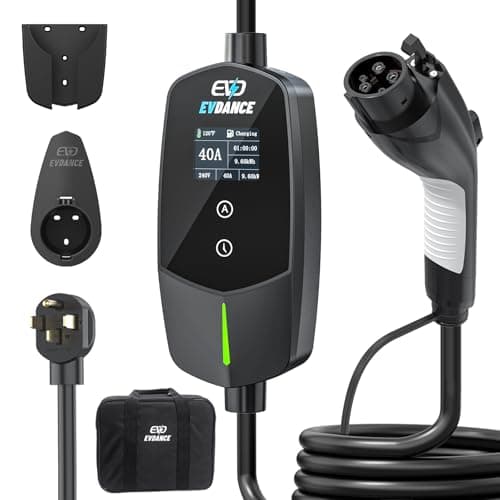
Off-peak charging without an app
EVDANCE 40A Portable
A 40-amp portable with adjustable current and a built-in delay timer on a long 25-foot cable — off-peak charging without needing an app.
#ad · As an Amazon Associate we earn from qualifying purchases.
Questions
Frequently asked
Does every new EV include a charging cable?
No longer. Many still include a portable Level 1 (or dual-level) cable, but several automakers have made it optional or dropped it to cut costs. Check your specific model and trim rather than assuming.
Is the included cable a real home charger?
It is a portable EVSE, not a mounted wall charger, and usually a slow 120-volt Level 1 unit (~3-5 miles of range per hour). It works as a backup or for very low mileage, but most owners want a faster Level 2 setup for daily charging.
Do I still need to buy a charger if my EV came with one?
Most people benefit from one. Keep the included portable in the trunk for travel and emergencies, and add a Level 2 charger (and a 240-volt circuit) for the ~20-30 miles-per-hour home charging that actually keeps up with a commute.
What does a Tesla come with?
A Mobile Connector (a portable EVSE) and a J1772 adapter, so it can charge from a standard outlet and from any J1772 home charger. A faster wall unit is a separate purchase.
Keep reading
Related
- Best Portable EV ChargersWhat to buy if your car shipped without a cable.
- Is a Home EV Charger Worth It?Why the included 120V cable rarely keeps up with daily driving.
- Level 1 vs Level 2Why the included Level 1 cable is slow and Level 2 is not.
- How to Choose an EV ChargerThe five-step framework for the unit you actually buy.
- Can I Plug Into a Regular Outlet?How the included 120V cable works as a backup.
More in this section
More Charging Guides
Receipts
Sources
- US DOE AFDC - charging an EV at home
- US DOE / fueleconomy.gov - EV charging basics
- US DOE Energy Saver - electric vehicles
We do not run a testing lab, and we do not pretend to. Where a measured number came from someone else's lab, we name them and link them. Where we could not verify something, we say so on the page rather than quietly leaving it out. Read our full method.