HUB 02 · Cables & Adapters
A Portable EV Charger for Emergencies
The cheapest peace of mind an EV owner can buy: a 120-volt portable that plugs into any household outlet. Slow, yes - but it turns any wall into a way home.
We earn a commission when you buy through our Amazon links, at no extra cost to you. It never affects our rankings, and we say so when the cheaper product is the better buy. How this works.
A portable Level 1 charger is the EV equivalent of a spare tire: you hope you never need it, and you are very glad it is there when you do. It plugs into any ordinary 120-volt household outlet, so anywhere with a wall socket - a relative's house, a motel, a campground, a friend's garage - becomes a place you can add range. It is slow, and it is not your daily charger, but as cheap trunk insurance it is hard to beat. Here is when it earns its keep and what to look for.
Why keep one in the trunk
The whole value of a 120-volt portable is universality. It needs no special outlet, no installation, and no planning - just a standard NEMA 5-15 wall socket, the kind in every building in North America. That makes it the safety net for the situations a charging map does not cover: you misjudged range, the fast charger you were counting on is broken or occupied, or you are staying somewhere with no EV charging but plenty of ordinary outlets. Overnight on a regular outlet, a Level 1 unit can add enough range to reach a proper charger. A plain 120-volt unit like the Morec Level 1 backup is exactly this kind of insurance.
Be honest about the speed
A Level 1 charger is slow - roughly 3 to 5 miles of range per hour, so an overnight 12-hour charge adds maybe 40-60 miles. That is the trade for its go-anywhere convenience, and it is why Level 1 is a backup, not a daily solution, as laid out in Level 1 vs Level 2. For emergencies, though, 40-60 miles overnight is often all you need to get to a DC fast charger or home. Set expectations correctly: this is enough-to-get-you- moving charging, not a fill-up.
The dual-level option: one unit for backup and home
If you would rather carry one device that does both jobs, a dual-level portable includes both a 120-volt plug (Level 1, for emergencies) and a 240-volt plug (Level 2, for real speed at a proper outlet). The WOLFBOX portable is a good example: 3-5 miles per hour on a household outlet as a backup, or ~25 miles per hour when you find a NEMA 14-50. It costs more than a bare Level 1 cord but replaces two devices - the case for it is in can a portable be your main charger. For pure trunk insurance, though, a cheap Level 1 unit is the minimalist pick, and both are ranked in best portable EV chargers.
Emergency charging safety
A few rules keep an emergency charge safe. Plug a Level 1 unit directly into a wall outlet, not a household extension cord or power strip - the wrong cord can overheat under a continuous EV load, a point we make in extension cord safety. Use a known-good outlet, and if the plug or outlet gets hot, stop and use a different one - the same warning as a plug getting hot at home. And never try to jury-rig a 240-volt connection in the field; if you find a 14-50, a proper Level 2 portable handles it, but a dryer outlet is not a safe shortcut - see can I use a dryer outlet.
An emergency Level 1 charge plugs straight into a standard, known-good wall outlet - never through an ordinary extension cord or power strip, and never into an improvised 240-volt connection. If the plug or outlet gets warm, stop and use another. A portable is trunk insurance, not a license to overload a questionable outlet.
For a small outlay and a little trunk space, a portable charger removes the single biggest anxiety of EV ownership - being stranded far from a station. Keep a Level 1 unit (or a dual-level portable) in the car, know it is slow, and rest easier knowing any wall outlet can get you moving again.
The gear
Recommended gear for this guide
The products this guide refers to, with prices pulled live from Amazon and dated on each card.
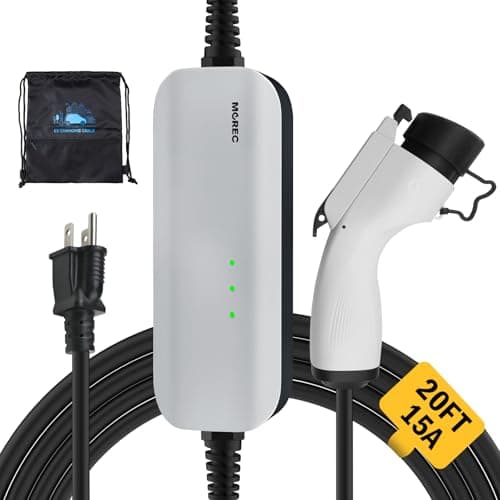
A 120V cord with a live readout
Morec Level 1 (15A)
A plain 15-amp household cord with an LCD that reports voltage, current and temperature while it charges — the one that tells you what the outlet is actually doing.
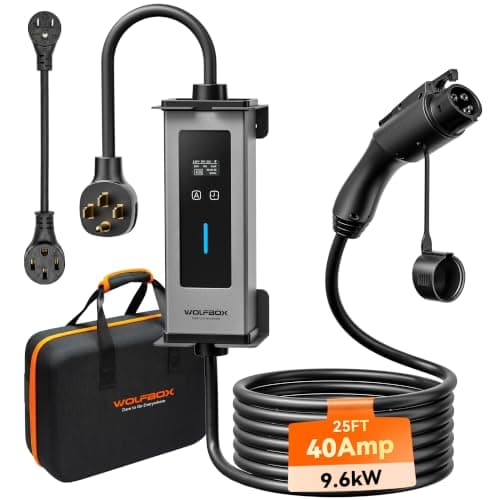
One charger for home and travel
WOLFBOX 40A Portable (Level 1/2)
A dual-level portable that doubles as a wall box — 40 amps on a NEMA 14-50, or Level 1 on a standard outlet with the included adapters. One weatherproof charger for the garage and the road.
#ad · As an Amazon Associate we earn from qualifying purchases.
Questions
Frequently asked
Is a portable charger worth keeping in the car?
For most owners, yes - as cheap insurance. A 120-volt portable plugs into any household outlet, so anywhere with a wall socket becomes a place to add range when you are stranded or a fast charger falls through. It is slow, but it gets you moving.
How much range does an emergency Level 1 charge add?
Roughly 3-5 miles of range per hour, so an overnight charge adds about 40-60 miles - usually enough to reach a proper charger. It is a backup, not a fill-up; for daily use you want Level 2.
Can I use an extension cord for emergency charging?
Not an ordinary household one - it can overheat under a continuous EV load. Plug the portable directly into a wall outlet. See extension cord safety for the rare exceptions and the risks.
Should I buy a Level 1 or a dual-level portable?
A bare Level 1 unit is the cheapest pure-backup pick. A dual-level portable costs more but adds a 240-volt plug, so one device covers both emergencies and fast charging when you find a 14-50 - see best portable chargers.
Keep reading
Related
- Best Portable EV ChargersThe Level 1 and dual-level units that make good trunk backups.
- Level 1 vs Level 2Why a 120V backup is slow and a 240V charger is not.
- Extension Cord SafetyWhy you plug an emergency charger straight into the wall.
- EV Road Trip Charging GuidePlanning that reduces how often you need the backup.
- Can a Portable Be Your Main Charger?When the same unit does double duty at home.
More in this section
More Cables & Adapters
Receipts
Sources
- US DOE AFDC - charging an EV at home
- US DOE / fueleconomy.gov - EV charging basics
- EC&M - NEC requirements for EV equipment (Article 625)
We do not run a testing lab, and we do not pretend to. Where a measured number came from someone else's lab, we name them and link them. Where we could not verify something, we say so on the page rather than quietly leaving it out. Read our full method.