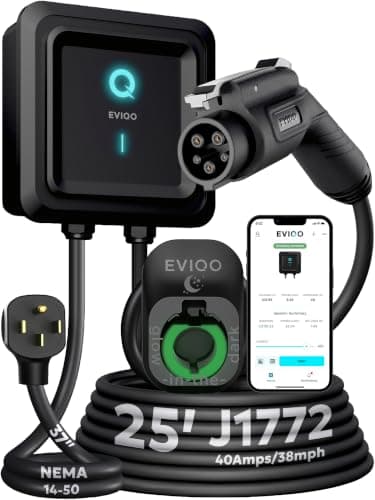
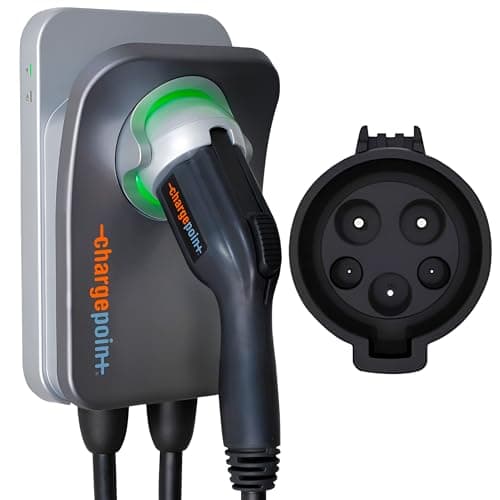
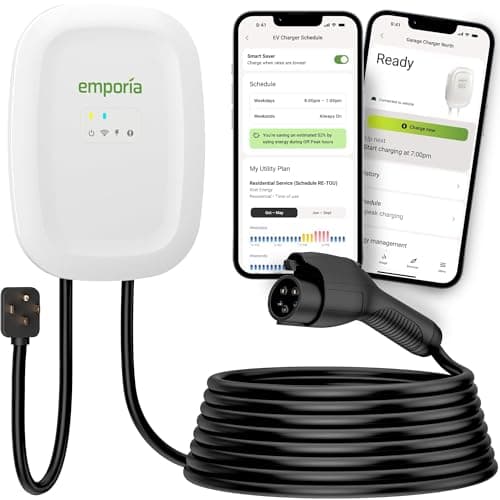
The best home charger for a Volkswagen ID.4 is the Emporia Level 2. A recent ID.4 is one of the EVs that can genuinely use a fast home charger - its onboard AC charger reaches up to about 11 kW on recent model years, so it can pull the full 48 amps a hardwired Emporia supplies, unlike many EVs that cap lower. The Emporia delivers that 48-amp speed plus real energy monitoring at a plain-box price. The Grizzl-E Ultimate is the rugged 48-amp fixture, the EVIQO is the certified 40-amp value pick, and the ChargePoint is the established-brand unit that dials up to 50 amps.
The ID.4 charges at home through a J1772 connector, the standard AC plug on nearly every non-Tesla EV, so any J1772 Level 2 charger here fits directly with no adapter. What makes VW different from a brand like Nissan is the onboard AC charger: on recent model years the ID.4 accepts up to about 11 kW, which is 48 amps - so it is one of the cars where paying for a 48-amp charger actually buys faster charging. We compiled the published vehicle and charger specs and did the arithmetic; we have not bench-tested anything, and we do not invent per-model charge times.
The important caveat is model year. The higher ~11 kW onboard charger is a recent-model-year feature; earlier or base ID.4 trims may have a lower onboard AC rating, in which case a 48-amp charger has headroom the car cannot fully use and a 40-amp unit is plenty. Confirm your specific model year's onboard AC spec before you decide the 48-amp unit is worth it - that one number is the whole difference on this page.
The short version
If you want one recommendation: buy the Emporia - it gives a recent ID.4 the full 48 amps it can use, plus monitoring, for less than most 48-amp rivals. Beyond that:
- Emporia Level 2 - best for a VW overall.The full 48 amps hardwired to match a recent ID.4's ~11 kW onboard charger, plus real energy monitoring, at a plain-box price. You only get 48 amps hardwired on a 60-amp circuit, and the app is central to setup. Full Emporia review.
- Grizzl-E Ultimate - the rugged 48-amp fixture. A dedicated 48-amp charger in a cast-aluminum IP67 shell, adjustable 16 to 48 amps. Hardwired only, and the heavy cable stiffens in deep cold. Full Grizzl-E Ultimate review.
- EVIQO Level 2 - the certified value pick. A 40-amp J1772 charger, double-listed UL and ETL, IP66 weatherproof, usually cheapest. Fine for an earlier ID.4 or a panel that cannot support 48 amps; its 40-amp ceiling is the trade-off for a recent car that could use more. Full EVIQO review.
- ChargePoint Home Flex - the established-brand pick. Dials up to 50 amps hardwired inside a mature home-and-public app. It costs more than newer brands and leans hard on the ChargePoint account. Full ChargePoint Home Flex review.
What a Volkswagen ID.4 can actually use
The one number that matters is the onboard AC charger, and it is what separates VW from lower-accepting brands:
- Connector - J1772. The ID.4 uses J1772 for AC home charging, so every charger here fits with no adapter.
- Onboard AC charger - up to ~11 kW on recent model years. That is 48 amps, so a recent ID.4 can convert the full output of a 48-amp charger into charging speed - roughly 40-plus miles of range an hour. This is why three of the four picks are 48-amp-capable; it is a genuinely different answer from a car that caps at 7 kW.
- Earlier or base trims may be lower. Not every ID.4 has the ~11 kW charger. On a trim or model year with a lower onboard AC rating, a 48-amp charger has headroom the car cannot use, and a 40-amp unit like the EVIQO covers it fully. Confirm your model year.
- DC fast charging uses CCS. The ID.4 fast-charges on the CCS standard in public - a separate topic from home charging, covered in our DC fast charging explainer.
Why the 48-amp question is real for a VW - and how to settle it
For many EVs the advice to skip a 48-amp charger is easy, because the car caps lower. A recent ID.4 is the case where 48 amps genuinely pays off - but only if two things are both true: your model year has the ~11 kW onboard charger, andyour panel can carry a hardwired 60-amp circuit. If either is not true, drop to a 40-amp charger and you lose nothing you could have used. So settle it in two checks. First, confirm your ID.4's onboard AC rating for its model year. Second, have a licensed electrician confirm the panel can support 60 amps with an NEC load calculation. If both clear, the Emporia or Grizzl-E Ultimate at 48 amps is worth it; if not, the EVIQO at 40 amps is the right, cheaper call. Our amperage guide and best 48-amp roundup cover both sides.
The practical takeaway:a recent ID.4 is worth a 48-amp charger; an earlier one, or a home that cannot support a 60-amp circuit, is not. The car's onboard charger and your panel together decide - confirm both before you pay for the extra amps.
The picks, in order
Below the summary table, each charger gets a full card with its score breakdown, pros and cons, and a "don't buy this if" note. In short: the Emporia wins on 48-amp speed plus monitoring and value, the Grizzl-E Ultimate is the rugged weatherproof 48-amp fixture, the EVIQO is the certified 40-amp pick for an earlier ID.4 or a tight panel, and the ChargePoint is the mature one-app option that dials to 50. If a full panel is forcing a lower amperage, our best adjustable chargers list covers dialing down to fit, and a very different-brand answer is on our best chargers for a BMW page, where the 11 kW onboard charger is standard rather than model-year-dependent.
How much faster 48 amps really is for an ID.4
It is worth putting numbers to why the 48-amp question is live for a VW. Charging time is energy added divided by power, so the more power the car accepts, the fewer hours a full charge takes. A 40-amp charger delivers 9.6 kW - roughly 30-plus miles of range an hour - while a 48-amp charger delivers 11.5 kW, roughly 40-plus miles an hour, which is exactly what a recent ID.4's ~11 kW onboard charger is built to accept. For a daily commuter the gap is academic: both fill the battery overnight with hours to spare. Where the extra speed pays off is a same-day top-up between trips, or charging a low battery on a tight schedule - there the faster rate turns a marginal window into a comfortable one.
That is the honest case for and against paying up on a VW. If your ID.4 has the ~11 kW onboard charger, your panel can carry a 60-amp circuit, and you value the fastest fill, the 48-amp Emporia or Grizzl-E Ultimate delivers it. If your model year accepts less, your panel tops out at a 50-amp circuit, or you simply plug in nightly and never need a fast turnaround, the 40-amp EVIQO serves the car just as well and costs less. The two confirmations - onboard rating and panel - settle it; do not assume either. And remember that a plug-in NEMA 14-50 unit is capped at 40 amps by code, so reaching the full 48 on a recent ID.4 specifically means a hardwired install.
Running costs for a VW at home
The ID.4 is efficient enough that home charging is inexpensive - a week of typical driving is a few dollars at normal residential rates, comfortably under the gasoline equivalent. Charging faster at 48 amps does not change what a full charge costs; it only fills the battery in fewer hours. We work the numbers specifically for the ID.4, with a calculator for your own rate, in our VW ID.4 home charging guide - the natural companion to this page - and the general method is in our cost to charge at home guide.
How to choose a charger for a Volkswagen
A VW is the brand where the amperage question is genuinely live, so the steps center on settling it before anything else.
1. Confirm the connector - J1772
The ID.4 charges on AC through a J1772 port, so every charger here fits with no adapter. If a 2025-or-newer VW in your driveway has a native NACS port, it still uses any J1772 charger through a NACS-to-J1772 adapter; the charger choice does not change. Confirm your port in the manual.
2. Confirm your model year's onboard AC rating
This is the step that matters most for a VW. A recent ID.4 accepts up to about 11 kWon AC - 48 amps - so it can use a 48-amp charger's full output. But earlier or base trims may accept less, in which case a 48-amp unit has headroom the car cannot touch and a 40-amp charger is plenty. Look up your exact model year's onboard AC charger spec before you decide; the whole 40-versus-48 decision hangs on this one number.
3. Confirm the panel can carry 60 amps
A 48-amp charger needs a hardwired 60-amp circuit, sized to 125 percent of the load. Have a licensed electrician run an NEC load calculation to confirm your panel can support that alongside everything else. If it cannot, a 40-amp charger on a 50-amp circuit - or an adjustable unit dialed down - is the practical answer, and a recent ID.4 still charges plenty fast on 40 amps. Do not assume the panel; confirm it.
4. Then choose the unit
If both checks clear - recent model year and a 60-amp-capable panel - the Emporia gives the ID.4 its full 48 amps with monitoring for the least money, and the Grizzl-E Ultimate is the rugged weatherproof alternative. If either check fails, the EVIQO at 40 amps is the right, cheaper choice. Want an established brand and one app for home and public charging? The ChargePoint, which also dials to 50 amps hardwired.
5. Plug-in or hardwired for a recent ID.4
This ties directly to the amperage decision. Reaching the full 48 amps a recent ID.4 can use requires a hardwired install, because a plug-in NEMA 14-50 unit is capped at 40 amps by code no matter what the box is rated for. So if the fastest fill is the point, plan for a hardwired Emporia, Grizzl-E Ultimate or ChargePoint on a 60-amp circuit. If 40 amps suits your driving - or your model year accepts less than 11 kW anyway - a plug-in EVIQO on a properly rated 14-50 is simpler and often cheaper to install, and unplugs if you move. Match the install method to whether you actually need the 48 amps; the hardwired vs plug-in guide weighs it in full.
So, which one?
Buy the Emporia for a recent ID.4 on a 60-amp-capable panel - the full 48 amps it can use, with monitoring, at a value price. Want the rugged weatherproof version? The Grizzl-E Ultimate. Have an earlier ID.4 or a panel that tops out at 40 amps? The EVIQO. Want the mature brand and unified app? The ChargePoint Home Flex. The two confirmations - model year and panel - decide whether the 48-amp units are worth it; everything else is preference.