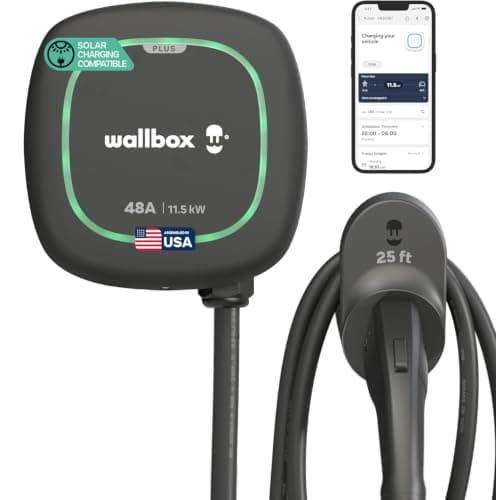
For anyone buying new today, the Wallbox Pulsar Plus is the clear pick - a compact, currently-supported 48-amp charger with a working app. The JuiceBox 40 was a genuinely good smart charger, but its maker, Enel X Way, shut down its North American business in October 2024, and the JuiceNet cloud and app were discontinued. The hardware still charges a car; the smart platform it was sold on is gone. That is the whole comparison, and it is not close.
We still get asked about the JuiceBox because it was everywhere for years, so this is an honest look rather than a dodge. The Wallbox appears in our best 48-amp chargers ranking; the JuiceBox no longer makes our roundups, for the reason below. We compile published specs and documented news rather than bench-testing either unit.
The elephant in the room: the JuiceBox shutdown
On October 2, 2024, Enel X Way announced it was winding down its North American operations. The JuiceNet cloud that powered JuiceBox scheduling, energy monitoring and remote control was discontinued, and the app stopped working for most owners through 2025. Existing JuiceBoxes keep delivering a basic Level 2 charge, and a third-party app has since appeared to restore some control, but there is no first-party support, no warranty path, and no guarantee the workarounds last. Buying one new in 2026 means buying an orphaned platform. The Wallbox, by contrast, is an actively sold and supported product.
Speed
The Wallbox, on the hardware. It is a hardwired 48-amp / 11.5 kW unit; the JuiceBox 40 is 40 amps / 9.6 kW. On a 60-amp circuit and a car that accepts it, the Wallbox adds range a little faster. If you only have a 50-amp circuit, both effectively land at 40 amps and the speed gap closes - but the Wallbox still wins on everything around the charge.
Smart features
No contest, and this is the heart of it. The Wallbox Pulsar Plus has a working app for scheduling and monitoring that will still be there next year. The JuiceBox's smart features - the entire reason people paid extra for it - depended on a cloud that has been shut down. As a smart charger, the JuiceBox effectively no longer functions as sold. If you want scheduling and monitoring you can rely on, the Wallbox delivers it and the JuiceBox cannot.
Build and connector
Both are sound hardware. The JuiceBox 40 uses a J1772 connector on a long 25-foot cable in a weatherproof, UL-listed polycarbonate case, plug-in or hardwired. The Wallbox is one of the smallest 48-amp units you can mount, Energy Star and UL certified, hardwired. On raw build they are comparable; the difference that matters is that one still has a company and a cloud behind it and the other does not.
The verdict
Buy the Wallbox Pulsar Plus - it is faster, supported, and its app still works. Consider the JuiceBox only if you already own one and want to keep it running as a basic charger. If you want the smart features on a budget instead, the Emporia is our value pick and, unlike the JuiceBox, its platform is very much alive. Before you wire anything, price the job with our installation cost guide.
How to choose a charger that lasts
Software longevity is a real spec
The JuiceBox story is the cautionary tale of home charging: a smart charger is only as smart as the cloud behind it, and when Enel X Way left North America, that cloud went with it. When you pay extra for scheduling and monitoring, you are betting the maker stays in business and keeps the servers on. Favor brands that are actively selling and updating the product - a working app next year is worth more than a spec sheet today. That is the first filter behind the Level 2 home chargers we rank - the JuiceBox is not on that list for exactly this reason.
Amps to kW
At 240 volts, the Wallbox's 48 amps is about 11.5 kW and the JuiceBox's 40 amps about 9.6 kW. Charging is a continuous load, so 48 amps needs a 60-amp breaker and 40 amps needs a 50-amp breaker, and you only reach either figure if your car's onboard charger accepts it. Size the circuit to the speed you actually intend to use.
Hardwired, plug-in and load management
The Wallbox is hardwired at 48 amps; the JuiceBox 40 came in plug-in (NEMA 14-50) or hardwired form. Hardwiring unlocks full amperage and looks cleaner; plug-in is capped at 40 amps but is removable. If a second EV is coming, check the charger's load management so two units can share one circuit safely - a live, supported app matters even more when load sharing depends on it.