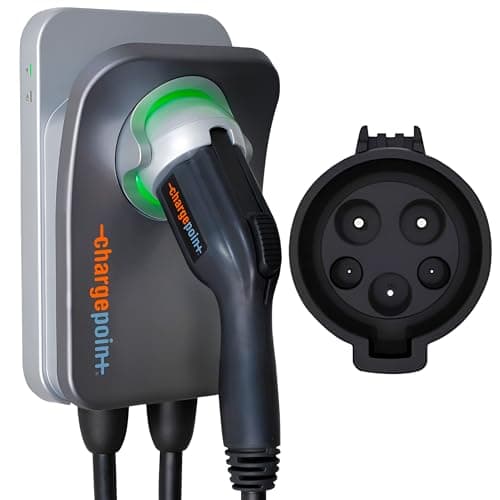
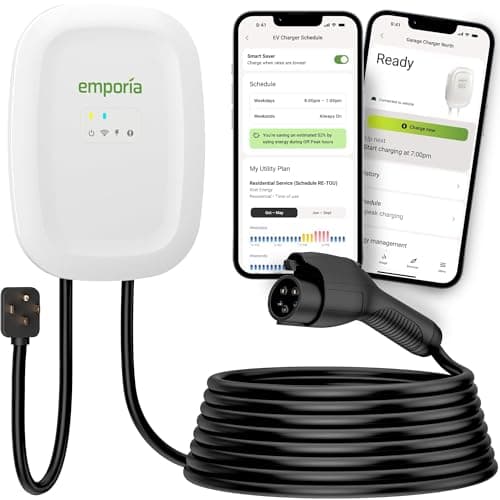
Buy the Emporia Level 2 if you want the smart features - scheduling, energy monitoring, 48-amp speed - at the lowest sensible price; it matches most of what the ChargePoint does for meaningfully less. Buy the ChargePoint Home Flex if you value a long track record, responsive support, and one app that covers both your home charger and the largest public-charging network in North America. Both are genuinely good; the question is whether the brand and network are worth the premium to you.
These are the two smart chargers most people cross-shop, and both sit near the top of our best Level 2 chargers roundup. Here is how they compare on the four things that decide it. We compile published specs and do the math rather than bench-testing either unit.
Speed
A marginal edge to the ChargePoint on paper. It is adjustable up to 50 amps; the Emporia reaches 48 amps / 11.5 kW when hardwired. In the real world that gap almost never shows up - most cars cap AC charging at 48 amps or below, and both units are limited by the circuit you install. On the same 60-amp circuit with the same car, expect the same charging speed. Our amperage guide explains why the breaker and the car, not the charger, set the ceiling.
App and features
This is where they diverge. Both give you scheduling and energy monitoring, but the ChargePoint app also ties into ChargePoint's public network - one account that maps and pays for public charging as well as running your home unit. If you charge in public often, that unified experience is a real convenience. The Emporia's app covers the home-charging essentials and slots into Emporia's broader home-energy monitoring, but it does not carry a public network. More network, or a lower price - that is the trade.
Build and support
The ChargePoint's advantage is maturity. It has the longest track record of the two and the support organization to match, which is worth something on a device wired into your panel for a decade. The Emporia is well-built and widely owned, but it is a newer brand. Neither has a durability problem; if a long history and a phone number that answers matter to you, the ChargePoint edges it.
Value
The Emporia, clearly, for most buyers. It delivers the same core smart-charging experience - 48-amp capability, scheduling, monitoring - at a price that usually undercuts the ChargePoint by a healthy margin. The ChargePoint asks a brand-and-network premium that is worth paying only if you will use the public-charging integration. If you will not, you are buying an ecosystem you will not touch, and the Emporia is the smarter spend.
The verdict
Emporia for value and everything most homes need; ChargePoint for the established brand, deeper support, and one app across home and public charging. Read the full Emporia and ChargePoint reviews for the detail, and size your circuit first with the amperage guide.
How to choose between them
Do you charge in public?
This is the single most useful question. The ChargePoint's standout feature is that its app also runs the biggest public-charging network in North America - so home and away live in one account. If you regularly charge away from home, that is worth the premium. If you charge almost entirely at home, it is a feature you will rarely open, and the Emporia gives you the home-side smarts for less.
Amps to kW, and the ceiling that actually applies
The ChargePoint tops out at 50 amps and the Emporia at 48 amps hardwired, which at 240 volts is about 12 kW versus 11.5 kW- a rounding error in practice. Both are held back by the same limits: the breaker (a 48-amp draw needs a 60-amp circuit; plug-in caps at 40 amps) and your car's onboard charger, which on many models accepts 48 amps or less. Buy for the features, not the two-amp spec gap.
Hardwired or plug-in, and load management
Both units offer plug-in (NEMA 14-50, capped at 40 amps) and hardwired (up to full amperage) installs, so the choice is about permanence and speed, not brand. If you plan to add a second EV, look at each brand's load management options so two chargers can share one circuit safely rather than forcing a second expensive line - size any shared circuit with a licensed electrician.