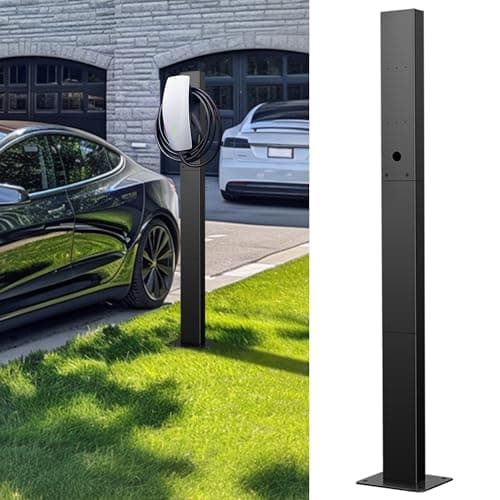
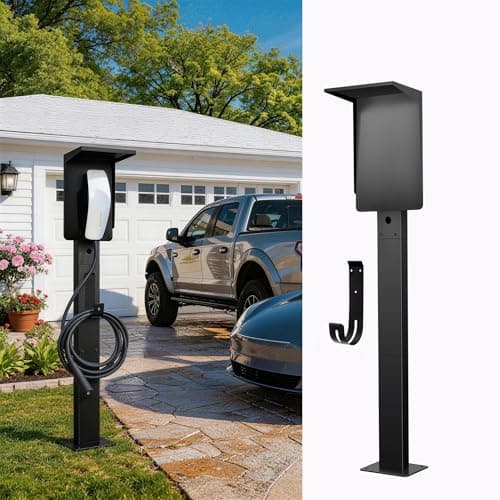
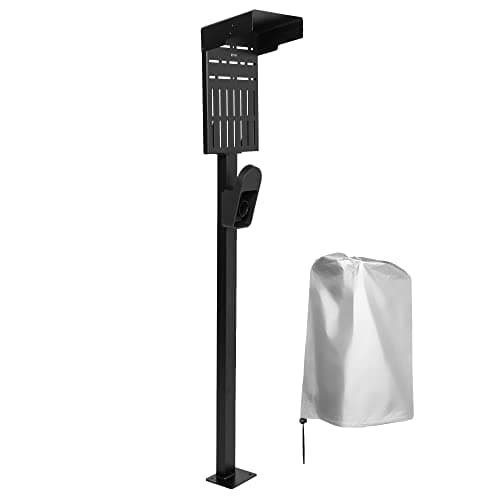
For a home driveway with no cover, buy the VIVO Outdoor EV Charging Stand: it is the only one here with a weather baffle over the charger and a magnetic cover for the car's charge port, on a stainless base that anchors into concrete. If your charger is already properly weather-rated and you only need a post, the Ufixed pedestal is the tidier and cheaper buy - powder-coated steel with the wiring routed up the inside. For two chargers or a shared parking area, the Inteset dual pedestal is the commercial-grade answer.
A pedestal solves exactly one problem: there is no wall where the car parks. Detached garage on the wrong side, a driveway that runs down the middle of the lot, a carport with posts in the wrong places, a shared parking area, a rented pad. In every one of those the charger is a wall-mount product with nowhere to go, and a post is the fix.
Two things to be clear about before the picks, because both catch people out. First, every product on this page is sold stand-only. No charger, no cable, no electrical work - and none of them carries a UL or ETL listing, because none of them is electrical equipment. The safety listing you should be checking is the one on the charger you bolt to it. Second, a pedestal does not make a charger weatherproof.Unless the stand has a hood, the charger's own enclosure rating is doing all the work, which is why the pairing advice below matters more than the choice of post.
Height is set by code, not by preference
This is the most useful number on the page and almost nobody selling a pedestal mentions it. NEC 625.50 governs where the coupling means - the connector - is stored: at least 18 inches above the floor indoors and at least 24 inches above grade outdoors, unless the equipment is specifically listed and marked otherwise. That is a floor, not a target. In practice a driveway post wants to put the connector at a comfortable working height, and the stands here run from about 59 to 62 inches tall for exactly that reason - tall enough that the connector hangs well clear of splash, snowmelt and road grit, and low enough to reach without stretching.
The corollary is that the post height and the charger's own mounting position interact. A 59-inch post with the charger mounted near the top puts the holster around chest height, which is right. A short post with a tall charger can put the connector low enough to sit in standing water, which is precisely what 625.50 exists to prevent.
The stands, side by side
| Stand | Height / size | Material | Weather cover | Cable routing | Chargers held | Mounting | Price tier |
|---|
| VIVO Outdoor EV Charging Stand | 61.7 in tall | Stainless steel base | Weather baffle + magnetic port cover | Cable holder with universal nozzle | One (33 lb capacity) | Anchors to concrete; M4 base or adapter plate | Value |
| Ufixed Universal Pedestal | Full-height post | Powder-coated steel | None - charger rating does the work | Internal, up the inside of the post | One | Reinforced base, anchors to concrete | Value |
| aesthlf Pedestal with Roof | Full-height post, 11 kg base plate | Galvanized steel + powder coat | Overhead roof | Heavy-duty cable hook | One | Pre-drilled base plate; stands unaided, anchoring advised | Mid |
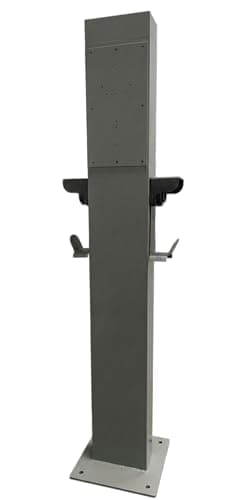
| Inteset Universal Dual Pedestal | ~60 in post, 8 x 4 in section | One-piece commercial aluminum | None - charger rating does the work | Holster and cable hooks included | One or two | Stainless 4 in anchor bolts; named brand plates | Commercial |
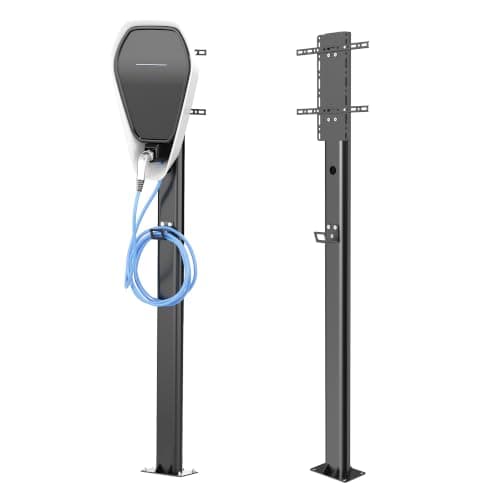
| sythdio 59-Inch Pedestal | 59 in tall | Cold-rolled steel | None | Routing opening in post + cable hook | One | Slotted plate, anchors to concrete | Budget |
The picks
The VIVO Outdoor EV Charging Stand wins because it protects the part everyone else forgets. The overhead baffle shields the charger, which is table stakes - but VIVO also includes a magnetic waterproof cover that sits over the connector and attaches to the side of the car, covering your charge port during a session in the rain or snow. That is the vulnerable end of an outdoor charge, and no other stand here addresses it. Published height is 61.7 inches, the base is stainless and anchors into concrete, and the rated capacity of 33 pounds covers any residential Level 2 unit comfortably. Check the fit first: VIVO specifies chargers with an M4 thread base or a wall-mount adapter plate.
The Ufixed pedestal is the sensible default if your charger is already rated NEMA 4 or IP66 and does not need a hood. Powder-coated steel, a reinforced base that anchors to concrete, and - the detail that separates a good post from a bad one - the supply wiring runs up the inside of the post rather than being strapped to the outside in conduit clips. It looks like an installation rather than an improvisation, and the wiring is protected.
The aesthlf pedestal is the one to buy when you want a roof but do not want to drill the driveway on day one. Its base plate weighs over 11 kilograms, enough to stand without anchoring while you decide where the post should live, and it is pre-drilled so you can anchor it properly later. A roof does catch wind, so anchor it in an exposed spot.
The Inteset Universal Dual Pedestal is a different class of object: one-piece commercial aluminum, roughly 60 inches of post in an 8 by 4 inch section, stainless 4-inch anchor bolts, and pre-cut mounting plates for the Wallbox Pulsar Pro and Plus, the Tesla Gen 3 Wall Connector, Grizzl-E and Autel, plus a blank plate to drill for anything else. It holds one or two chargers and ships with a holster and cable hooks. Buy it for a shared lot, a fleet yard or a two-charger install - it is priced for those and it is overkill for one house.
The sythdio 59-inch pedestal is the budget entry: cold-rolled steel, a slotted mounting plate that fits a range of bolt patterns, a cable routing opening in the post and a hook, with the hardware in the box. It is the lightest build here and it depends entirely on being anchored to solid concrete - which, to be fair, is what you should be doing with any of these.
Running power to a pedestal is electrician work, and it is not the same as a wall run. A post in the middle of a driveway needs a buried feed in conduit at the depth your local code requires, terminated in a wet-location-rated enclosure, on a dedicated GFCI- protected circuit. Pull a permit. A pedestal is the last ten percent of that job, not a way around the other ninety.
How to choose a pedestal
1. Check the mounting plate against your charger, first
This is where most returns come from. Universal is a marketing word, not a standard - EV chargers do not share a bolt pattern. Before ordering, find your charger's mounting hole spacing in its manual and compare it against what the stand offers. Three patterns exist in this group: a fixed plate with a named-model list (VIVO, aesthlf), a slotted plate that flexes across a range of spacings (sythdio, Ufixed), and pre-cut plates per brand plus a blank you drill yourself (Inteset). If your charger is unusual, the blank plate is the only guaranteed fit.
2. Decide whether you need a hood
The honest test is your charger's enclosure rating, not the weather. A charger rated NEMA 4 or IP66 - a cast-aluminum Grizzl-E Classic, for instance, which is NEMA 4 and IP67 - is designed to live outdoors uncovered, and a hood adds nothing but tidiness. A charger rated NEMA 3R, which covers rain but is a lower bar, benefits from cover. And if the post sits under trees, a roof earns its keep on leaves and sap alone. Our best outdoor chargers roundup ranks the chargers by enclosure type, which is the right page to read alongside this one.
3. Anchoring is the whole structural argument
Every stand here is rated on the assumption that it is bolted to concrete. That is not conservative advice: a post carries the tug of a 25-foot cable being pulled toward a car several times a week, and an unanchored post takes that load as a lever. The aesthlf's heavy base plate is genuinely stable enough to stand unaided while you position it, but the pre-drilled holes are there for a reason. On asphalt or gravel, a pedestal needs a poured pad - budget for it before you buy the stand.
4. Cable management is not decoration outdoors
A connector left hanging low or resting on the ground collects grit and standing water on contacts that are about to carry 40 amps, and that is a common cause of intermittent charging faults. Outdoors it is worse, because the water freezes. Every pick here includes either a holster, a hook or both - use them, and mount the holster so the connector hangs nose-down and drains. If your stand does not include a cradle for your connector type, the parts are cheap: see holsters and organizers. A J1772 cradle will not seat a NACS connector, so buy for the plug your charger ends in.
5. The electrical side, honestly
The stand is the cheap part. Feeding a freestanding post means a trench, conduit at code depth, conductors sized for a continuous load at 125 percent of the charger rating, a wet-location enclosure at the base and GFCI protection - and in most jurisdictions a permit and an inspection. Distance is the cost driver, so if the post can be sited nearer the panel without ruining the parking, do that. Our how far from the panel guide covers voltage drop and conductor sizing, and weatherproofing an outdoor install covers the sealing details that decide whether the install survives its first winter.
What a pedestal will not do
- It will not upgrade your charger's weather rating. A hood helps; it does not turn a NEMA 3R box into a NEMA 4 one.
- It will not make the install portable. Once the feed is trenched and the base anchored, a pedestal is at least as permanent as a wall mount.
- It will not solve reach on its own.Put the post where the car's charge port ends up, then check the cable covers every way you park - the method is in our cable length guide.
So, which one?
Exposed driveway, no cover: the VIVO, for the baffle and the port cover. Weather-rated charger that only needs a post: the Ufixed, for the internal wiring route. Want a roof without drilling immediately: the aesthlf. Two chargers, or a shared lot: the Inteset. Lowest cost onto solid concrete: the sythdio. In every case, check the bolt pattern against your charger before you order, and get the feed quoted before you buy the post.