HUB 03 · Charging Guides
32-Amp vs 40-Amp EV Charger: Which Do You Need?
The gap is about six miles of range an hour. The real difference is the circuit behind the charger - and on a new install, the faster one often costs almost nothing extra.
We earn a commission when you buy through our Amazon links, at no extra cost to you. It never affects our rankings, and we say so when the cheaper product is the better buy. How this works.
On a new installation, buy the 40-amp charger. It delivers 9.6 kW against the 32-amp unit's 7.7 kW - about six more miles of range per hour - and it runs on the 50-amp circuit and NEMA 14-50 outlet that electricians fit for EVs as a matter of course, so the extra capability usually costs very little more than the slower circuit would have. Choose 32 amps when your panel genuinely cannot spare a 50-amp circuit, or when your car's onboard charger tops out at 7.2 kW and the extra amps would go unused.
There is a detail that makes this comparison different from 32 amps vs 48 amps or 40 amps vs 48 amps, and almost nobody says it plainly: 32 amps and 40 amps are usually the same charger.Most 40-amp units are adjustable and include 32 amps as a setting, so you are not really choosing between two products. You are choosing which circuit to put behind one product - and that decision is made by your electrician's load calculation, not by a spec sheet.
The speed difference, in miles rather than kilowatts
Charging power is volts times amps, and a home charger runs at a nominal 240 volts.
| Charger | Power at 240V | Rough range added per hour | Over a 10-hour night |
|---|---|---|---|
| 32 amps | 7.7 kW | About 27 miles | About 270 miles |
| 40 amps | 9.6 kW | About 33 miles | About 330 miles |
Range figures assume roughly 3.5 miles per kilowatt-hour, a reasonable mid-point for a modern EV in mild weather; your car and your winter will move the number. The honest reading of that table is that both amperages are comfortably more than the average US driver needs overnight. Six miles an hour matters if you drive a lot, share one charger between two cars, or need a quick turnaround between trips. It is invisible if you plug in at seven and leave at seven.
The circuit is the real decision
EV charging is a continuous load, so the National Electrical Code requires the circuit to be sized at 125 percent of the charger's draw - which, read backwards, means a charger may draw no more than 80 percent of its breaker. That single rule produces the whole difference between these two options:
| 32-amp charger | 40-amp charger | |
|---|---|---|
| Breaker | 40 A | 50 A |
| Typical copper conductor | About 8 AWG | About 6 AWG |
| Outlet, if plug-in | Often NEMA 6-50 or 14-50 | NEMA 14-50 - the standard EV outlet |
| Panel capacity consumed | 40 A of the service | 50 A of the service |
| Power delivered | 7.7 kW | 9.6 kW |
Those conductor sizes are planning figures for 240-volt copper on a dedicated circuit; the real sizing depends on wire type, insulation temperature rating, run length, ambient temperature and bundling, and it is your electrician's call. Our wire and breaker size guide has the full table.
Here is why this usually resolves in favor of 40 amps on a new install: the labor is the same. Running a circuit means a breaker, a cable pull, a box and an inspection, and the cost is dominated by the distance and the difficulty, not by one gauge of wire. Going from 8 AWG to 6 AWG over a typical run is a modest material difference against the total. Meanwhile, 40 amps is what the NEMA 14-50 outlet is built around, which is the receptacle electricians install for EVs by default. In other words, asking for the slower circuit is often asking for a custom job that saves very little. Our installation cost guide breaks down where the money actually goes.
Two reasons 32 amps is genuinely the right answer
1. Your panel cannot spare 50 amps
This is the common one, and it is not a compromise so much as arithmetic. A licensed electrician runs a load calculation under NEC Article 220, adds up the house, and tells you what is left. If that number is 40 amps, you install a 40-amp circuit and set the charger to 32 - and you still add about 270 miles overnight. In an older home this is frequently the difference between charging at home this month and waiting for a service upgrade. Our chargers for a 100-amp panel roundup is written for exactly that house, and the load calculation guide explains what the electrician is adding up.
2. Your car cannot use 40 amps
The car's onboard charger is a hard ceiling that no wall unit can raise. A vehicle that accepts 7.2 kW will draw about 30 amps and no more, so a 40-amp charger on a 50-amp circuit delivers exactly what a 32-amp charger would have - you simply paid for headroom the car declines. Check the kW figure in your owner's manual before you choose an amperage; how fast will my EV charge walks through the three limits and the rule that the lowest one wins.
The exception worth knowing: if you expect a different car in a few years, buy the bigger circuit now. The charger can always be turned down, and a 50-amp circuit with a 14-50 outlet accepts almost anything you will plug into it later. Retrofitting a bigger circuit, by contrast, means paying for the install twice.
Why most 40-amp chargers are also 32-amp chargers
Nearly every credible 40-amp unit lets you set a lower current, and the mechanism varies in a way that matters more than the number:
- An internal dial set at installation, as on the Grizzl-E Classic. Nobody can change it by accident and it needs no app - the right choice when the amperage is dictated by the circuit and should never move.
- An app setting, as on the Emporia and the Autel. Convenient, and genuinely useful if your available capacity changes - but it depends on the app being reachable.
- A setting chosen during commissioning, as on the ChargePoint Home Flex, whose output is selectable to match the circuit it is installed on.
The practical consequence: buy the 40-amp unit even for a 40-amp circuit, set it to 32 amps, and you keep the option of the full 9.6 kW if the panel is ever upgraded. A charger with a fixed 32-amp ceiling saves little and closes that door. The best adjustable chargers ranking covers which units adjust, and how.
Plug-in or hardwired, at these two amperages
Both 32 and 40 amps can be plug-in, which is the useful thing about this pair: a NEMA 14-50 outlet is rated for a 40-amp continuous load, so 40 amps is the maximum you can get through a plug. That is why the jump to 48 amps is a bigger step than the jump from 32 to 40 - 48 amps is hardwire-only, with no plug-in option at all. If portability matters to you, the 32-to-40 decision keeps both doors open and the 48-amp decision does not. See hardwired vs plug-in, and if you are having a receptacle fitted, best NEMA 14-50 outlets - a cheap receptacle is the part that fails under a sustained 40-amp draw.
What this costs to run
Nothing, in the sense that matters: amperage changes how fast the energy arrives, not how much energy the car needs. Forty kilowatt-hours costs the same whether it took four hours or five. The only cost difference between these two is the install, and a marginal one in standby draw. Run your own numbers with our cost-to-charge calculator. Where amperage does touch your bill is on a time-of-use rate with a narrow cheap window: the faster charger fits more of the charge inside the cheap hours, which is an argument for 40 amps rather than against it. See off-peak charging.
The short version
- New circuit, panel has room, car accepts 9.6 kW or more: 40 amps. The install is barely different and you get about six more miles of range an hour.
- Panel is tight: 40-amp charger, 40-amp circuit, set to 32 amps. You keep the upgrade path for free.
- Car accepts 7.2 kW: either works identically today. Still buy the adjustable 40-amp unit if the price gap is small, because the next car may accept more.
- Existing 40-amp circuit you are not changing: 32 amps, and do not pay for a 48-amp unit you cannot feed.
What to look for either way
- A published adjustment range, with the method named."Adjustable" is not enough; you want to know whether it is a dial, an app or a commissioning setting.
- A real safety listing. UL or ETL to UL 2594, from a Nationally Recognized Testing Laboratory, verified rather than claimed. At 32 or 40 amps this unit runs unattended for hours.
- A NEMA 14-50 plug, if plug-in. It is the standard EV receptacle and it covers both amperages, so it does not lock you to the slower one.
- Cable length you measured, not guessed. 25 feet reaches across a two-car garage; a 16-foot cable often does not.
- An outdoor enclosure rating if the unit will live outside - NEMA 4 / 4X or IP65 and above.
The four below are the registry picks that cover both amperages from one box - each is a 40-amp unit that can be set lower, with the adjustment method noted on its card.
The gear
Recommended gear for this guide
The products this guide refers to, with prices pulled live from Amazon and dated on each card.
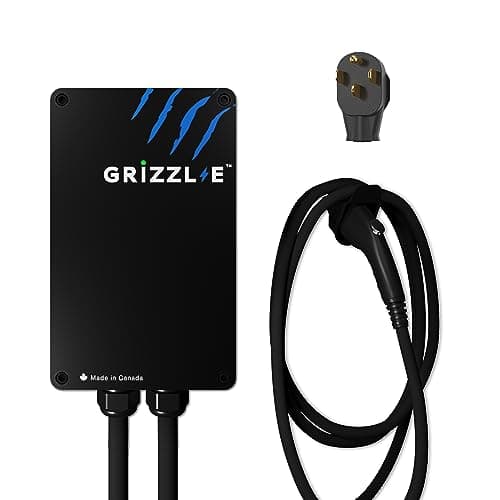
People who want a charger, not an app
Grizzl-E Classic (40A)
A UL-certified cast-aluminum box with no app to update and nothing in the cloud to fail — the durability default for people who want a charger, not a gadget.
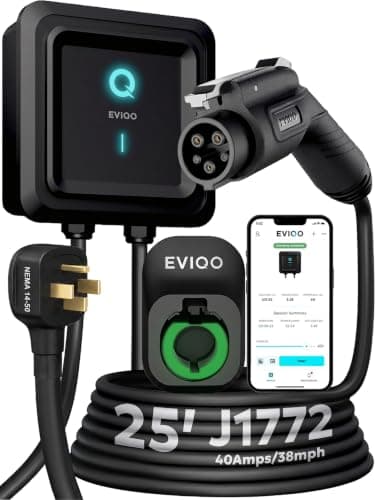
Budget buyers who still want smart features
EVIQO Level 2 (40A)
A double-listed (UL and ETL), IP66-weatherproof smart charger that keeps landing at the bottom of the price band — a lot of certified hardware for the money.
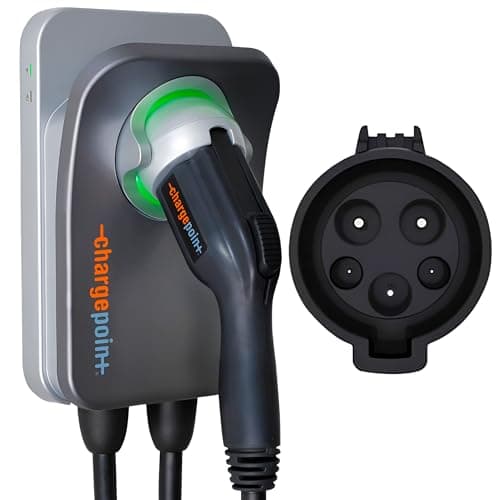
Buyers who want the established brand + one app
ChargePoint Home Flex
The mature, well-supported pick — amperage you dial in up to 50A, wired into the biggest public-charging app in North America. You pay for the polish.
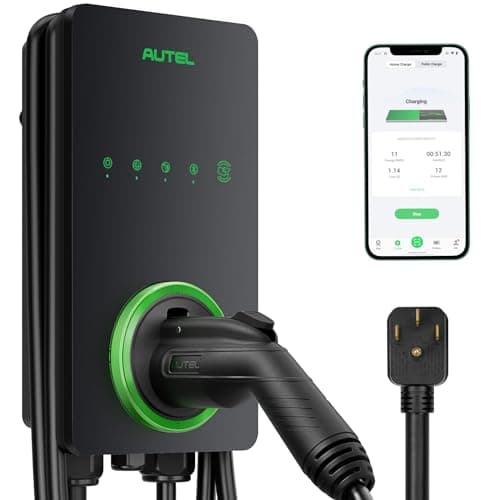
Feature-maximalists who want a clean install
Autel MaxiCharger (40A)
The everything-in-the-box option: Wi-Fi and Bluetooth both, a weather-rated shell, and a holster included so the install is tidy from day one.
#ad · As an Amazon Associate we earn from qualifying purchases.
Questions
Frequently asked
Is a 40-amp EV charger better than a 32-amp one?
Faster, by about six miles of range per hour - 9.6 kW against 7.7 kW. Whether that is "better" depends on two things you can check: whether your panel can spare a 50-amp circuit rather than a 40-amp one, and whether your car's onboard charger accepts more than 7.2 kW. If both are yes, take the 40 amps; on a new install the circuit costs little more. If either is no, 32 amps loses you nothing real.
What circuit does each one need?
A 32-amp charger needs a 40-amp breaker and roughly 8 AWG copper; a 40-amp charger needs a 50-amp breaker and roughly 6 AWG. That comes from the NEC continuous-load rule, which sizes the circuit at 125 percent of the charger's draw. Final sizing depends on wire type, run length and ambient temperature, and is your electrician's call - see our wire and breaker guide.
Can I run a 40-amp charger on a 40-amp circuit if I turn it down?
Yes, and it is the move we would recommend. Set the unit to 32 amps at installation - by dial, in the app or during commissioning, depending on the model - and it draws no more than the circuit allows. You get the current circuit's speed now and the full 9.6 kW later if the panel is ever upgraded, without buying a second charger. What you must not do is the reverse: run a charger at more amps than its breaker permits.
How much slower is 32 amps in practice?
About 27 miles of range per hour versus about 33 at 40 amps, assuming roughly 3.5 miles per kWh. Over a ten-hour overnight window that is roughly 270 miles versus 330 - both far more than a typical driving day. The gap becomes real if you cover high mileage, share the charger between two EVs, or turn the car around quickly between trips.
Does a 32-amp charger use a different plug?
Not necessarily. Plenty of 32-amp units ship with a NEMA 14-50 plug, the same as 40-amp models, because 14-50 is the receptacle electricians fit for EVs. Some use a NEMA 6-50. The plug tells you what outlet it needs, not what the circuit behind that outlet is rated for - which is exactly why the charger's current setting has to match the breaker, not the plug.
Should I skip both and go straight to 48 amps?
Keep reading
Related
- 32 amps vs 48 ampsThe bigger jump, where the circuit and the hardwire requirement change the answer.
- 40 amps vs 48 ampsThe other neighboring comparison, and the onboard-charger catch.
- Wire and breaker sizeThe NEC 125-percent rule and the sizing table behind this page.
- Best 40-amp chargersThe field at the amperage this page usually recommends.
- Best 32-amp chargersThe units worth buying when the panel settles the question at 32.
- Best adjustable chargersWhich units cover both amperages from one box, and how the setting is made.
More in this section
More Charging Guides
Receipts
Sources
- EC&M - NEC requirements for EV equipment (Article 625: EVSE is a continuous load, circuits sized at 125 percent of the load)
- US DOE AFDC - charging an electric vehicle at home (Level 1 and Level 2 charging)
- US DOE / fueleconomy.gov - EV charging basics (Level 1, Level 2 and DC fast charging)
- Intertek - UL 2594 testing and certification for electric vehicle supply equipment
- ChargePoint - Home Flex amperage settings (selectable output)
- Emporia - adjusting the amperage / charge rate on your EV charger
- United Chargers - Grizzl-E Classic 40A (UL certified, cast aluminum, indoor/outdoor, NEMA 14-50 plug, adjustable via internal dial)
- EVIQO - Level 2 EV chargers (40A, UL and ETL listed, IP66 / NEMA 4, 25 ft cable)
- Autel Energy - MaxiCharger AC Home datasheet (adjustable output, J1772, 25 ft cable)
We do not run a testing lab, and we do not pretend to. Where a measured number came from someone else's lab, we name them and link them. Where we could not verify something, we say so on the page rather than quietly leaving it out. Read our full method.