HUB 04 · Charging Costs
Chevy Silverado EV: Home Charging Time and Cost
The big-battery truck that tests your home circuit - what it costs to charge, how long its 200+ kWh pack really takes, and why the optional 19.2 kW charger needs a bigger circuit.
We earn a commission when you buy through our Amazon links, at no extra cost to you. It never affects our rankings, and we say so when the cheaper product is the better buy. How this works.
A Chevy Silverado EV has one of the biggest batteries on the road - north of 200 kWh on the long-range trims - so home charging is a genuine planning exercise, not an afterthought. A full 10-to-80-percent refill costs roughly twenty-five dollars and, on a standard 11.5 kW charger, takes most of the night. The truck offers an optional 19.2 kW onboard charger that roughly halves that time - but it needs a much larger home circuit. Here is the time, the cost and the charger that fits, with the arithmetic shown.
Two onboard chargers, two very different home setups
The Silverado EV ships with an 11.2 kW (about 48-amp) onboard AC charger as standard, and offers an optional 19.2 kW (80-amp) unit. That distinction matters more here than on any other EV because the battery is so large:
- Standard 11.5 kW / 48A - runs on a normal 60-amp EV circuit and a common 48-amp Level 2 charger. The right choice for most owners.
- Optional 19.2 kW / 80A - needs an 80-amp continuous circuit (a 100-amp breaker) and a charger that can deliver 80 amps, which few home units do. That often means a service upgrade and a much bigger install bill; see whether your panel can take it in do I need a panel upgrade.
How long it takes
At 11.5 kW the Silverado EV adds roughly 18 to 22 miles of range per hour - lower than a car because a full-size electric truck is heavy and thirsty. On the standard charger, expect to fill the big pack over a long night; the optional 19.2 kW unit roughly doubles the rate.
Roughly, on the standard 48 amps / 11.5 kW (long-range ~205 kWh pack):
- Overnight 10 to 80 percent (~143 kWh): about 12 to 13 hours
- A 40-mile daily commute back (~20 kWh): about 2 hours
- On the optional 19.2 kW charger, the 10-to-80 time drops to roughly 7 to 8 hours
The takeaway: on a standard charger you do not fully refill a near-empty Silverado EV in a single overnight window. In practice you rarely need to - you top up the 20 to 40 kWh a day's driving used, which is quick, and reserve the big fills for before a long haul.
What it costs
Same formula, bigger numbers. For a 10-to-80-percent refill (~143 kWh into a ~205 kWh pack):
- Energy drawn from the wall: 143 / 0.90 = ~159 kWh
- At the US average of about $0.16/kWh: 159 x $0.16 = about $25.40
- Cost per mile at ~2.0 mi/kWh: about 8 cents, or ~$8.00 per 100 miles
A big battery makes off-peak rates matter more than on any other EV - shifting these kilowatt-hours to cheap overnight hours is real money. Run your own rate below, then see off-peak charging.
Run it for your car
Cost-to-charge calculator
Put in your electricity rate, your battery size and your car's efficiency. The math is the same one shown above, with a 10% charging loss included so the number is realistic.
- $8.09
- A 10% to 80% charge
- $11.56
- A full (empty to 100%) charge
- $0.05
- Cost per mile
- $5.08
- Cost per 100 miles
Estimate only. Actual cost depends on your exact utility rate (including any time-of-use pricing and fees), your car's real efficiency, temperature, and charging losses. Check your electric bill for your true rate.
The charger: J1772 at home, and size the circuit first
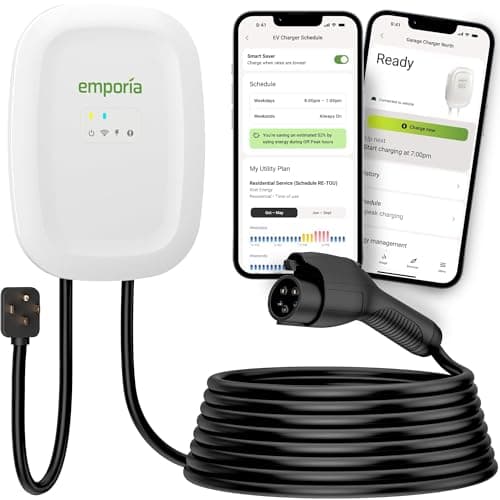
For home AC the Silverado EV uses a J1772 connector, so any Level 2 J1772 charger plugs straight in. For the standard 11.5 kW truck, a rugged 48-amp unit on a 60-amp circuit is the pick - the weatherproof Grizzl-E Ultimate or the value Emporia Level 2. Only pursue an 80-amp / 19.2 kW setup if you genuinely need the speed and your panel can support it; for most owners the payback does not justify the far bigger install. GM's NACS adapter, like other brands', is for DC Superchargers on the road, not your home wall unit.
The gear
Recommended gear for this guide
The products this guide refers to, with prices pulled live from Amazon and dated on each card.
- Guide
A permanent, weatherproof 48A install
Grizzl-E Ultimate (48A)
A dedicated 48-amp charger in a cast-aluminum, IP67 shell - the toughest full-speed box here, built to be hardwired to a wall and left to work.
Most homes that want speed and smarts
Emporia Level 2 (48A)
The charger that refuses to charge you extra for being smart: full 48-amp speed and real energy monitoring at roughly the price of a plain plug-in box.
#ad · As an Amazon Associate we earn from qualifying purchases.
Questions
Frequently asked
What size charger does a Chevy Silverado EV need at home?
For the standard 11.5 kW truck, a 48-amp charger on a 60-amp circuit is the practical maximum. The optional 19.2 kW onboard charger can use an 80-amp unit, but that needs a 100-amp circuit and often a service upgrade - worth it only if you must refill the big pack fast and often.
Can a Silverado EV fully charge overnight at home?
On the standard 11.5 kW charger, a near-empty 200+ kWh pack takes longer than a typical overnight window - roughly 12 to 13 hours for 10 to 80 percent. Day to day you only replace what you used, which is quick; full refills are the exception, not the rule.
Is the 19.2 kW charger worth it?
Only if you regularly deplete the battery and need it back fast, and your electrical panel can take an 80-amp continuous circuit. For most owners the standard 48-amp setup is far cheaper to install and keeps the truck full for daily use.
Keep reading
Related
- Does My GM EV Need an Adapter?GM's published list of which 2026 models are CCS and which are native NACS.
- Best chargers for a ChevyThe Bolt, Equinox EV, Blazer EV and Silverado EV picks.
- Do I need a panel upgrade?Whether your panel can take a 60- or 100-amp circuit.
- Best 48-amp chargersThe standard full-speed units for the truck.
More in this section
More Charging Costs
Receipts
Sources
- EvoCharge - 2025 Chevrolet Silverado EV charger specs (11 kW standard / 19.2 kW optional onboard AC)
- InsideEVs - Chevrolet Silverado EV (200+ kWh battery, GM Ultium)
- US EIA - average price of electricity (residential rates)
- US DOE AFDC - charging at home
We do not run a testing lab, and we do not pretend to. Where a measured number came from someone else's lab, we name them and link them. Where we could not verify something, we say so on the page rather than quietly leaving it out. Read our full method.