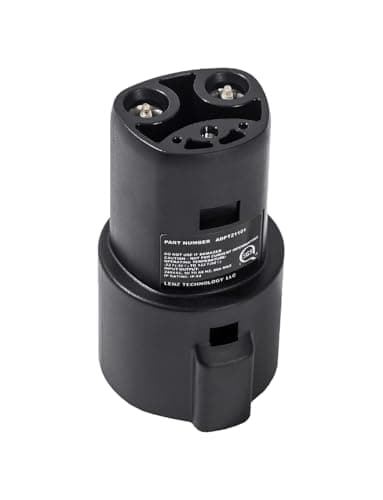
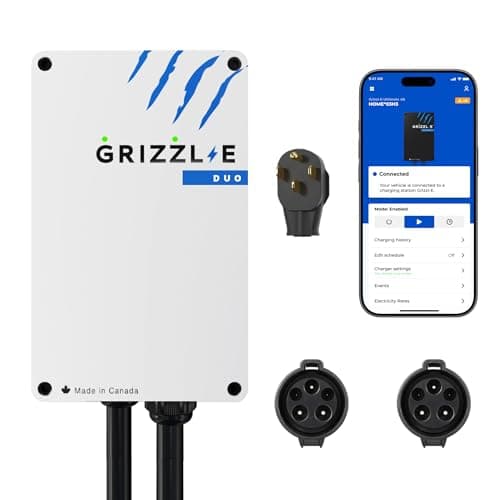
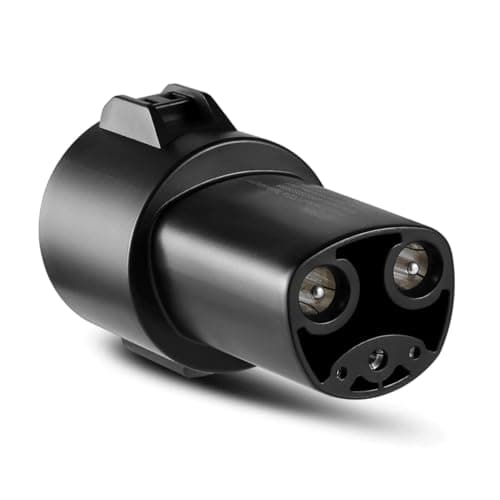
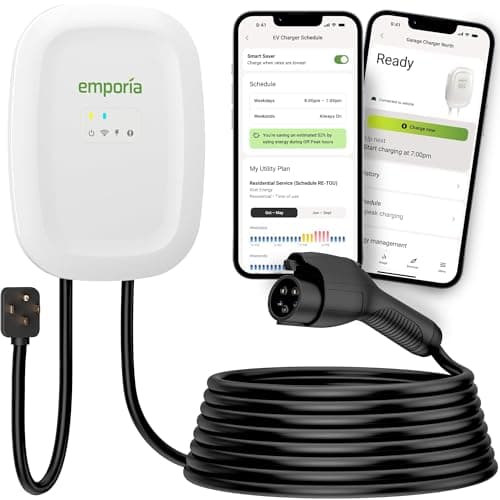
Buy a 48-amp J1772 charger - the Emporia Level 2 is the one we would pick - and add a UL-listed J1772-to-NACS adapter such as the LENZ for the Tesla. That combination charges both cars at full speed, costs less than a dual-connector wall unit, and leaves you with an adapter the Tesla can take on the road. If you would rather have two plugs permanently on the wall and no adapter to lose, the Tesla Universal Wall Connector is the only wall unit with both built in. If both cars need to charge at the same time on one circuit, the Grizzl-E Duo is the answer instead.
One clarification first, because it is the thing people get wrong when they search for this. A dual-port charger is about charging two cars at once from one circuit. A mixed-connector garage is about one cable fitting two different plug shapes. They are separate problems with separate hardware, and most households that think they have the first one actually have the second - two cars that both sit plugged in overnight, but never simultaneously. If you genuinely need both at once, read best dual-port chargers instead.
Which direction does your driveway need?
Adapters are directional, and buying the wrong one is the single most common mistake here. The adapter is named for what it takes in first and what it presents out second.
| Your charger | The car that does not fit | What you need | Where it lives |
|---|
| J1772 (almost every non-Tesla wall unit) | Tesla or any NACS-port car | J1772-to-NACS adapter | On the charger's connector, or in the Tesla |
| NACS (Tesla Wall Connector, native NACS units) | J1772 car | NACS-to-J1772 adapter | In the non-Tesla's trunk |
| Tesla Universal Wall Connector | Neither - both fit | Nothing | The J1772 adapter docks on the unit |
If you are not sure which port your own car has, our NACS or J1772 identification guide settles it in one look, and adapter compatibility by brand has every make in one table.
Why the adapter route wins on cost and flexibility
A home AC adapter is a passive part. It carries the two power conductors, the ground, and the J1772 control pilot and proximity lines straight through to the NACS pins - there is no electronics deciding anything, which is why a listed one can be rated to 80 amps and still cost a fraction of a charger. The car and the charger run exactly the same handshake they would without it, and the charging rate is unchanged.
That gets you three things a dual-connector wall unit does not. The adapter is portable, so the Tesla can use a friend's J1772 charger or a public Level 2 post. It is replaceable for twenty or thirty dollars if it is lost or damaged, rather than being part of a hardwired fixture. And your charger stays a mainstream J1772 unit, which is the connector the overwhelming majority of home chargers, public Level 2 stations and future resale buyers still use.
Buy a listed adapter, and only use it for AC. Look for UL 2251 or UL 2252 certification, which is the difference between a tested connector assembly and a moulded lump of plastic carrying 40 amps for eight hours. And note that home AC adapters are not DC adapters - they will not work at a DC fast charger. Our Supercharger adapter guide explains why.
When the dual-connector wall unit is worth it instead
Three situations. If the non-Tesla driver will not reliably handle an adapter - a teenager, a houseguest, anyone who will leave it on the floor of the garage - a unit with both plugs removes the human step. If the Tesla is the primary car and you want its app integration at home. Or if you want the charging hardware to look like one finished installation rather than a charger with a part hanging off it.
The honest caveats: the Tesla Universal Wall Connector is hardwired, so it is a permanent fixture rather than something you unplug and take to the next house, and its Amazon availability is intermittent - which is why its row shows a tagged search rather than a live price. Tesla sells it directly. If both cars have NACS ports already, skip all of this and read best NACS home chargers.
The two-cars-at-once case
If both cars really must charge simultaneously and you have one circuit, you need hardware that splits it: a dual-port charger like the Grizzl-E Duo, or two chargers that power-share. A dual-port unit shares its amperage between the two cables, so two cars at once each get roughly half the rate - which is almost always fine overnight. Note that a dual-port J1772 charger plus one adapter still serves a mixed driveway, so these approaches combine. The detail is in can two EVs share one charger and best load-balancing chargers.
How the options compare
| Route | Serves both connectors? | Two cars at once? | Portable? | Install |
|---|
| J1772 charger + J1772-to-NACS adapter | Yes | No | Adapter yes, charger if plug-in | Plug-in or hardwired |
| Tesla Universal Wall Connector | Yes, both plugs on the unit | No | No | Hardwired |
| Dual-port charger + adapter | Yes | Yes, at shared amperage | No | Plug-in or hardwired |
| Two separate chargers | Yes, one each | Yes, if the panel allows | No | Two circuits or load management |
So, which one?
Emporia Level 2 plus the LENZ adapter for most mixed driveways: full speed for both cars, the lowest total cost, and an adapter the Tesla can take with it. Swap in the Lectron 80A adapter if you want the brand with the broader UL 2252 range. Tesla Universal Wall Connector if you want two plugs on the wall and no part to lose, and you are buying direct. Grizzl-E Duo if the real constraint is two cars needing charge on the same night, on one circuit.
If the Tesla charger is already on the wall - inherited with the house, or installed by a previous owner - you are solving a narrower version of this problem, and the adapter route is laid out in can a Tesla Wall Connector charge a non-Tesla EV.