HUB 03 · Charging Guides
Charging an EV With Solar Panels
Free miles from your roof are real, but only if the timing lines up. Here is how solar-plus-EV actually works, and the charger features that make it pay.
We earn a commission when you buy through our Amazon links, at no extra cost to you. It never affects our rankings, and we say so when the cheaper product is the better buy. How this works.
Charging an EV from your own solar panels is one of the genuine joys of going electric - miles that cost close to nothing and come from your roof. But the appeal hides a timing problem: panels make power during the day, and most people charge at night. Solving that mismatch - with charging schedules, net metering, or a home battery - is what separates "solar EV charging" from wishful thinking. Here is how it actually works.
The core idea, and the catch
A typical home solar array produces several kilowatt-hours per sunny day. An EV charging at Level 2 draws 7-11 kW, so on a bright afternoon the panels can feed the car directly. The catch is timing: the sun peaks at midday, but the car is usually at work then, and you plug in after dark when the panels are asleep. There are three ways to bridge that gap.
Way 1: Charge during the day
The cleanest match is to charge when the sun is up - a car that is home during the day (remote work, a second vehicle, weekends) can soak up solar directly. A smart charger with scheduling lets you set charging to run midday, and one with energy monitoring - like the Emporia - shows how much you are actually pulling so you can align it with production. Some solar-aware chargers can even modulate to match surplus output.
Way 2: Net metering (the practical default)
Most solar owners do not literally push sunlight into the car. Instead, panels export daytime surplus to the grid, the meter credits it, and the car draws from the grid at night against those credits. Economically it is close to charging on solar, as long as your utility's net metering terms are fair. Check your plan: full-retail net metering makes overnight charging nearly free against daytime exports, while lower export rates change the math. Pair it with an off-peak rate for the best result.
Way 3: A home battery
A home storage battery captures midday solar and releases it at night to charge the car - the most complete solution, and the most expensive. It makes the most sense where net metering is weak or where backup power is also a goal. For most people, day-charging plus net metering gets 90 percent of the benefit at a fraction of the cost.
How much array does it take?
A rough, honest estimate: driving 1,000 miles a month at about 3 miles per kWh needs roughly 330 kWh of charging. A solar array producing that much depends heavily on your location and roof, but it is on the order of a few kilowatts of panels dedicated to the car - a meaningful but not enormous addition to a typical residential system. The exact figure is a job for a solar installer who knows your sun hours; do not trust a flat number.
The charging side of solar-EV is simple: any standard Level 2 charger works. The features that help are scheduling (to charge when the sun is up) and energy monitoring (to see what you use). A dumb charger still works fine on net metering.
The takeaway
Solar and EVs are a natural pair, but the win comes from timing and tariffs, not from the charger hardware. If your car can charge during daylight, a scheduling smart charger like the Emporia or Wallbox helps you line up with production; if it charges at night, good net metering does the heavy lifting. Either way, the running cost drops toward the lowest it can go - see cost to charge at home. Both of those chargers place in the best Level 2 home chargers we've compared, where scheduling is one of the scored features.
The gear
Recommended gear for this guide
The products this guide refers to, with prices pulled live from Amazon and dated on each card.
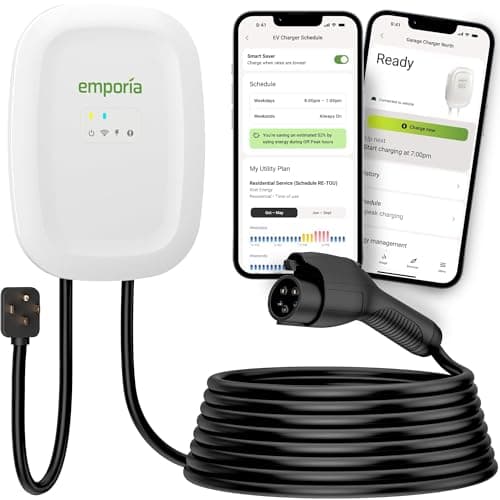
Most homes that want speed and smarts
Emporia Level 2 (48A)
The charger that refuses to charge you extra for being smart: full 48-amp speed and real energy monitoring at roughly the price of a plain plug-in box.
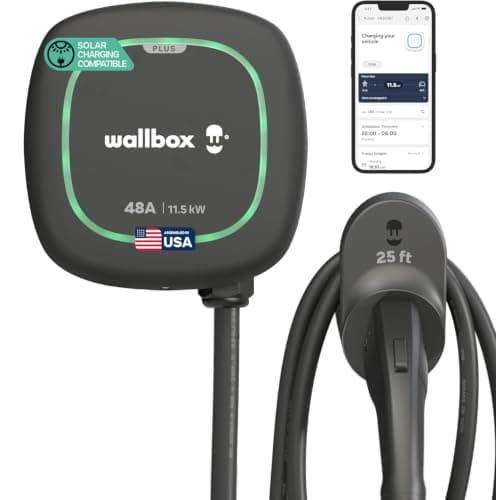
A compact, fast, hardwired install
Wallbox Pulsar Plus (48A)
One of the smallest 48-amp chargers you can hang on a wall — full-speed hardwired charging in a box that barely announces itself.
#ad · As an Amazon Associate we earn from qualifying purchases.
Questions
Frequently asked
Can I charge my EV directly from solar panels?
Yes, if the car is home during the day - a Level 2 charger can run on the panels' midday output. If the car is only home at night, you instead rely on net metering: panels export by day and the car draws grid power at night against those credits.
Do I need a special charger for solar EV charging?
No - any standard Level 2 charger works. A smart charger with scheduling and energy monitoring helps you charge when the sun is up and track your usage, and some solar-aware models can modulate to match surplus, but none of that is required.
How many solar panels does it take to charge an EV?
Roughly a few kilowatts of panels dedicated to the car for average mileage, but it depends heavily on your location, roof and driving. A solar installer who knows your local sun hours should size it - avoid any source that gives a single flat number.
Keep reading
Related
More in this section
More Charging Guides
Receipts
Sources
- US DOE Energy Saver - electric vehicles
- US DOE AFDC - charging at home
- US EIA - electricity data (residential rates, net metering context)
We do not run a testing lab, and we do not pretend to. Where a measured number came from someone else's lab, we name them and link them. Where we could not verify something, we say so on the page rather than quietly leaving it out. Read our full method.