On a plug-in EV charger, the NEMA 14-50 outlet is the single part most likely to fail. A continuous 40-amp draw for hours every night is exactly the load that cooks a cheap receptacle until the contacts char - the melted-outlet photos you see online are almost never the charger. Spend a little here. Our pick is the Leviton 1450R, the receptacle Leviton built specifically for EV charging; the RONROX industrial outlet is the value ETL option, the EPLESFTON is the weather-resistant pick for a damp or exterior wall, and the Wayona outlet box is the all-in-one answer for a surface-mount or outdoor run.
A NEMA 14-50 is the 240-volt, 50-amp receptacle an electric range or an RV pedestal uses, and it is what a plug-in Level 2 charger plugs into. It looks like a commodity part, and the $8 versions at the hardware store are built for a range that draws hard for twenty minutes at dinner - not for an EV charger pulling 40 amps, unattended, for six to ten hours a night. That difference is the whole point of this page. If you are shopping the chargers that plug into one, see our best NEMA 14-50 plug-in chargers; here we rank the outlet itself. We compile published manufacturer specifications and safety listings; we do not run a test lab.
Why the outlet is the part that fails
EV charging is what the code calls a continuous load: full current, for hours, every single day. A receptacle is a set of spring contacts gripping the plug's blades, and every one of those contact points has a tiny resistance. Push 40 amps through a slightly loose or thinly plated contact and it heats; heat relaxes the spring, which loosens the grip, which raises the resistance, which makes more heat. That runaway is why the receptacle - not the charger, and not the wire - is the component that browns, melts, and in the worst cases starts a fire. A range receptacle rarely sees the sustained load that exposes it; an EV charger does, nightly.
The fix is not exotic. It is buying a receptacle built for continuous high current - heavy brass contacts, a high-impact housing, and solid terminals - and having it installed correctly. Every outlet on this page clears that bar. What separates them is how they are built, whether they are listed by an independent lab, and where they are meant to mount.
What separates a good 14-50 outlet
- EV-rated or industrial grade, never residential. This is the one that matters. Leviton is blunt about it: its standard 279-S00 range receptacle is labeled not recommended for EV charging, and it points buyers to the 1450R instead. An "industrial grade" or purpose-built "EV" receptacle uses heavier contacts and better plating than the residential part that shares the same slot pattern.
- A real safety listing (UL or ETL). A UL or ETL listing means an independent lab tested the part to a standard. On a component carrying this much current continuously, an unlisted bargain receptacle is the one corner never to cut. Every pick here is UL or ETL listed.
- Solid terminals and heavy contacts. Look for brass (not plated steel) contacts and pressure-plate or clamp terminals rated for the wire gauge you will use, torqued to spec. A loose lug is the origin of most overheating, so the terminal design is not a detail.
- The right mount for your wall. A flush receptacle drops into a recessed wall box for a tidy indoor install. If you are running exposed conduit or mounting outdoors, an all-in-one weatherproof box is cleaner and code-friendlier than trying to weatherproof a flush part.
- Weather rating, if it lives outside. An exterior or damp-garage outlet wants a UV-resistant body and corrosion-resistant straps, plus a wet-location, in-use cover. Outdoors, NEC Article 625 also calls for GFCI protection on the circuit.
The picks
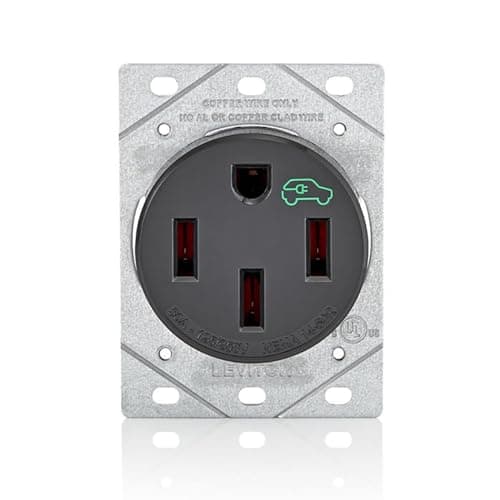
The Leviton 1450Ris the one to buy for a standard indoor or garage install. It is Leviton's dedicated EV receptacle, built for the extended sessions and constant plug cycles a home charger inflicts, with pressure-wire terminals torqued to 75 in-lb and the spec-grade reputation electricians already trust. It costs several times a basic range part, and it is still a rounding error next to the charger and the circuit.
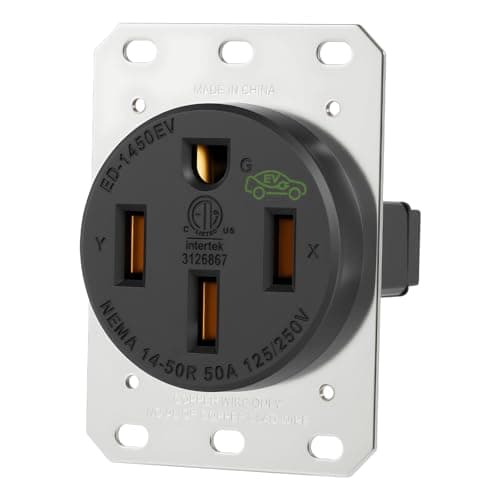
The RONROX industrial outlet is the value pick: an ETL-listed, 3-pole 4-wire 14-50R with brass contacts, zinc-plated steel straps, and a wide #8 to #4 AWG terminal range, for about half the Leviton. It ships ready for a standard box and is a sensible choice when you want a listed, heavier-than-residential part without paying the name-brand premium.
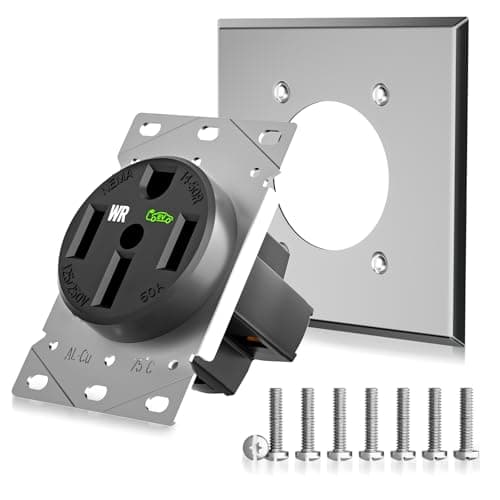
The EPLESFTON weather-resistant 14-50R is the pick when the outlet sits in a damp garage or on an exterior wall but you still want a flush receptacle. It is ETL listed with a UV-resistant body and galvanized straps rated from -40 to 60 C, ships with a matching wall plate, and fits both single- and 2-gang boxes - for a truly wet spot, add a weatherproof in-use cover.
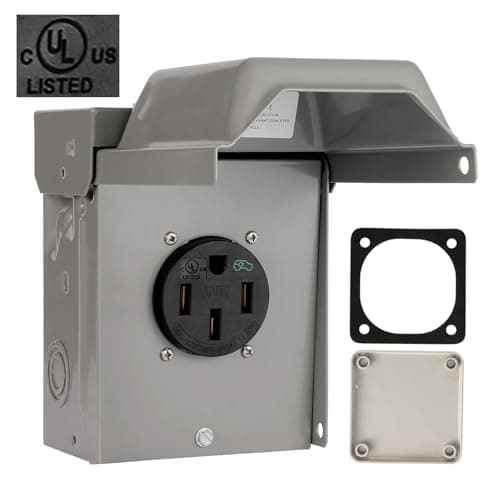
The Wayona outlet box is the all-in-one answer for a surface-mount or outdoor run. It is ETL listed as a complete assembly around a UL-certified, EV-grade 14-50R receptacle; the hinged cover locks against unplugging or power theft and still shuts over a connected 50-amp plug, and the whole NEMA 3R metal unit bolts to a wall or a post where you cannot recess a box. NEMA 3R sheds rain, sleet and ice rather than a direct hose, so mount it where driven water will not sit on it; indoors, a flush receptacle is tidier.
The outlet is only half the job - the install is the other half. A 40-amp charger draws continuously, so by code the receptacle sits on a 50-amp circuit (40 x 1.25) wired in 6 AWG copper, and outdoors it needs a wet-location in-use cover and GFCI protection under NEC Article 625. Unless you are qualified, this is an electrician's job. The full mechanics are in our NEMA 14-50 outlet guide, and the wiring and breaker sizing in wire and breaker size.
How to choose, in one minute
Start with where it mounts. Indoors in a recessed wall box, buy the Leviton 1450R and stop reading - it is the safest, most trusted part for the money. Watching the budget on a dry indoor install, the RONROX is a listed, industrial-grade outlet for less. If the receptacle lives in a damp garage or on an exterior wall, the weather-resistant EPLESFTON adds a UV-rated body and a wall plate. And if you are surface-mounting on conduit or out in the open with no wall box to recess into, the Wayona all-in-one box is the clean, lockable, fully-listed way to do it. Whatever you pick, do not pair a good outlet with a bad install: the circuit, the wire gauge, and a torqued connection matter as much as the part.
One more decision worth naming: if you would rather have no receptacle at all, hardwiring the charger removes this failure point entirely - there is no plug to loosen. That is the tidier, more secure route, especially outdoors; see best hardwired chargers and hardwired vs plug-in. The outlets here are for the plug-in path - chosen because it keeps the charger portable and the install DIY-friendly when a rated outlet already exists.
The four compared
| Outlet | Rating | Receptacle | Safety listing | Mount | Weather | Price tier |
|---|
| Leviton 1450R | 50A / 125-250V | NEMA 14-50R, 3-pole 4-wire | EV-rated, Leviton listed | Flush, recessed box | Indoor / garage | Premium |
| RONROX industrial | 50A / 125-250V | NEMA 14-50R, 3-pole 4-wire | ETL listed | Flush, recessed box | Indoor / dry | Budget |
| EPLESFTON WR | 50A / 125-250V | NEMA 14-50R, weather-resistant | ETL listed | Flush, 1- or 2-gang | WR, -40 to 60C, UV body | Mid |
| Wayona outlet box | 50A / 125-250V | EV-grade 14-50R in an enclosure | ETL listed assembly | Surface / post | NEMA 3R, lockable cover | Mid |
Ratings and listings are as published by each manufacturer. We compare documented specifications and safety listings rather than bench-testing parts, as our methodology sets out.
The two numbers behind the outlet
A NEMA 14-50 is a 50-amp, 240-volt receptacle, and by code a plug-in charger on it is limited to 40 amps continuous - 80 percent of the breaker, because NEC 625.42 classifies EV charging as a continuous load and Article 210 sizes the overcurrent device at 125 percent of it. Forty amps at 240 volts is 9.6 kW, which is why almost every plug-in Level 2 charger you can buy tops out at exactly that figure and why a 48-amp unit has to be hardwired on a 60-amp circuit instead. The full arithmetic is in what amp charger do I need, and the wire and breaker sizing in wire and breaker size.
That ceiling is the honest argument for the other path. Hardwiring removes the receptacle - the single most failure-prone part of a plug-in setup - and unlocks 48 amps and 11.5 kW on a 60-amp circuit. What you give up is portability and a DIY-friendly swap. Weigh it in hardwired vs plug-in. If reach rather than power is what is pushing you toward a new outlet, read extension cables first - sometimes the cheaper answer is a cable, and sometimes it very much is not.