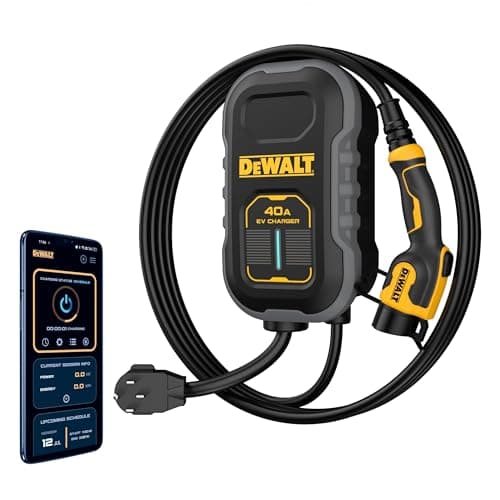
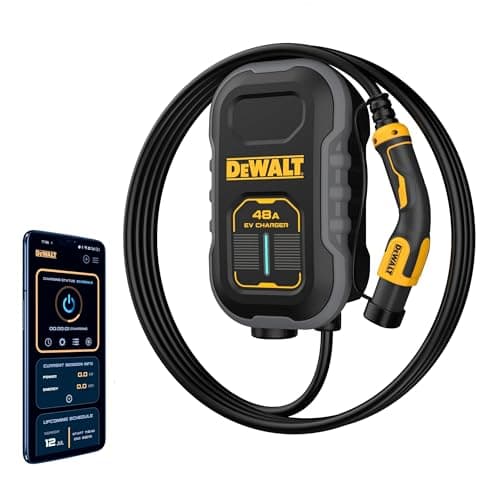
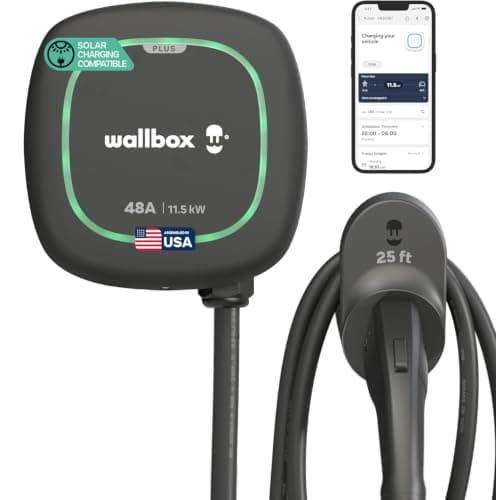
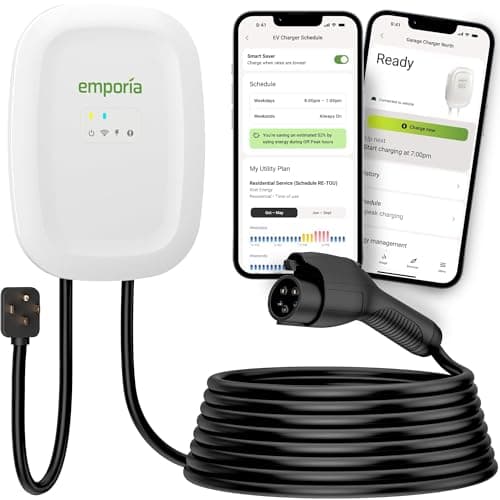
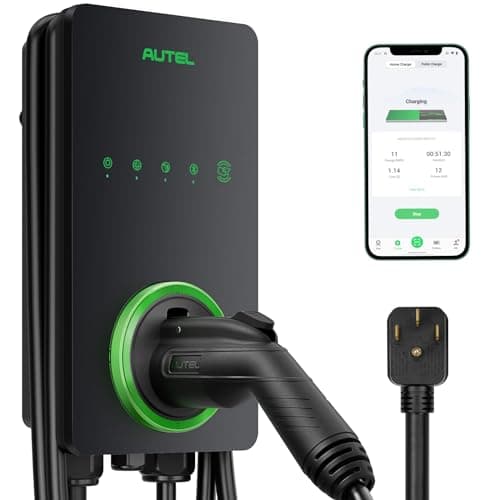
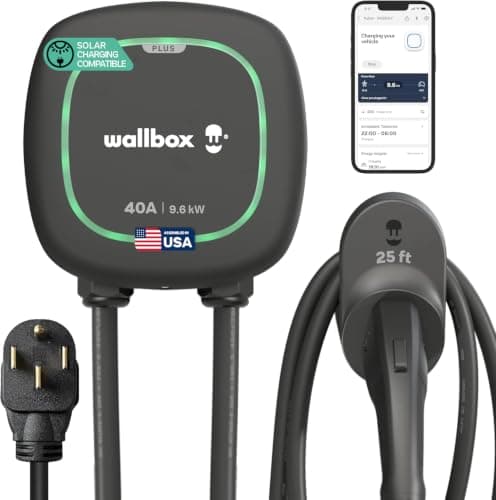
The Wallbox Pulsar Plus has the smallest wall face of any Level 2 charger we can find published dimensions for - 7.9 by 7.8 inches - and the 40-amp plug-in version is the one that is reliably in stock. If you want the lightest and shallowest package instead, the DEWALT Level 2 Compact is 4.6 inches deep and 10.7 pounds with a NEMA 14-50 plug already fitted. And if what you actually need is minimum projection off the wall, the answer is a surprise: the Emporia Level 2 sticks out 3.5 inches and the Autel MaxiCharger 3.3, less than either of the two above.
Every charger listing on the internet says compact. This page ignores that word entirely and ranks on published enclosure dimensions- the manufacturer's own figures, reproduced in the table below. That is the only honest way to write a size page, and it turns up an answer most buyers do not expect: the small-looking chargers and the shallow chargers are not the same products.
Before you shop, work out which of the two you are short of, because they trade against each other:
- Wall face is height by width - the rectangle the unit occupies on the wall. It matters when the charger has to fit between a door frame and a window, beside a panel, or under a shelf.
- Projection depth is how far it sticks out into the room. This is the number that decides whether you can still open the car door, and in a narrow single-bay garage it matters far more than the face. A shallow, wide charger beats a square, deep one every time in a tight garage.
The dimensions, side by side
| Charger | Published size (H x L x W) | Amps / kW | Plug type | Cable | Smart / Wi-Fi | Safety listing | Price tier |
|---|
| Wallbox Pulsar Plus (40A) | 7.9 x 3.9 x 7.8 in | 40A / 9.6 kW | NEMA 14-50 plug or hardwired | 25 ft | Wi-Fi + Bluetooth, myWallbox | UL listed, Energy Star | Premium |
| DEWALT Level 2 Compact (40A) | 4.6 x 12.6 x 7.4 in, 10.7 lb | 12-40A / 9.6 kW | NEMA 14-50 plug | 20 ft | Wi-Fi + Bluetooth, DEWALT app | CSA certified, IP66 | Mid |
| DEWALT Level 2 Compact NACS (48A) | 4.6 x 12.6 x 7.4 in, 10.7 lb | 12-48A / 11.5 kW | Hardwired, NACS | 20 ft | Wi-Fi + Bluetooth, DEWALT app | CSA certified, IP66 | Mid |
| Wallbox Pulsar Plus (48A) | 7.9 x 3.9 x 7.8 in | 48A / 11.5 kW | Hardwired | 25 ft | Wi-Fi + Bluetooth, myWallbox | UL listed, Energy Star | Premium |
| Emporia Level 2 | 3.5 x 12.6 x 9 in | 6-48A / up to 11.5 kW | NEMA 14-50 plug (40A) or hardwired (48A) | 25 ft | Wi-Fi, energy monitoring | UL listed, Energy Star | Value |
| Autel MaxiCharger (40A) | 13.2 x 3.3 x 7.5 in | 40A / 9.6 kW | NEMA 14-50 plug | 25 ft + in-body holster | Wi-Fi + Bluetooth | Weather-rated enclosure | Mid |
One charger is deliberately absent and it is worth saying why: the ChargePoint Home Flexis an excellent unit but its published depth is a little over seven inches - roughly double the Emporia's projection. It is the counterexample that makes the point of this page. A charger can be a modest rectangle on the wall and still be the most intrusive thing in a narrow garage.
The picks
The Wallbox Pulsar Plus wins on the spec this page is about. At 7.9 by 7.8 inches it occupies less wall than anything else here, it is UL and Energy Star certified, and the same body is sold as a 40-amp plug-in unit or a 48-amp hardwired one. We have ranked the 40-amp version first purely because it is the one with a consistently live listing; the 48-amp version is the identical box.
The DEWALT Level 2 Compact is the pick if weight and installation simplicity matter as much as size. DEWALT publishes 4.6 in H x 12.6 in L x 7.4 in W at 10.7 pounds, ships it with a NEMA 14-50 plug already fitted, and puts an LCD on the front so the current setting is readable without opening an app. CSA certified with an IP66 rating. The trade-off is the cable: 20 feet, not 25, which is the one place the compact design costs you something real. The NACS version is the same enclosure hardwired at 48 amps with a Tesla-style plug.
The Emporia Level 2 is the value answer and, on the measurement that usually matters most, the winner: a published 3.5-inch depth means it projects less into the garage than any Wallbox or DEWALT here. It is a wider unit, so it needs more clear wall - but if your constraint is the car door rather than the wall, this is the one. The Autel MaxiCharger is shallower still at 3.3 inches, and it has a holster built into the body, which is genuinely valuable in a small garage where a cable on the floor is a cable you trip over.
Measure the depth, not the box. Manufacturer dimensions describe the enclosure only. Add the cable when it is docked - a coiled 25-foot lead on a holster typically adds several more inches of projection, and that is the number your car door actually meets.
The compact charger buyer's guide
Small does not mean slow, and it does not mean unsafe
A common worry, and it is unfounded. Level 1 versus Level 2 is about voltage, not size: Level 1 is a 120-volt outlet at roughly 1.4 kW, Level 2 is 240 volts and everything from 16 to 80 amps. The DEWALT Compact and the Wallbox Pulsar Plus are full Level 2 units delivering the same 9.6 or 11.5 kW as any large box, because power is set by the circuit and the electronics, not the enclosure. What a small case does constrain is heat dissipation and, on some designs, cable length - which is why the DEWALT ships 20 feet rather than 25.
Amps to kilowatts
Volts times amps. At 240 volts, 32 amps is 7.7 kW, 40 amps is 9.6 kW and 48 amps is 11.5 kW, and 48 is the practical ceiling for home charging on a normal service. Roughly, a 40-amp unit adds about 30 miles of range an hour and a 48-amp unit about 35. For a car parked overnight both are comfortably enough, which is why choosing a smaller 40-amp charger over a bulkier 48-amp one costs most people nothing they will notice. Our what amp charger do I need guide checks that against real daily mileage.
NACS or J1772
For Level 2 AC the two connectors deliver identical power at the same amperage - the plug shape is the only difference. Most compact units here are J1772; the DEWALT Compact NACS is the Tesla-shaped option. If your car and your charger disagree, a small passive adapter bridges either direction, though in a tight garage it is one more thing to store. The full comparison is in J1772 vs NACS connectors, and the NACS-native field is ranked in best NACS home chargers.
Hardwired versus plug-in, in a small space
This choice has a size consequence people miss. A plug-in charger needs a NEMA 14-50 receptacle behind it plus the depth of the plug and its strain relief - realistically several inches of additional projection you will not find in the dimensions table. A hardwired unit runs conduit into the back of the enclosure and sits flat against the wall. So in the tightest installs, hardwiring is itself a space-saving decision, not only a speed one. Hardwiring also unlocks 48 amps, since the 14-50 receptacle caps a continuous load at 40. The full argument is in hardwired versus plug-in.
Mounting clearance and height
Code sets a floor on where the connector can live: the coupling means must be stored at least 18 inches above the floor for indoor installations and 24 inches above grade outdoors. In practice most installers mount the unit around chest height, which is well clear of both. Leave roughly a foot and a half of clear wall beside the charger for the docked cable, and check the swing of the car door at the mounting height rather than at the floor. Our where to mount an EV charger guide covers the siting decision properly.
Load management: the other way to fit a charger into a tight house
Sometimes compact is a panel problem rather than a wall problem. If the constraint is a full breaker panel rather than a narrow garage, a charger with adjustable current lets you install on the circuit you can actually spare - the Emporia adjusts in single-amp steps from 6 to 48, and the DEWALT from 12 to its rated maximum. A charger that watches the whole house and backs off under load goes further still; those are ranked in best load-balancing chargers.
Do not trade the safety listing for size
There are genuinely tiny unlisted boxes on the marketplaces, and they are the one thing to avoid here. A home charger draws 32 to 48 amps continuously, unattended, for hours. UL 2594 is the ANSI/UL standard for EV supply equipment, and an ETL mark from Intertek is an equal - both are OSHA-recognized testing laboratories certifying to the same standard. CSA certification, which both DEWALT units carry, is the same class of third-party listing. What is not a safety listing: IP66, NEMA 4 and Energy Star, which describe water ingress and standby power respectively. Our UL-listed chargers page explains how to verify a claim rather than believe a bullet point.
So, which one?
Smallest wall footprint: the Wallbox Pulsar Plus. Lightest and easiest to hang yourself: the DEWALT Level 2 Compact. Least projection into a narrow garage: the Emporia Level 2 or the Autel MaxiCharger. A compact NACS unit at full speed: the DEWALT Compact NACS. Measure the wall you actually have - face and depth, with the car door open - before you choose between them.