HUB 03 · Charging Guides
Can Two EVs Share One Charger?
Three ways to charge a two-EV household - swap the plug, run a dual-port unit, or load-share two chargers - and the electrical reality behind each.
We earn a commission when you buy through our Amazon links, at no extra cost to you. It never affects our rankings, and we say so when the cheaper product is the better buy. How this works.
Yes - two EVs can absolutely share home charging, and most two-car households do not need two full circuits to manage it. There are three practical approaches: simply move one cable between cars overnight, run a single dual-port charger, or install two chargers that load-balance across a shared circuit. The right one depends on how much both cars drive and how much you want to spend on the panel. Here is each, with the electrical reality.
Option 1: One charger, swap the plug
The cheapest answer is a single Level 2 charger and a habit: plug in car A when you get home, swap to car B before bed. Because most daily commutes only need a couple of hours of Level 2 charging, one 40- or 48-amp unit can easily refill two cars across a long night. It costs nothing extra and works for the large majority of two-EV homes where neither car is driven to near-empty every single day. The only downside is remembering to move the plug.
Do the math on your own driving: a 40-amp charger adds roughly 30 miles of range per hour, so an 8-hour night is about 240 miles of range to divide between two cars. Unless both are high-mileage daily drivers, the swap is genuinely enough.
Option 2: A dual-port charger
A dual-port unit has two cables from one wall box and splits the available current between them - charging both cars at once, at a shared rate. If the box is on a 50-amp circuit, two cars charging together share about 40 amps; charge one at a time and it gets the full 40. This is the tidy hands-off answer for a household where both cars are frequently low. The catch is that simultaneous charging is slower per car, and dual-port hardware costs more. See our best dual-port chargers.
Option 3: Two chargers that load-balance
The premium answer is two smart chargers linked to share one circuit through load management(also called power sharing). Each car gets its own cable at its own parking spot, and the chargers coordinate so their combined draw never exceeds the circuit's limit - full speed when only one is plugged in, a shared rate when both are. This is the best day-to-day experience and the safe way to avoid a costly second circuit or a panel upgrade. Units like the load-balancing chargers we rank support it.
What about two independent full-speed circuits?
You can install two separate 48-amp chargers on two 60-amp circuits for full speed on both at once - but that is 120 amps of continuous load, which most residential panels cannot spare without a service upgrade. For all but the highest-mileage two-EV homes, it is expensive overkill. Load management exists precisely so you do not have to do this.
Which to choose
| Approach | Cost | Best for |
|---|---|---|
| One charger, swap plug | Lowest | Most two-EV homes; moderate daily miles |
| Dual-port charger | Medium | Both cars often low; want it hands-off |
| Two load-balanced units | Higher | Two parking spots; best daily experience |
Start by being honest about how much both cars actually drive. Most people discover the plug swap is plenty; if it is not, a dual-port or load-balanced pair solves it without a service upgrade. Whichever you pick, a licensed electrician confirms your panel's capacity first. If the plug swap is your answer, the single unit to swap between the cars is the top pick in our ranked Level 2 chargers.
The gear
Recommended gear for this guide
The products this guide refers to, with prices pulled live from Amazon and dated on each card.
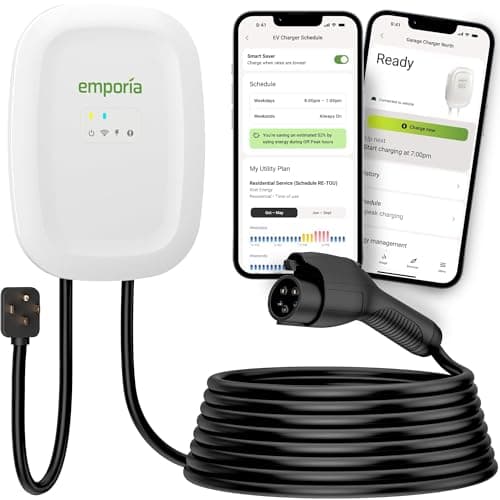
Most homes that want speed and smarts
Emporia Level 2 (48A)
The charger that refuses to charge you extra for being smart: full 48-amp speed and real energy monitoring at roughly the price of a plain plug-in box.
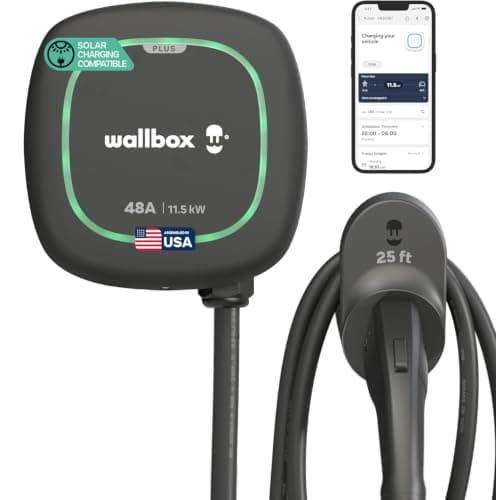
A compact, fast, hardwired install
Wallbox Pulsar Plus (48A)
One of the smallest 48-amp chargers you can hang on a wall — full-speed hardwired charging in a box that barely announces itself.
#ad · As an Amazon Associate we earn from qualifying purchases.
Questions
Frequently asked
Can I charge two EVs on one circuit?
Yes - either with a single charger you move between cars, a dual-port unit that splits current across two cables, or two smart chargers that load-balance on a shared circuit so their combined draw stays within the breaker's limit.
Is one EV charger enough for two cars?
For most households, yes. A 40-amp charger adds about 30 miles of range per hour, so a long night can refill two cars if you swap the plug. It only falls short when both cars are driven to near-empty every day.
What is load balancing on an EV charger?
Load balancing (power sharing) lets two or more chargers coordinate their draw so the total never exceeds a shared circuit's capacity. One car plugged in charges at full speed; two share the available current - avoiding a second circuit or a panel upgrade.
Keep reading
Related
More in this section
More Charging Guides
Receipts
Sources
- EC&M - NEC requirements for EV equipment (Article 625: continuous load, circuit sizing)
- US DOE AFDC - charging at home
We do not run a testing lab, and we do not pretend to. Where a measured number came from someone else's lab, we name them and link them. Where we could not verify something, we say so on the page rather than quietly leaving it out. Read our full method.