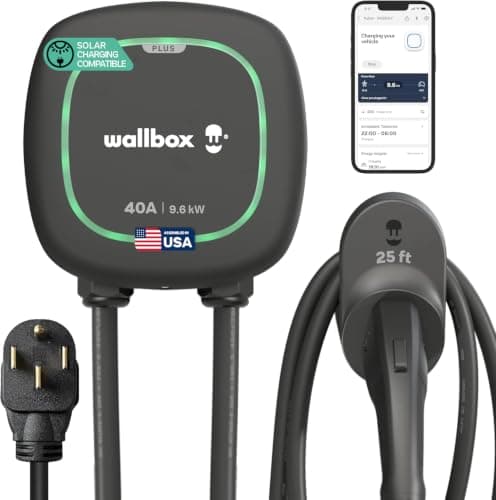
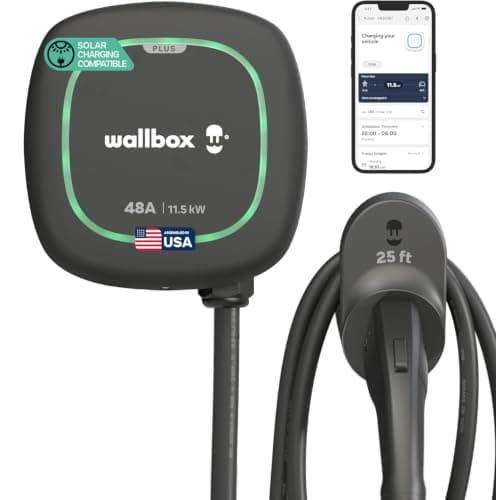
The Wallbox Pulsar Plus does two things almost nothing else does: it delivers a full 48 amps from a body the size of a paperback, and it lets two units share one circuit so a two-EV home does not need a second panel run. If space is tight or a second car is coming, this is the one.
In our best Level 2 chargers roundup the Pulsar Plus is the compact pick, and this is the longer look at why. As always, we compile the published specs and do the math rather than bench-testing hardware - read this as documented research on a very well-regarded unit, not a lab teardown.
Who it is for
Two buyers. First, anyone with a cramped garage or a wall where a big charger looks wrong - the Pulsar Plus is one of the smallest 48-amp units made, and it disappears next to a Grizzl-E. Second, the two-EV household: Wallbox's Power Sharing lets a pair of Pulsar Plus units split a single circuit, charging both cars without a second breaker. It is the wrong charger for the person who never wants an app - Wi-Fi and the MyWallbox app are central to setup.
The specs that matter
Wallbox rates it at up to 48 amps / 11.5 kW hardwired, with a J1772 connector, a 25-foot cable, and Wi-Fi plus Bluetooth control. Two numbers do the real work:
- 48 amps, hardwired, from a tiny body. To get the full 48 amps you hardwire on a 60-amp circuit and your car has to accept 48 too - our amperage guide covers which cars do. What is unusual is getting that speed in this footprint.
- Power Sharing across two units.Install two Pulsar Plus chargers and they coordinate to stay under one circuit's limit - the clean answer to charging two EVs without a panel upgrade. See our load-balancing picks.
What is good
The size-to-speed ratio is the headline: full 48-amp charging from the most compact body in its class, which matters on a narrow wall or beside a parked car. Power Sharing is a genuine feature, not a spec-sheet line - it is the difference between one circuit and two when a second EV arrives. The 25-foot cable reaches across a two-car garage, and the app handles scheduling for off-peak rates. For a small, fast, expandable charger, little else matches it.
Where it falls short
The Pulsar Plus leans on its app and connectivity, so setup is more involved than a sealed plug-and-go box, and owners occasionally report the app or Wi-Fi pairing being fussy. The full 48 amps requires hardwiring, like every full-speed unit. If you want a charger you bolt up and forget, without ever pairing a phone, a metal box like the Grizzl-E is the calmer choice - you just give up the small footprint and the two-car sharing.
The Pulsar Plus lineup: same body, two amperages, two connectors
Wallbox sells the Pulsar Plus as one design in two ratings, which makes this an unusually clean decision. Per Wallbox's product page and the North America datasheet:
- Pulsar Plus 40A - the plug-in version, on a NEMA 14-50, delivering 9.6 kW. Same 7.9 by 7.8 inch wall face, same 25-foot cable. This is the one to buy if you rent, might move, or already have a rated 14-50 on the wall.
- Pulsar Plus 48A - hardwired, 11.5 kW, on a 60-amp circuit. Identical footprint. This is the one to buy if the circuit is going in new and your car accepts 48 amps.
- J1772 or NACS - Wallbox now publishes the Pulsar Plus with either connector, so a Tesla or a factory-NACS EV does not need an adapter dangling off the handle.
Everything else is shared: 208/240V input, the same 7.8 by 7.9 by 3.9 inch enclosure, UL 2594 and UL 2231 certification, Energy Star, integrated CCID20 ground monitoring, and Bluetooth plus Wi-Fi. Wallbox also documents current selection from a hardware selector (16 amps up to the rated current) and in software down to 6 amps, so either version can be dialled to a smaller circuit rather than replaced.
Installation notes
The 40-amp version wants a properly rated NEMA 14-50 on a 50-amp circuit; the 48-amp version is hardwired on a 60-amp circuit with appropriately sized wire. Either way, have a licensed electrician confirm the panel can carry the load. Two Pulsar Plus details are worth telling your installer before they quote: Power Sharing links multiple units over a Cat 5e run so they can sit on one circuit, and Power Boost uses a Wallbox power meter to let a single charger run at full output without a panel upgrade. Both are documented Wallbox features, and both change what the electrician needs to pull.
Bottom line
The Pulsar Plus wins on geometry and on expandability rather than on price: nothing else puts a full 48 amps behind a wall face this small, and nothing else makes the second EV as cheap to add. Buy the 48-amp hardwired version if this is your house and the circuit is going in; buy the 40-amp plug-in version if you might take it with you. If the app is the part that worries you, the sealed Grizzl-E lineup is the honest alternative - it is just a much bigger box.
The Pulsar Plus versions, side by side
Every figure below is Wallbox's own published specification, from the Pulsar Plus product page and the North America technical datasheet cited in Sources. We compile specs and do the electrical arithmetic; we do not run a test lab.
| Version | Amps / kW | Connector | Plug or hardwired | Cable | Smart / Wi-Fi | Safety listing |
|---|
| Pulsar Plus 48A | 6-48A / up to 11.5 kW | J1772 or NACS | Hardwired, 60A circuit | 25 ft | Wi-Fi + Bluetooth, scheduling, Power Sharing, Power Boost | UL 2594 / UL 2231, Energy Star |
| Pulsar Plus 40A | 6-40A / 9.6 kW | J1772 or NACS | NEMA 14-50 plug (also offered hardwired) | 25 ft | Same app and feature set | UL listed, Energy Star |
| Both versions | Selector 16A to rated; software to 6A | 208/240V, 60 Hz | Same 7.9 x 7.8 x 3.9 in enclosure | Same handle and holster | Works without an active internet connection | Integrated CCID20 ground monitoring |
How to pick the right Pulsar Plus
Level 1 versus Level 2
Level 1 is the 120-volt cord in the trunk - about 5 miles of range an hour per the US Department of Energy, which refills a plug-in hybrid overnight and barely dents an EV. Level 2 is 240 volts, roughly 2.9 to 19.2 kW. Both Pulsar Plus versions are Level 2, and the gap between them (9.6 versus 11.5 kW) is far smaller than the gap between either one and the cord that came with the car.
Amps to kW, and the circuit each version needs
Amps x 240 volts / 1000 = kW. 40 amps is 9.6 kW; 48 amps is 11.5 kW. EV charging is a continuous load, so the breaker is sized to 125 percent of the draw: 50 amps for the 40-amp version, 60 amps for the 48-amp one. In practice that is about a 20 percent difference in charge rate for a meaningfully bigger circuit - worth it if the wire is going in new and your car accepts 48 amps, not worth re-pulling an existing 50-amp run for. Our amperage guide covers which cars can actually use 48.
NACS or J1772
Wallbox publishes the Pulsar Plus with either connector. Buy NACS (SAE J3400) for a Tesla or a 2025-and-later EV with a factory NACS port; buy J1772 for anything older, and for a mixed household where adapting the newer car is the cheaper direction. Our J1772 vs NACS guide has the model-by-model detail.
Hardwired or plug-in
This is the whole decision on this charger, because it also sets your amperage. Hardwired gets you 48 amps and removes the receptacle - the part that overheats when it is a cheap one - from the current path. Plug-in caps you at 40 amps and lets you take the charger with you, which is the right call for renters and anyone who might move. If you go plug-in, pair it with a listed, industrial-grade NEMA 14-50 outlet rather than a bargain receptacle.
Load management: Power Sharing and Power Boost
This is where the Pulsar Plus earns its premium. Power Sharing links more than one Pulsar Plus on the same circuit over a Cat 5e run so two EVs charge without a second breaker - the cheapest honest answer to a second car. Power Boost adds a Wallbox power meter that watches whole-home draw and lets the charger run at full output without a service upgrade, throttling only when the rest of the house demands it. Both are documented activation procedures from Wallbox, not marketing lines, and both are worth pricing against a panel upgrade - see our load-balancing picks and two chargers in one garage.