HUB 04 · Charging Costs
Cost to Charge a Plug-In Hybrid at Home
A plug-in hybrid's pack is small enough that a full charge costs about the same as a load of laundry - and small enough that the free cord in the trunk usually finishes it overnight.
We earn a commission when you buy through our Amazon links, at no extra cost to you. It never affects our rankings, and we say so when the cheaper product is the better buy. How this works.
A plug-in hybrid costs very little to charge, because the thing you are filling is small. A pack in the 8-to-18 kWh range takes a dollar or two of electricity to fill at typical US residential rates, and it does so from an ordinary wall socket overnight. The useful question for a PHEV owner is not what a charge costs - it is what fraction of your miles you can move onto electricity, because that is the number that decides whether the car is cheap to run or an expensive hybrid.
Our cost to charge at homepage covers the full-size battery EV case. A PHEV is a genuinely different calculation, for three reasons: the pack is a fraction of the size, the car falls back to gasoline instead of stopping, and the charging hardware decision usually resolves to "you already own it".
The arithmetic, with nothing hidden
Three inputs: the usable battery size in kWh, your electricity rate in dollars per kWh, and a charging efficiency factor, because some of what the meter records is lost as heat in the car's onboard charger rather than stored. We use 0.90, the same figure as everywhere else on this site.
Cost per full charge = battery kWh / 0.90 x your rate per kWh
Take Toyota's Prius Plug-in Hybrid, whose battery Toyota publishes at 13.6 kWh - a fair mid-point for the class. At 12 cents per kWh that is 13.6 / 0.90 x $0.12 = about $1.81 for a full charge. At 18 cents it is about $2.72. Toyota also publishes the charging times for that car: roughly 11 hours on a standard 120-volt outlet, or about 4 hours on a Level 2 charger.
Those two numbers - under three dollars, and overnight on a household socket - are the whole character of PHEV charging. Scale them for your own car:
| Usable pack | kWh drawn from the wall | At $0.12/kWh | At $0.18/kWh |
|---|---|---|---|
| 8 kWh | 8.9 | About $1.07 | About $1.60 |
| 11 kWh | 12.2 | About $1.47 | About $2.20 |
| 13.6 kWh | 15.1 | About $1.81 | About $2.72 |
| 18 kWh | 20.0 | About $2.40 | About $3.60 |
Rates vary enormously by state and by time of day, and the US residential average has been running in the high teens of cents per kWh through 2026 in EIA's monthly data. Your own bill is the only rate that matters - put it into the calculator below rather than trusting any average, including ours.
Run it for your car
Cost-to-charge calculator
Put in your electricity rate, your battery size and your car's efficiency. The math is the same one shown above, with a 10% charging loss included so the number is realistic.
- $8.09
- A 10% to 80% charge
- $11.56
- A full (empty to 100%) charge
- $0.05
- Cost per mile
- $5.08
- Cost per 100 miles
Estimate only. Actual cost depends on your exact utility rate (including any time-of-use pricing and fees), your car's real efficiency, temperature, and charging losses. Check your electric bill for your true rate.
Cost per electric mile, and the comparison that counts
PHEVs are less efficient per mile than dedicated EVs - they are carrying an engine, a fuel tank and a transmission around - so a reasonable working figure is 3.0 miles per kWh rather than the 3.5 we use for battery EVs. That gives:
Cost per electric mile = (1 / 3.0) / 0.90 x your rate
At 12 cents that is about 4.4 cents a mile; at 18 cents, about 6.7 cents. Against gasoline in the same car - say 40 mpg in hybrid mode at $3.50 a gallon - you are paying about 8.8 cents a mile. So electricity is roughly a third to a half cheaper per mile than the car's own gas mode, which is a real saving but not the four-to-one advantage a battery EV has over a 28-mpg gas car. Our EV versus gas page runs that fuller comparison.
The number that dominates everything: your electric mile share.A PHEV with a 35-mile electric range driven 30 miles a day and plugged in nightly runs almost entirely on electricity. The same car driven 120 miles a day, or never plugged in, is a slightly heavy hybrid. The difference between those two owners is not a few cents per mile - it is most of the car's running cost. A PHEV that is not charged is the worst value proposition in motoring.
Why Level 1 is usually the right answer
This is where PHEV advice diverges sharply from battery-EV advice. The Department of Energy notes that many owners meet their daily range needs by charging overnight on Level 1 equipment, requiring no additional cost or installation, provided there is an outlet on a dedicated branch circuit near where they park. For a full-size EV that is a qualified "sometimes". For a PHEV it is usually just true, because the pack is small enough to refill in a single night at 120 volts - Toyota's own figure of about 11 hours for the Prius Plug-in Hybrid is a normal overnight window.
So the honest hardware recommendation for most PHEV owners is: use the cordset that came with the car, on a dedicated 120-volt circuit, and spend nothing. Three situations change that answer:
- Short dwell times. If the car is home for five hours rather than twelve - two school runs and an evening out - Level 1 cannot refill the pack between trips and Level 2 doubles or triples your electric mile share.
- Two electric cars sharing one outlet. The arithmetic stops working as soon as the socket has to serve two packs a night.
- Cold winters. Cabin heating and battery conditioning eat into a small pack hard, and some of a Level 1 charge goes to keeping the battery warm rather than filling it. See winter charging cost.
Note what is noton that list: wanting the fastest possible charge. A PHEV's onboard charger is modest by EV standards, so a big 48-amp wall unit cannot charge it any faster than a modest one - the car is the limit, not the charger. If you do install Level 2, buy for the car, and read what amp charger do I need first.
What a PHEV adds to your electricity bill
Multiply the per-charge cost by how often you fill it. Charging a 13.6-kWh pack every weekday is roughly 22 charges a month, or about 330 kWh at the wall - which lands somewhere between $40 and $60 a month at the rates in the table above. Against that, you are buying maybe 1,000 electric miles that would otherwise have cost around $88 in gasoline at 40 mpg and $3.50 a gallon.
Two ways to make that bill smaller. Move the charging into an off-peak window if your utility has one - a small pack is the easiest load in the house to shift, and almost every PHEV has a departure-time setting that does it for free. And check whether your utility has an EV rate at all; see off-peak and time-of-use charging and whether you need a separate meter.
The honest summary
Charging a plug-in hybrid at home costs one to three dollars a fill and roughly 4 to 7 cents a mile, against about 9 cents a mile on its own gasoline. You will not need a charger installation to achieve it in most cases. And the single highest-value thing you can do with a PHEV is the simplest: plug it in every single night, because every charge you skip is a charge bought back at gas-station prices.
What to look for if you do buy a cordset or charger
- Do not over-buy amperage.A PHEV's onboard charger is the ceiling. Check the figure in your manual before paying for 40 or 48 amps you cannot use.
- Adjustable current, down to 8 or 12 amps, so a Level 1 cordset can be dialed down to live safely on an older household circuit.
- A real safety listing - UL or ETL to UL 2594 - because this cord runs for hours unattended, usually in an attached garage.
- A dual-voltage unit if you might go Level 2 later, which lets one purchase cover a 120-volt socket now and a 240-volt outlet after an upgrade.
- Or a 24-amp unit on a dryer circuit, which is the cheapest route to Level 2 speeds with no new circuit - see the dryer outlet guide.
The three picks below cover those three routes, in rising order of speed and cost.
The gear
Recommended gear for this guide
The products this guide refers to, with prices pulled live from Amazon and dated on each card.
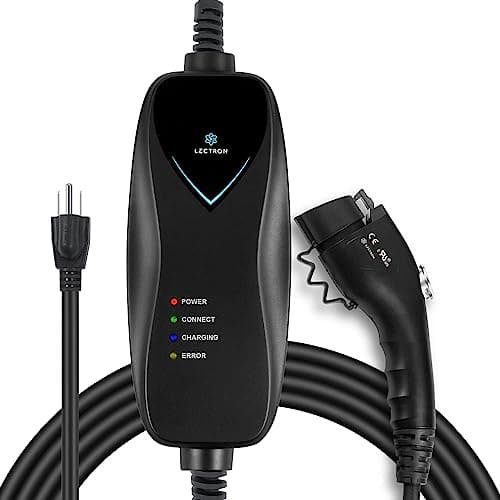
The certified 120V cord
Lectron Level 1 (15A)
The Level 1 cord to buy if you buy only one: ETL certified to UL 2594 and Energy Star listed, which most of the 120-volt field on Amazon cannot claim.
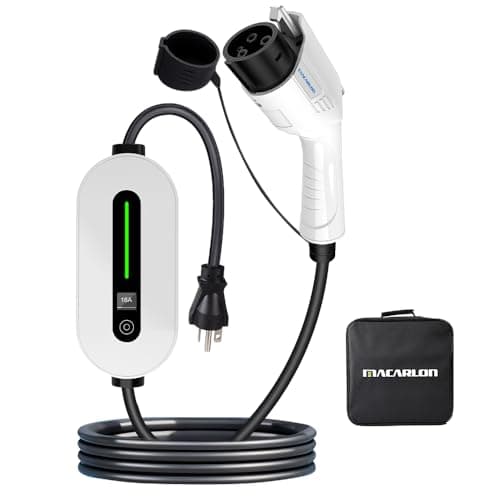
A 120V cord with a 240V upgrade path
MACARLON 16A Level 1/2
A 120-volt cord that also does Level 2 - it ships with a NEMA 6-20 plug and a 5-15 adapter, so a spare 240-volt outlet roughly doubles your charging speed for no extra hardware.
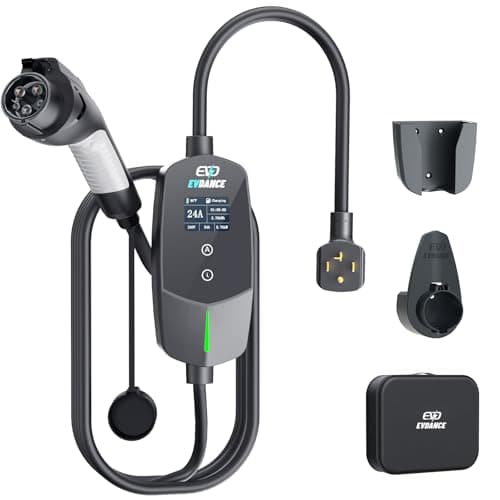
Most J1772 cars on a dryer outlet
EVDANCE 24A NEMA 14-30 (J1772)
Built for the dryer outlet rather than adapted to it: a 14-30 plug on the cord and a 24-amp ceiling, so even its highest setting stays inside what a 30-amp circuit may carry continuously.
#ad · As an Amazon Associate we earn from qualifying purchases.
Questions
Frequently asked
How much does it cost to charge a plug-in hybrid at home?
About one to three dollars for a full charge. The math is battery kWh divided by 0.90 for charging losses, times your rate: a 13.6-kWh pack is about $1.81 at 12 cents per kWh and about $2.72 at 18 cents. Charging every weekday adds roughly $40 to $60 a month to the electricity bill, against about $88 of gasoline for the same miles at 40 mpg and $3.50 a gallon.
Do I need a Level 2 charger for a plug-in hybrid?
Usually not. A PHEV pack is small enough to refill overnight on a standard 120-volt outlet - Toyota publishes about 11 hours for the Prius Plug-in Hybrid's 13.6-kWh battery, which is a normal overnight window. Level 2 earns its cost when the car is home for short periods between trips, when two cars share one outlet, or in a hard winter. Otherwise the cord in the trunk is the correct hardware.
Is charging a PHEV cheaper than using its gas engine?
Yes, by roughly a third to a half per mile. At 3.0 miles per kWh, electricity costs about 4.4 cents a mile at 12 cents per kWh and about 6.7 cents at 18 cents. The same car in hybrid mode at 40 mpg and $3.50 a gallon is about 8.8 cents a mile. The saving is real but smaller than a battery EV's, because a PHEV is less efficient per mile.
Does a bigger charger charge a plug-in hybrid faster?
Only up to the car's own limit. The onboard charger converts AC to DC and sets the ceiling: beyond it, a larger wall unit delivers nothing extra. Check your manual for the kW figure, then buy to match it - our charging speed guide shows how the three limits interact.
Is it worth plugging in a plug-in hybrid every day?
It is the single most valuable habit a PHEV owner has. Every charge you skip is a tank of miles bought at gas prices instead of a dollar or two of electricity, and an uncharged PHEV is simply a heavy hybrid carrying a battery for nothing. A nightly plug-in, ideally on an off-peak schedule, is where essentially all of the car's running-cost advantage comes from.
Will charging a PHEV overload a normal household circuit?
A Level 1 cordset at 12 amps on a dedicated 15- or 20-amp branch circuit is within limits, but it must not share that circuit with other significant loads, and an old or marginal receptacle should be checked. If you see nuisance trips, dial the cordset down to 8 amps - slower, but far more tolerant. See plugging a charger into a regular outlet.
Keep reading
Related
- Cost to charge at homeThe full-size battery EV version of this calculation.
- EV vs gasThe wider fuel comparison, with the assumptions shown.
- Level 1 vs Level 2Why a PHEV is the one case where Level 1 usually wins.
- Best Level 1 chargersIf you want a better 120-volt cord than the one in the trunk.
- Off-peak and time-of-use chargingA small pack is the easiest load in the house to shift into cheap hours.
- Best 16-amp chargersThe modest Level 2 class that matches a plug-in hybrid's onboard charger.
- Best chargers for a plug-in hybridWhich charger to buy for the car this cost math is about.
More in this section
More Charging Costs
- Tesla Model 3 & Model Y: Home Charging Time and Cost
- Ford Mach-E & F-150 Lightning: Home Charging Time and Cost
- Rivian R1T & R1S: Home Charging Time and Cost
- Hyundai Ioniq 5/6 & Kia EV6/EV9: Home Charging Time and Cost
- Chevy Equinox EV, Blazer EV & Bolt: Home Charging Time and Cost
- Nissan Ariya & Leaf: Home Charging Time and Cost
Receipts
Sources
- Toyota USA Newsroom - Prius Plug-in Hybrid (13.6-kWh battery; about 11 hours on a standard 120V outlet, about 4 hours on a Level 2 charger)
- US EIA - Electric Power Monthly, average retail price of electricity by sector (residential)
- US DOE AFDC - charging an electric vehicle at home (many owners meet their daily range needs charging overnight on Level 1 equipment)
- US DOE / fueleconomy.gov - EV charging basics (Level 1, Level 2 and DC fast charging)
- US DOE / fueleconomy.gov - how electric vehicles work (onboard charger and battery)
- EC&M - NEC requirements for EV equipment (Article 625: EVSE is a continuous load, circuits sized at 125 percent of the load)
- Intertek - UL 2594 testing and certification for electric vehicle supply equipment
We do not run a testing lab, and we do not pretend to. Where a measured number came from someone else's lab, we name them and link them. Where we could not verify something, we say so on the page rather than quietly leaving it out. Read our full method.