HUB 04 · Charging Costs
How Much Does It Cost to Charge an EV Per Mile?
Two numbers decide it: your efficiency in miles per kWh and your electricity rate. Here is the formula, a worked example, and a table you can read straight off.
We earn a commission when you buy through our Amazon links, at no extra cost to you. It never affects our rankings, and we say so when the cheaper product is the better buy. How this works.
Charging cost per mile comes down to just two numbers: how far your EV travels on a kilowatt-hour (its efficiency, in miles per kWh) and what you pay for electricity (your rate, in dollars per kWh). Nothing else moves it - not the brand of charger, not the size of the battery. Get those two numbers and the per-mile cost is a single line of arithmetic, which is exactly what this page shows.
The formula
Cost per mile is the cost of the energy it takes to go one mile:
Cost per mile = (1 / efficiency in mi/kWh) / 0.90 x rate ($/kWh)
The 1 / efficiency converts miles into the kWh a mile needs; dividing by 0.90 adds the roughly 10 percent charging loss (energy that leaves the wall but never reaches the battery); multiplying by your rate turns kWh into dollars.
The 0.90 matters. About a tenth of the electricity your meter records is lost as heat in the cable and the car's onboard charger instead of becoming range, so a calculation that skips it lands about 10 percent too low. We keep it in every figure on this page and in the calculator below.
A worked example
Take an efficient EV that gets 3.5 miles per kWh, on the US residential average rate - which has recently been in the neighborhood of 16 to 17 cents per kWh, though you should check your own bill because it varies a lot by state and utility. Plug 3.5 mi/kWh and $0.16/kWh into the formula:
- Energy per mile: 1 / 3.5 = about 0.286 kWh into the battery
- From the wall, with the loss: 0.286 / 0.90 = about 0.317 kWh
- Cost: 0.317 x $0.16 = about $0.051, or roughly 5 cents per mile
That is about $5 per 100 miles. Drive 12,000 miles a year and you are looking at roughly $600 in electricity - the kind of number that makes an EV pencil out against gas. For that head-to-head, with the gas side laid out the same way, see EV vs gas cost.
The two levers, in one table
Because only efficiency and rate move the answer, you can read your own cost straight off a grid. Here is cost per mile at four common rates and two efficiencies - a thirsty 3.0 mi/kWh (a heavier SUV or truck) and an efficient 4.0 mi/kWh (a small, aero sedan), both including the 10 percent loss:
| Electricity rate | At 3.0 mi/kWh | At 4.0 mi/kWh |
|---|---|---|
| $0.10 / kWh | ~$0.037 / mi | ~$0.028 / mi |
| $0.16 / kWh (near US average) | ~$0.059 / mi | ~$0.044 / mi |
| $0.25 / kWh | ~$0.093 / mi | ~$0.069 / mi |
| $0.35 / kWh | ~$0.130 / mi | ~$0.097 / mi |
Notice the spread: even at a steep 35 cents per kWh, an efficient EV stays under 10 cents a mile, and at a cheap 10 cents it is under 3. The whole range sits below what most gas cars cost to fuel. Where your car and rate land in this grid is your real per-mile cost.
Run it for your car
Cost-to-charge calculator
Put in your electricity rate, your battery size and your car's efficiency. The math is the same one shown above, with a 10% charging loss included so the number is realistic.
- $8.09
- A 10% to 80% charge
- $11.56
- A full (empty to 100%) charge
- $0.05
- Cost per mile
- $5.08
- Cost per 100 miles
Estimate only. Actual cost depends on your exact utility rate (including any time-of-use pricing and fees), your car's real efficiency, temperature, and charging losses. Check your electric bill for your true rate.
Why the charger brand is not on this list
Look again at the formula: the charger does not appear. Every home Level 2 charger pushes the same kilowatt-hours into your car, so a budget unit and a premium one cost exactly the same per mile to run. The only way hardware changes the number is indirectly - a smart charger that shifts your charging to cheaper off-peak hours lowers the rate half of the equation. That is a scheduling win, not a hardware one; see off-peak and time-of-use charging for how it works.
The one hardware move that lowers cost per mile: put charging on a cheaper overnight rate. A charger with scheduling, like the Emporia below, does it automatically - but the energy it delivers, and therefore the per-mile cost at a given rate, is identical to any other Level 2 unit.
Turning cents per mile into a bill
Per mile is the cleanest way to compare cars, but you probably want to know the monthly damage too. Multiply your cents-per-mile by how far you drive: at 5 cents a mile and 1,000 miles a month, that is about $50. We do that math, with the assumptions shown, in cost to charge per month, and the full per-charge version lives in cost to charge at home.
The gear
Recommended gear for this guide
The products this guide refers to, with prices pulled live from Amazon and dated on each card.
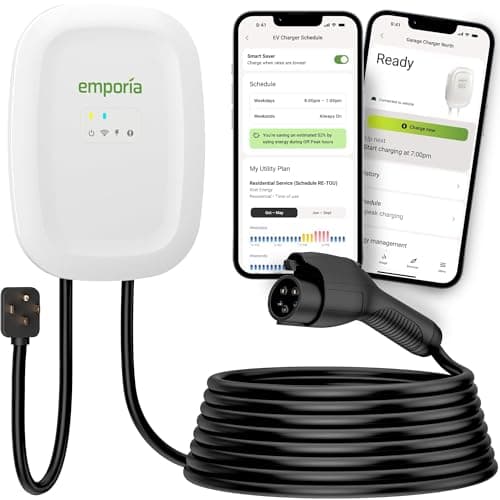
Most homes that want speed and smarts
Emporia Level 2 (48A)
The charger that refuses to charge you extra for being smart: full 48-amp speed and real energy monitoring at roughly the price of a plain plug-in box.
#ad · As an Amazon Associate we earn from qualifying purchases.
Questions
Frequently asked
How much does it cost to charge an EV per mile?
For an efficient EV at the US average electricity rate, about 5 cents a mile, or roughly $5 per 100 miles. It ranges from under 3 cents on cheap power to around 10 cents where electricity is expensive, depending on your car's efficiency and your rate. Run the calculator above for your exact figure.
What is the formula for EV cost per mile?
(1 / efficiency in mi/kWh) / 0.90 x your rate in dollars per kWh. The 1 / efficiency is the energy a mile needs, the 0.90 accounts for the roughly 10 percent charging loss, and the rate turns kilowatt-hours into dollars.
Does a faster or more expensive charger lower the cost per mile?
No. Every Level 2 charger delivers the same energy, so the per-mile cost is identical whatever you paid for the unit. The only way hardware helps is a smart charger that schedules charging into cheaper off-peak hours - that lowers your rate, not the energy used.
Why divide by 0.90 in the cost math?
Because roughly 10 percent of the electricity you pull from the wall is lost as heat in the cable and the car's onboard charger and never reaches the battery. Dividing the battery energy by 0.90 accounts for that loss, so your estimate is not about 10 percent too low.
Keep reading
Related
- Cost to charge at homeThe full formula and the calculator behind these numbers.
- EV vs gas costHow the per-mile number compares to a gas car.
- Cost to charge per monthThe same math turned into a monthly bill.
- EV charging cost by stateHow the rate half of the equation swings by state.
- Off-peak chargingThe only way the charger changes your per-mile cost.
More in this section
More Charging Costs
Receipts
Sources
- US EIA - electricity data (residential rates)
- US DOE / fueleconomy.gov - EVs and cost of driving
- US DOE / fueleconomy.gov - EV charging basics
We do not run a testing lab, and we do not pretend to. Where a measured number came from someone else's lab, we name them and link them. Where we could not verify something, we say so on the page rather than quietly leaving it out. Read our full method.