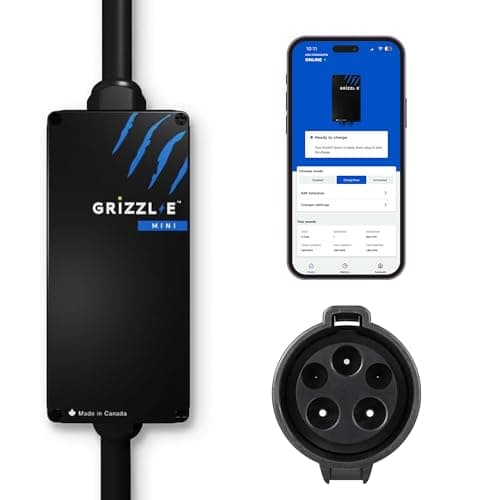
Buy the Grizzl-E Mini if you want wall-charger build quality in something portable, and you need it to plug into whatever outlet you can reach. United Chargers publishes 7-to-40-amp adjustable output, a 25-foot cable, a NEMA 14-50 plug with four adapters in the box, an aluminum Type 4 indoor/outdoor enclosure, UL file E510712, an operating range of -22F to 122F, and a three- or five-year warranty. Nothing else in the portable class is built like this. The reason this is not an easy recommendation is price: the Mini costs more than several fully certified wall-mounted 40-amp chargers we rank, and more than twice what a good 24-amp dryer-outlet unit costs - for charging speed that is identical once the circuit, not the charger, becomes the limit.
What it is
The Mini is a Grizzl-E with the mounting bracket made optional. Same company, same material, same certification file as the wall units - but it ships with a carrying case, a bracket and a set of plug adapters, so the same unit can hang in a garage all year or live behind the seat. That combination is unusual: most portables in this price range are plastic-bodied units with a one-year warranty.
| Specification | Published figure |
|---|
| Maximum current | 40 A, adjustable 7-40 A |
| Power at 240V | 9.6 kW by arithmetic (Grizzl-E markets it as "40A 10kW") |
| Cable | 25 ft (7.6 m) |
| Plug | NEMA 14-50, with four adapters included |
| Connector | J1772 (Type 1) or NACS |
| Enclosure | Aluminum, Type 4 indoor/outdoor, 6.9 x 3.1 x 2.4 in |
| Weight | 19.84 lb (9.0 kg) |
| Operating temperature | -22F to 122F (-30C to +50C) |
| Certification | UL file E510712 |
| Connectivity | Wi-Fi 2.4 GHz, Grizzl-E Connect app |
| Warranty | 3 years, with a 5-year option |
One honesty note on that table: 40 amps at a nominal 240 volts is 9.6 kW, so we use 9.6 kW throughout and flag the manufacturer's rounder marketing figure rather than repeating it. And a 40-amp draw through a NEMA 14-50 plug is the maximum a 14-50 receptacle is rated to carry continuously, which is why no plug-in charger of any brand exceeds it.
The adapters are the actual product
A 40-amp portable with a 14-50 plug is a commodity. A 40-amp portable that also fits the outlets you already own is not, and that is what the four included adapters buy. The native plug is a NEMA 14-50 - the standard 50-amp EV and RV receptacle - and the adapters extend it to the lower-rated outlets common in older garages and at campsites.
And here is the catch that matters more than any other sentence in this review: an adapter changes the shape of the plug, not the rating of the circuit behind it. Put the Mini on a 30-amp dryer outlet and you must set its current down to 24 amps yourself first, by DIP switch or in the app, before you plug the car in. The adapter does not do it for you, and no adapter from any brand does. Charging at 40 amps through a 30-amp circuit is exactly the scenario the NEC continuous-load rule exists to prevent - EV charging is sized at 125 percent, so a 30-amp breaker supports a 24-amp continuous draw and no more.
Our outlet adapter roundup covers the same problem for chargers that do not include adapters, and can I use a dryer outlet for EV charging has the full set of checks for the 14-30 route.
Build and certification: the strongest part of the case
The aluminum enclosure and the Type 4 indoor/outdoor rating are the same story the wall-mounted Grizzl-E units tell, and the published UL file number is the detail worth pausing on. A file number is checkable - it is a specific listing, not the phrase "manufactured to UL standards" that cheaper units use to imply one. UL 2594 is the standard for EV supply equipment, and both UL Solutions and Intertek (ETL) are OSHA-recognized laboratories that test to it, so either mark is real where a self-declaration is not.
The temperature range is genuinely wide at both ends, and the aluminum case is a real advantage for a unit that may live in a truck bed or a garage that freezes. The trade-off arrives in your hands: 19.84 pounds is heavy for something described as portable. It is a two-hands-and-a-bag object, not a thing you toss in a frunk and forget. Treat it as a charger that can move houses rather than one you carry daily.
A second honest caveat on the cold: Grizzl-E's cables have a reputation for stiffening in a hard freeze, which is the trade that comes with a tough jacket. We say the same thing on the cold-weather roundup, where the units that stay pliable are ranked.
The app, described accurately
United Chargers lists Wi-Fi at 2.4 GHz and the Grizzl-E Connect app for the Mini Connect, with scheduling, monitoring and cost tracking. Retail listings for this unit describe connecting to it within range of the charger, which is a narrower claim than remote control from anywhere, and we are not going to pretend the difference does not exist. If the reason you want an app is to start a charge from the office, verify that specific capability with the seller before buying, and read best chargers with scheduling for the units whose scheduling story we can state without hedging.
One piece of practical advice that applies to any charger with a schedule: set it in one place only. The most common reason an overnight schedule silently fails is the car and the charger both holding a timer and each waiting for the other.
Who should not buy it
- If the dryer outlet is your permanent answer. On a 30-amp circuit the Mini is limited to 24 amps, where a purpose-built 24-amp 14-30 charger costs far less and charges the car at exactly the same rate. The money only pays off if a 50-amp circuit is genuinely coming.
- If it is going on a wall and never moving. Then buy a wall unit. The Grizzl-E Classic is the same build and the same dial-set amperage in a shape designed to hang there - see the Grizzl-E Classic review.
- If you want the cheapest working portable. Several plastic-bodied 40-amp portables cost a fraction of this and charge identically; what you give up is the enclosure, the warranty length and the published listing file. Our portable roundup ranks that field.
- If you drive a plug-in hybrid.A PHEV cannot use 40 amps - most top out near 7 kW - so the Mini's headroom is unusable. See best chargers for a plug-in hybrid.
Mini, Classic or Ultimate?
| Model | Maximum | Install | Buy it when |
|---|
| Mini | 40 A / 9.6 kW | Plug-in, portable, four adapters | The outlet you can reach keeps changing, or the circuit will be upgraded later |
| Classic | 40 A / 9.6 kW | Plug-in, wall-mounted, internal dial | One parking spot, a NEMA 14-50, and no app wanted |
| Ultimate | 48 A / 11.5 kW | Hardwired on a 60-amp circuit | A car that accepts 11.5 kW and a panel that can feed it |
The full lineup, including the dual-cable Duo and the 80-amp Ultimate, is laid out in the Classic review, and Classic vs Ultimate takes the plug-in-versus-hardwired decision head on.
Verdict
The Grizzl-E Mini is the best-built portable Level 2 charger we rank, and the specification sheet backs that up rather than just the marketing: a checkable UL file, an aluminum Type 4 case, a 25-foot cable, a wide temperature range and a warranty three to five times the budget norm. It earns its place for one buyer in particular - the owner charging from a dryer outlet today who knows a 50-amp circuit is coming, because this is the unit that grows into that circuit instead of being replaced by it.
For everyone else the arithmetic is less kind. If the circuit you have is the circuit you will always have, a cheaper charger matched to it delivers the same kilowatt-hours overnight, and the difference stays in your pocket. That is the honest read, and it is the same one we would give a friend.