Skip to content
The Charge Curve

HUB 01 · Home EV Chargers

Emporia Level 2 vs Tesla Wall Connector

A universal J1772 smart charger against Tesla's native-NACS wall unit - compared on the four things that decide it, with the one question that settles it first.

By Stephen V.Updated How we compare
#ad

We earn a commission when you buy through our Amazon links, at no extra cost to you. It never affects our rankings, and we say so when the cheaper product is the better buy. How this works.

The short answer

Quick picks

  • Emporia Emporia Level 2 (48A)
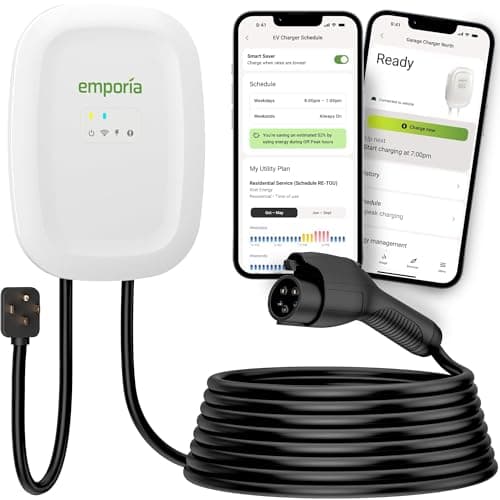
    01 Emporia Level 2 (48A)
    9.0

    The charger that refuses to charge you extra for being smart: full 48-amp speed and real energy monitoring at roughly the price of a plain plug-in box.

    Best for: Most homes that want speed and smarts

    $449.00Amazon
  • 02 Tesla Wall Connector (Gen 3)
    8.6

    Tesla's own home charger: a clean, Wi-Fi-connected 48-amp unit with a native NACS plug and no adapter to fumble - the obvious pick when every car in the driveway is a Tesla.

    Best for: A Tesla-only household

    Check priceAmazon

#ad · Live prices from the Amazon Product API, as of Jul 30, 2026. Where we have no verified live price, we show none — we would rather leave a gap than print a number that has gone stale.

Buy the Tesla Wall Connector if every car in your driveway is a Tesla - a native NACS plug means no adapter to fumble, at the same 48-amp speed. Buy the Emporia Level 2 if you drive a J1772 car, or a mix of vehicles, or you just want real energy monitoring at the lowest price - it is 48-amp capable hardwired and priced like a plain charger. The connector on your car settles most of this before any of the other specs matter.

These two are both excellent 48-amp home chargers, so this is not a quality fight - it is a fit fight. The Tesla is a native NACS unit; the Emporia is a universal J1772 unit. We compile published specs and do the math rather than bench-testing either one - see how we compare.

The question that comes first: your charge port

A Tesla Wall Connector has a native NACS plug. That plugs straight into a Tesla with nothing in between - the cleanest possible daily charge. A J1772 car (most non-Teslas built through 2024) cannot use it without a NACS-to-J1772 adapter hanging off the end. The Emporia is the mirror image: native J1772, so it fits every non-Tesla directly, and a Tesla plugs in with the J1772-to-NACS adapter Tesla ships with the car (or a third-party one). If your household will always be all-Tesla, the Tesla unit removes an adapter; if it is mixed or J1772, the Emporia removes one. New to the connector alphabet? Start with connector types explained.

Speed

A tie. Both are adjustable up to 48 amps / 11.5 kW when hardwired on a 60-amp circuit, which is the fastest a single-phase home charger goes and more than most cars accept anyway. Whether your car can use all 48 amps depends on its onboard charger, not the wall unit - see what amperage you actually need. The Emporia has a plug-in (NEMA 14-50) version capped at 40 amps; the Tesla is hardwired only, so its 48 amps is always on the table.

Smart features

Both are Wi-Fi connected with scheduling, so the difference is in the details. The Emporia's app leans on genuine energy monitoring- it reports the kWh and dollars each session used, which is the feature that pays for itself on a time-of-use rate. The Tesla's strength is ecosystem integration: it lives inside the Tesla app alongside the car, and multiple units can share a circuit with Group Power Management. If you own a Tesla, that integration is genuinely convenient; if you do not, it is a feature you will never open.

Build and value

Both are well-built, weather-rated units with a 24-to-25-foot cable, fine for indoor or outdoor mounting. On price the Emporia is usually the cheaper of the two and undercuts most smart chargers outright - it is our overall value pick and tops the best Level 2 roundup. The Tesla is keenly priced for what it is, but you are buying it for the native NACS plug and the app, not to save money. Live prices for both are on their cards above.

The verdict

For an all-Tesla driveway, the Tesla Wall Connector is the tidy default - no adapter, full speed, deep app integration. For literally everyone else - a J1772 car, a mixed household, or a buyer who wants the most monitoring for the least money - the Emporia is the smarter buy, and you keep Tesla compatibility through the included adapter. If your driveway mixes a Tesla and a J1772 car and you want one unit with both plugs built in, look instead at the Tesla Universal Wall Connector.
In detail

The picks, in full

01
Emporia Emporia Level 2 (48A)

Most homes that want speed and smarts

Emporia Level 2 (48A)

Up to 48A / 11.5kWJ177225ft cableWi-Fi + app
9.0/10

The charger that refuses to charge you extra for being smart: full 48-amp speed and real energy monitoring at roughly the price of a plain plug-in box.

Charge speed
10
Build & weather
8
Smart features
9
Cable & connector
8
Value
10

Pros

  • 48-amp capable when hardwired — quicker than the 40-amp plug-in default most units top out at
  • Genuine energy tracking and scheduling in the app, priced below almost every other smart charger
  • The 25-foot cable reaches either side of a two-car garage

Cons

  • You only get 48 amps hardwired on a 60-amp circuit; the plug-in version is capped at 40A like everything else
  • The app and Wi-Fi are central to the experience, so first-time setup takes longer than a plug-and-go box

Don't buy this if…

you never intend to open an app. A lot of what you are paying for is the software; if a sealed, silent box is what you actually want, the Grizzl-E Classic is the honest call.

$449.00View on Amazon

Price as of Jul 30, 2026. Prices change — Amazon's is the one that counts.

#ad · we may earn a commission from this link to Emporia Level 2 (48A)

02

A Tesla-only household

Tesla Wall Connector (Gen 3)

Adjustable to 48A / 11.5kWNACS connector24ft cableWi-Fi, hardwired
8.6/10

Tesla's own home charger: a clean, Wi-Fi-connected 48-amp unit with a native NACS plug and no adapter to fumble - the obvious pick when every car in the driveway is a Tesla.

Charge speed
9
Build & weather
9
Smart features
8
Cable & connector
8
Value
9

Pros

  • Native NACS plug charges a Tesla directly - no J1772-to-NACS adapter to buy, lose, or leave dangling on the wall
  • Adjustable up to 48 amps / 11.5 kW on a 60-amp circuit, matching the fastest home chargers
  • Deep Tesla-app integration, a tidy 24-foot cable, and a well-built enclosure rated for indoor or outdoor mounting

Cons

  • NACS only - a J1772 car (most non-Teslas built through 2024) needs a NACS-to-J1772 adapter to use it
  • Hardwired install only; there is no plug-in version to unplug and take with you

Don't buy this if…

you drive a non-Tesla EV with a J1772 port. You would be adding an adapter to every charge, and a straightforward J1772 charger like the ChargePoint Home Flex or the Emporia is the simpler call. If your driveway mixes a Tesla and a J1772 car, the dual-connector Tesla Universal Wall Connector is the better Tesla unit.

Check price on Amazon →

We don't have a verified live price for this right now, so we aren't showing one.

#ad · we may earn a commission from this link to Tesla Wall Connector (Gen 3)

How we picked

We do not run a testing lab

We compiled published specifications from manufacturer manuals and spec sheets, verified the safety listings (UL / ETL), computed the real running and installation costs, checked the wiring math against the NEC continuous-load rule, and read aggregated owner reviews — then scored each product against a published rubric. The scores are judgments from documented research — they are not bench measurements, because we do not have a test lab and we are not going to pretend we do. Every spec and cost figure is cited in Sources.

Questions

Frequently asked

Can a non-Tesla use the Tesla Wall Connector?

Yes, with a NACS-to-J1772 adapter on the end of its native NACS plug. It works, but you are adding an adapter to every charge. If your car is J1772, a native J1772 charger like the Emporia is the simpler call.

Is the Emporia as fast as the Tesla Wall Connector?

Hardwired, yes - both hit 48 amps / 11.5 kW on a 60-amp circuit. The Emporia's plug-in version is capped at 40 amps like all plug-in units. On a 50-amp circuit the two charge at an identical rate.

Which is better value?

The Emporia, for most buyers - it usually costs less and adds full energy monitoring. The Tesla's value is the native NACS plug and Tesla-app integration, which only pay off if you drive a Tesla.

Keep reading

Receipts

Sources

We do not run a testing lab, and we do not pretend to. Where a measured number came from someone else's lab, we name them and link them. Where we could not verify something, we say so on the page rather than quietly leaving it out. Read our full method.