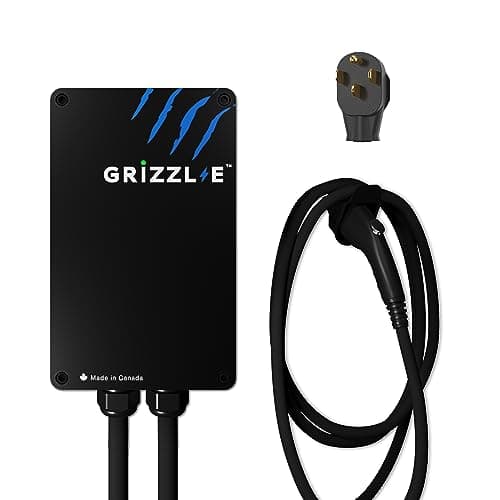
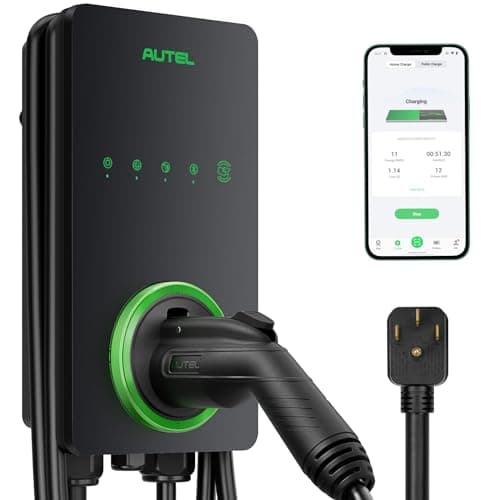
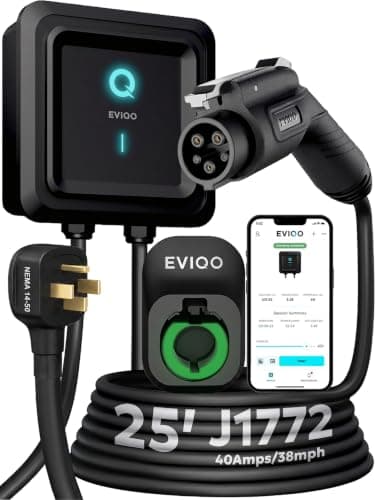
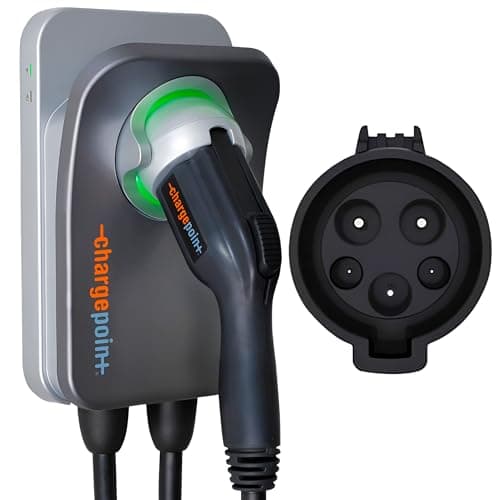
Buy the ChargePoint Home Flex and set it to 40 amps. Mercedes specs its US EQ models to accept about 9.6 kW of AC, which is exactly what 40 amps at 240 volts delivers - so a 40-amp charger is the match, and a 48-amp charger is money spent on amperage an EQ will not draw. The Home Flex is the pick because its output is selectable at setup: it meets the EQ at 9.6 kW today and still has headroom if a faster-charging EV replaces it. If you would rather own a sealed box with no app at all, the Grizzl-E Classic. If you want the longest cable and a holster in the box, the Autel MaxiCharger. If the budget is the constraint, the EVIQO.
This is the page that saves an EQ owner money rather than spending it. Almost every charger roundup on the internet pushes you up the amp ladder, and on a Mercedes that ladder stops early. The published Mercedes-Benz EV guidance is that EQ models "typically accept up to 9.6 kW" on a 240-volt Level 2 charger, through a J1772 inlet, with CCS1 for DC fast charging. Our Mercedes EQ home charging page runs the hours and the cost per model.
Why 40 amps is the ceiling worth buying
| Charger size | Power at 240V | What an EQ draws | Circuit required |
|---|
| 32 amps | 7.7 kW | 7.7 kW - about 2 kW short of the car | 40-amp breaker |
| 40 amps | 9.6 kW | 9.6 kW - the full rate | 50-amp breaker, NEMA 14-50 if plug-in |
| 48 amps | 11.5 kW | Still 9.6 kW - the car caps it | 60-amp breaker, hardwired only |
The middle row is where an EQ owner should stop. The only reason to buy the bottom row is a different car in the household later: a 60-amp circuit accepts anything, and a 48-amp unit can always be turned down. If that is your situation, the honest answer is that you are buying for the next car, not this one, and should I upgrade to a 48-amp charger is the page that argues it out.
The EQS is the one that makes the habit matter
At a fixed 9.6 kW, the thing that changes between EQ models is how much battery that rate has to fill. Mercedes' published home-charging figures run to about 11.5 hours for an EQE SUV and about 14 hours for an EQS SUV from empty to full on a 240-volt charger. Nobody charges from empty, but the direction is clear: on the big-pack cars the overnight window is something to plan rather than assume.
- Plug in on arrival, not at bedtime. Four extra hours of a 14-hour window is the whole difference.
- Schedule for off-peak if your utility has a time-of-use rate, but check the window is long enough for the pack. Off-peak and time-of-use charging runs those numbers, and chargers with scheduling ranks the units that do it on the charger rather than in the car.
- Do not fix a slow charge with a bigger charger. If an EQ is drawing less than 9.6 kW, the cause is the circuit, a derating condition or a setting - not the amp class. EV charging slow at home walks the diagnosis.
How the four compare
| Charger | Max amps | Install | Cable | App needed to charge? |
|---|
| ChargePoint Home Flex | Selectable up to 50A | Plug-in (NEMA 14-50) or hardwired | 23 ft | No |
| Grizzl-E Classic | 40A, internal dial | Plug-in (NEMA 14-50) | 24 ft | No app exists |
| Autel MaxiCharger (40A) | 40A, adjustable | Plug-in or hardwired | 25 ft, holster included | No |
| EVIQO Level 2 (40A) | 40A, adjustable | Plug-in (NEMA 14-50) | 25 ft | No |
Published manufacturer specifications, cited in Sources - not our measurements. All four carry a UL or ETL listing to UL 2594, and all four charge with the house Wi-Fi down, which matters because garages are where Wi-Fi goes to die.
Plug-in is the better default here
Because 40 amps is the target and 40-amp units are available as plug-ins, an EQ owner gets something a Porsche or Volvo owner does not: a reversible install. A NEMA 14-50 outlet on a 50-amp circuit is the single most useful piece of electrical work you can have done for an EV - it accepts almost any charger you will ever buy, it moves with you to the next wall, and it is the receptacle electricians fit for EVs by default. Our NEMA 14-50 outlet guide covers the install and the outlet roundup covers which receptacle to specify, because a cheap one is the part that fails.
Connector-wise, current US EQ models use J1772 for AC, so every charger here plugs straight in. If you want to use Tesla-style AC equipment, that is a NACS-to-J1772 adapter, not a different wall unit.