HUB 03 · Charging Guides
Can an EV Charger and a Dryer Share One Circuit?
The laundry room has the only 240-volt outlet in the house and the car needs it. Here is the honest version: sharing works, but only sequentially - and whether to buy a switch or an electrician comes down to arithmetic you can do in two minutes.
We earn a commission when you buy through our Amazon links, at no extra cost to you. It never affects our rankings, and we say so when the cheaper product is the better buy. How this works.
One at a time: yes, and it is a legitimate way to charge. Both at once: never, under any circumstances, with any device. A dryer circuit is a 30-amp, 240-volt circuit, and it has exactly one circuit's worth of capacity to give. An EV charger on it is limited to 24 amps - about 5.8 kW - because the NEC treats charging as a continuous load and sizes the circuit at 125 percent of the draw. Add a running dryer on top of that and you are over the breaker: best case it trips, worst case a connection you cannot see gets hot for years. So the only question worth asking is how you guarantee the two never run together - by hand, or by buying a device that enforces it.
Three ways to share, in increasing order of cost
1. Unplug the dryer. Free.
Unglamorous and completely effective. You pull the dryer plug, put the charger plug in, and the physics guarantee what no device has to. The real cost is behavioural: a 240-volt dryer plug is stiff, the outlet is usually behind the machine, and you will do this twice a day forever. People who try this for a month mostly end up buying one of the options below - but it is free, and it tells you whether the shared-circuit idea works for your household before you spend anything.
2. An automatic splitter switch. A few hundred dollars.
This is the product class people are actually searching for. A splitter switch plugs into the dryer receptacle and presents two sockets - one for the dryer, one for the car - and switches between them so only one is live at a time. Splitvolt, the best-known maker, describes its unit as automatically switching an existing 30-amp dryer circuit between the two loads so no additional 240-volt circuit is needed, and says an internal breaker keeps the charger from exceeding NEC safe-charging limits or stressing the house wiring. Those are the manufacturer's claims; its listing is cETLus through Intertek, conforming to UL 60730-1 and certified to CSA E60730-1 - a controls standard, which is what a switching device is.
What you are buying is enforcement. The device makes the rule mechanical instead of behavioural, which is worth real money if the alternative is trusting yourself at 11pm.
3. A new dedicated circuit. Usually four figures.
The permanent answer, and the one every long-term EV owner arrives at. A dedicated 50-amp circuit with a NEMA 14-50 outlet unlocks 40 amps instead of 24, removes the sharing question entirely, and adds a feature the next owner of the house will pay for. Our installation cost guide has the real numbers, which vary enormously with the distance from the panel.
The arithmetic that decides it
Do not decide this on principle. Decide it on the gap between 24 amps and 40 amps, in your own week:
| Setup | Charging current | Power | Range added in 8 hours |
|---|---|---|---|
| Level 1 household outlet | 12A at 120V | 1.4 kW | Roughly 40 miles |
| Shared dryer circuit | 24A at 240V | 5.8 kW | Roughly 150 miles |
| Dedicated 50A circuit | 40A at 240V | 9.6 kW | Roughly 250 miles |
Range figures use the DOE's rough Level 2 rule of about 25 miles of range per hour at a full 240-volt rate, scaled by power, and they are approximations - your car's efficiency moves them. The point is the middle row. 150 miles overnight is more than most people drive in two days. If your daily driving is 40 miles, the 24-amp cap is invisible to you and spending four figures to remove it buys nothing but a number. If you drive 120 miles a day, tow, or run two EVs, the gap is real and the circuit is the right purchase.
The rules, if you share
- Never both at once.Not for ten minutes, not on a "small" load. Two 240-volt appliances on one 30-amp circuit exceed it.
- Never a passive Y-splitter. A plain two-way adapter that lets both sockets be live simultaneously is the dangerous version of this idea. The whole value of a proper splitter switch is that it prevents what a Y-adapter permits.
- Cap the charger at 24 amps, and check it is actually capped. If the charger cannot be set that low, it does not belong on this circuit. Adjustability is the first thing to check - adjustable chargers are ranked on how the setting is made.
- Four-prong outlets only. A NEMA 14-30 has a separate ground. The older three-prong 10-30 does not, and EV chargers depend on a proper ground for fault protection. Our dryer-outlet guide covers that distinction in full.
- Inspect the receptacle first. A dryer outlet has had a heavy plug worked in and out of it for twenty years under intermittent load. EV charging is continuous load for hours, which is a different kind of stress. If the plug feels loose, replace the receptacle before you charge through it.
- Feel the plug after the first long session. Warm is fine. Hot is a problem - see EV charger plug getting hot.
Three cases where you should skip the splitter entirely
- You have a gas dryer. Then the 240-volt laundry outlet, if one exists, is not shared with anything and there is nothing to switch. Use it directly with a 24-amp charger or an adapter cord.
- Your daily drive is short. The DOE points out that many owners meet their daily needs charging overnight on Level 1 alone, given an outlet on a dedicated branch circuit where they park. If that is you, the cheapest correct answer is the cordset that came with the car and no hardware at all.
- The laundry is nowhere near the car. Running a long cord from a laundry room to a driveway turns a wiring question into an extension cord question, which is a worse trade than paying an electrician.
What to buy, if you are sharing
A splitter switch for the enforcement, plus a charger that can genuinely be limited to 24 amps. A 14-30-plug charger is purpose-built for this circuit; an adjustable 14-50 unit plus a 10-gauge adapter cord is the other route and leaves you ready for a proper circuit later without buying a second charger. Everything in this registry that fits a dryer outlet is ranked on best chargers for a 14-30 dryer outlet, and the adapter cords are on best EV charger outlet adapters. Whatever you choose, insist on a UL or ETL listing to UL 2594 from an OSHA-recognised laboratory. This is a device running at its limit, unattended, on a circuit that was designed for something else.
The bottom line
Sharing a dryer circuit is a real, safe way to charge at 24 amps, provided the two loads can never run together. Start by unplugging the dryer for a month - it costs nothing and tells you whether 150 miles overnight is enough. If it is and the plug-swapping annoys you, buy a listed splitter switch. If it is not, skip straight to a dedicated circuit, because that is where you are heading anyway.
The gear
Recommended gear for this guide
The products this guide refers to, with prices pulled live from Amazon and dated on each card.
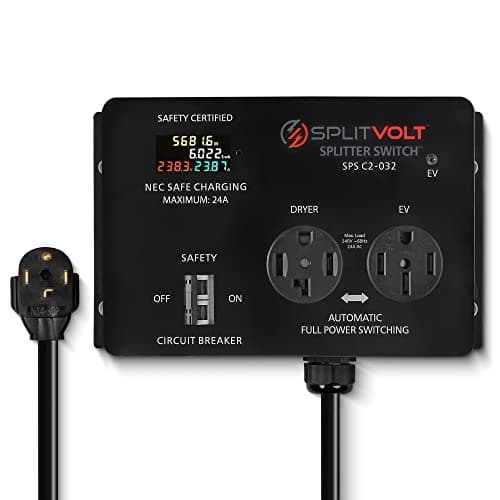
Sharing one outlet with the dryer
Splitvolt 14-30/14-50 Splitter Switch
The listed way to keep the dryer and charge the car from one 14-30 outlet: it switches the circuit's power automatically between a dryer socket and an EV socket, behind its own 24-amp breaker.
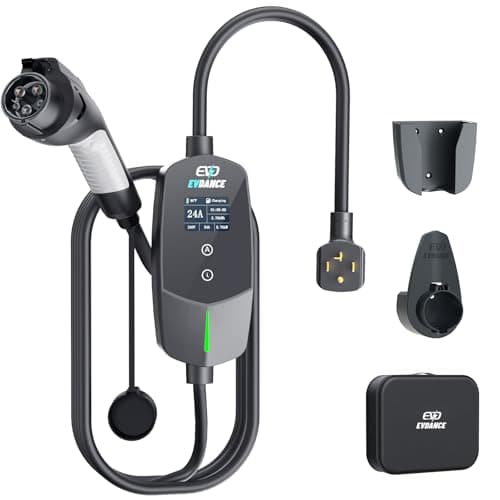
Most J1772 cars on a dryer outlet
EVDANCE 24A NEMA 14-30 (J1772)
Built for the dryer outlet rather than adapted to it: a 14-30 plug on the cord and a 24-amp ceiling, so even its highest setting stays inside what a 30-amp circuit may carry continuously.
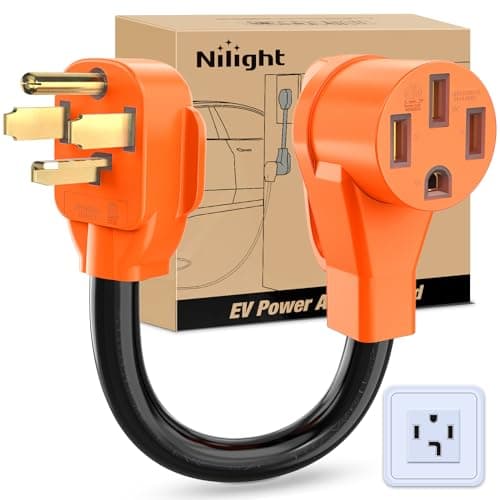
A modern 4-prong (14-30) dryer outlet
Nilight 14-30P to 14-50R Adapter
The one to buy if your laundry room has the modern 4-prong dryer outlet: 10-gauge pure copper, and the 14-30 plug carries a real equipment ground rather than borrowing the neutral.
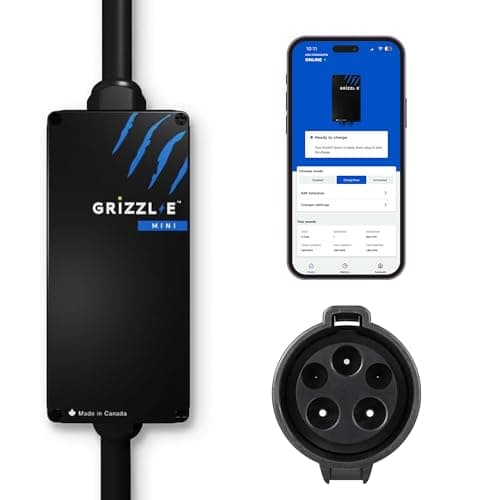
A dryer outlet now, a 14-50 later
Grizzl-E Mini (40A Portable)
A UL-certified, cast-aluminum 40-amp portable that ships with a NEMA 14-30P adapter - the one to buy if the dryer outlet is a stopgap and a 50-amp circuit is in your future.
#ad · As an Amazon Associate we earn from qualifying purchases.
Questions
Frequently asked
Can I run my EV charger and my dryer at the same time?
No. A dryer circuit is 30 amps, and an EV charger on it already draws up to 24 amps continuously - the NEC sizes a continuous load at 125 percent, which is where that cap comes from. Adding a running dryer exceeds the circuit. A proper splitter switch exists specifically to make simultaneous use impossible.
Are EV charger splitter switches safe?
A listed one, used as intended, yes - its whole function is to prevent two loads running at once. Splitvolt's unit is listed cETLus through Intertek to a controls standard and the maker says an internal breaker keeps the charger inside NEC limits. What is not safe is a passive Y-adapter that leaves both sockets live, which is a different product entirely.
How fast can I charge on a shared dryer circuit?
24 amps at 240 volts, about 5.8 kW, which adds roughly 150 miles of range in an eight-hour night. That is more than most drivers use in two days, which is why the shared-circuit route is a reasonable answer rather than a compromise.
Is a splitter switch cheaper than a new circuit?
Usually by a wide margin - a few hundred dollars against four figures for a dedicated circuit, depending on the run from your panel. The new circuit buys 40 amps instead of 24, removes the sharing rule and adds value to the house, so it is better rather than merely more expensive. Which one is right depends on how far you actually drive.
Can I use a splitter with a three-prong 10-30 dryer outlet?
We would not. A 10-30 has no separate ground, and EV chargers rely on a proper ground for fault protection. The right move with a 10-30 laundry is to have an electrician install a grounded circuit - see can I use a dryer outlet for EV charging.
Do I need a permit for a splitter switch?
A plug-in device on an existing receptacle is not new wiring, so typically no - but local rules differ and a new dedicated circuit certainly does need a permit and an inspection. Our permit guide covers what the process looks like.
Keep reading
Related
- Can I use a dryer outlet for EV charging?The plug shapes, the ground, and the 24-amp cap in full.
- Best chargers for a dryer outletThe 24-amp units built for exactly this circuit.
- Best EV charger outlet adaptersThe 10-gauge cords that let a 14-50 charger reach a dryer outlet.
- EV charger installation costWhat the dedicated circuit alternative actually costs.
- EV charger load calculationWhether your panel can take a new circuit at all.
- Best adjustable chargersDialling down to 24 amps is the requirement here, not a nice-to-have.
More in this section
More Charging Guides
Receipts
Sources
- EC&M - NEC requirements for EV equipment (Article 625: EVSE is a continuous load, branch circuits sized at 125 percent of the load - the arithmetic behind the 24-amp cap on a 30-amp dryer circuit)
- EV Tech Insider - Splitvolt's splitter switch for existing 30-amp dryer circuits (the manufacturer's claims: automatic switching between the dryer and the EV charger so no additional 240-volt circuit is needed, an internal breaker to keep the charger inside NEC safe-charging limits, and cETLus certification through Intertek conforming to UL 60730-1 and certified to CSA E60730-1 for models SPS C1-011, SPS C2-022 and SPS C2-032)
- US DOE AFDC - charging an electric vehicle at home (many owners meet daily driving range needs charging overnight on Level 1, given an outlet on a dedicated branch circuit)
- Intertek - UL 2594 testing and certification for electric vehicle supply equipment
We do not run a testing lab, and we do not pretend to. Where a measured number came from someone else's lab, we name them and link them. Where we could not verify something, we say so on the page rather than quietly leaving it out. Read our full method.